
Latest News
2026 Chevrolet Tahoe ReviewThe Austin-Healey 100-4 is British Roadster Royalty
The Austin-Healey 100-4 kicked off a new era for the British roadster, one that still endures, influences, and inspires to this day.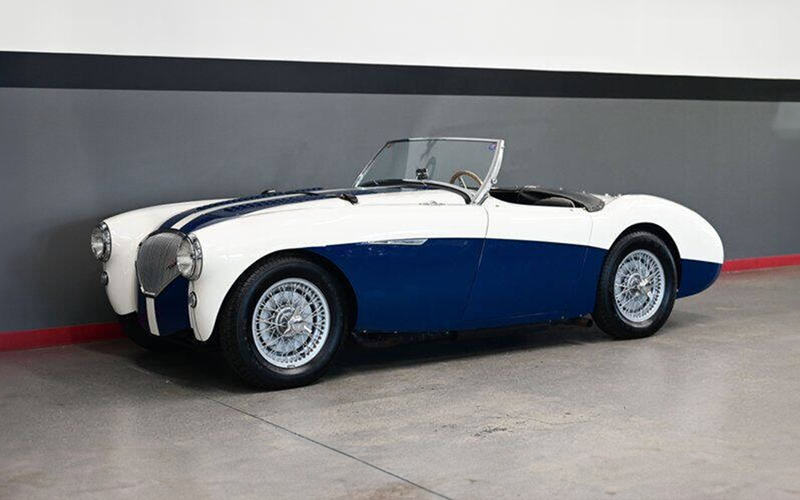
Making it About the Ride
The British roadster holds a special place within the sports car pantheon. The combination of lightweight nimbleness and open-top driving perfected by the Brits has gone on to influence or directly contribute to other legendary cars like the Mazda Miata and AC Cobra. British roadsters occupy the opposite end of the sports car spectrum from the bruising muscle cars like, say, the Dodge Challenger, they are about lightness not only literally but spiritually. They evoke whimsy rather than intimidation. The name of the game is driving enjoyment rather than zero to sixty times.
It was with this ethos in mind that we sought an Austin-Healey 100-4 on Carsforsale.com to represent this classic car category. The example we found does that in spades. It’s a 1954 Austin-Healey 100-4 BN1 with Le Mans package modifications guaranteed to put a smile on your face.
Reimagining the British Roadster
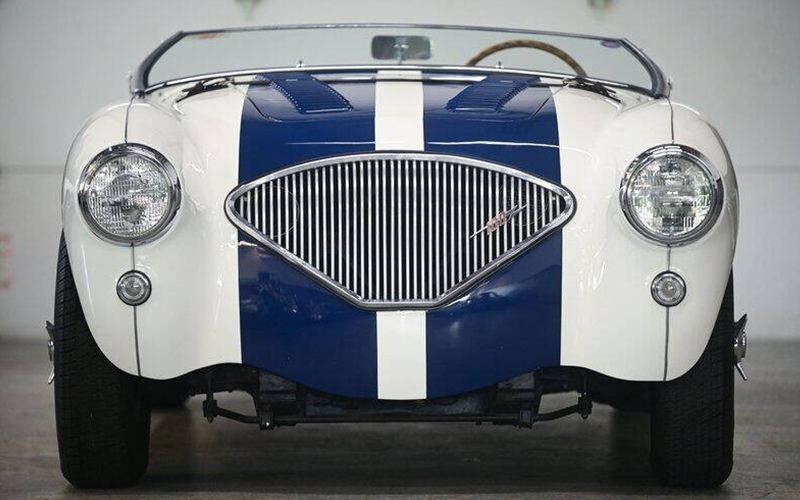
Why is the Austin-Healey 100-4 a touchstone car among British roadsters? Because it advanced the basic concept both competitively (as a racecar) and aesthetically. The Austin-Healey 100-4, with its streamlined body and integrated headlights, shed many of the pre-war design cues that competitors like the Triumph TR2 and MG TC had chosen to retain. But it didn’t do so in a vacuum. The 100-4 owed its design to an earlier car built by Healey.
Austin-Healey was a joint venture between British Motor Company and Don Healy Motorcar Company, built in part as a replacement for Austin’s A90 Atlantic. Don Healey was an eager collaborator, having worked with the American carmaker Nash-Kelvinator on the Nash-Healey of 1951. That car’s initial design was done by Len Hodges, whose work was then refined the following year by Battista Farina and his team at Pininfarina. When it came time for Healey’s new collaboration in 1953, designer Gerry Coker had a good template to work from.
“World’s Fastest” Austin-Healey
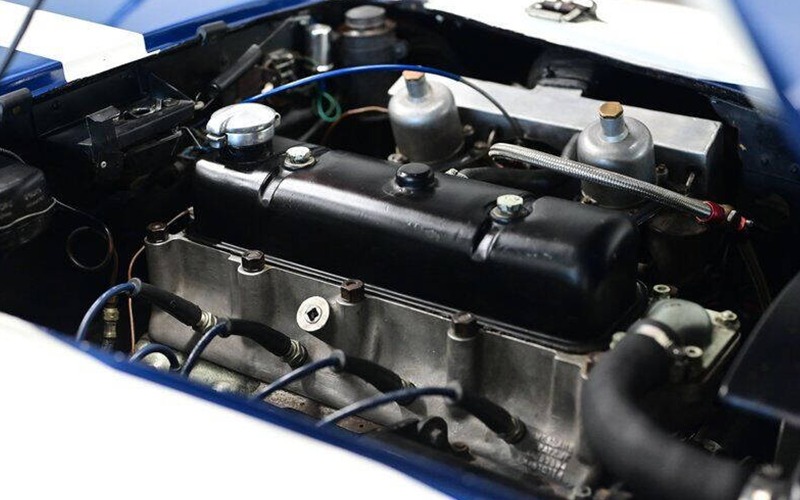
The Austin-Healey 100-4 naming is both straightforward and convoluted. The 100 refers to the car’s targeted top speed of 100 mph, a number it would end up exceeding. The four simply refers to the number of cylinders in its 2660-cc engine. The BN1 and BN2 are a bit more complicated. The B indicating an engine between 2000 and 3000 cc, the N a two-seater, and 1, 2, and so on the version/generation of car.
The early cars, the BN1s, featured the 2660-cc motor (90 horsepower) connected to a three-speed manual transmission with overdrive that was in fact a four-speed with the first gear blanked. The car’s tested top speed registered 106 mph. 10,030 of the BN1 100-4s were built. The BN2 received a new genuine four-speed transmission as well as a new rear axle and an expanded list of color options (the two-tones being the 100-4s more popular looks).
In 1955, a high-performance model was added, the 100M “Le Mans” package. The 100M added bigger carbs and a cold air box, a revised suspension, a high-lift cam shaft, and higher compression (8:1) pistons. All these modifications cranked output to a full 110 horsepower. 640 examples of the 100M “Le Mans” package were factory produced, but also BMC (British Motor Corporation) offered kits to retrofit existing cars.
A high-end racing version, the 100S got its name from a successful run at the 12 Hours of Sebring in 1954, where it won its class. This version was tuned to 132 horsepower and came with an aluminum cylinder head and four-wheel disc brakes, making it the first production car to feature disc brakes front and rear. A scant 50 Austin-Healey 100Ss were built.
This 1954 Austin-Healey 100-4 BN1 “Le Mans”
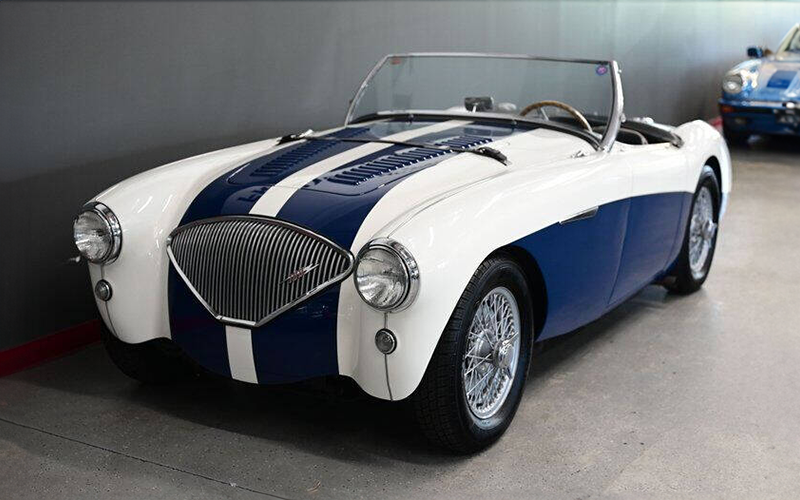
This car is a 1954 Austin-Healey 100-4 BN1 “Le Mans.” This being a ’54 model year, it would have been retrofitted to “Le Mans” specs. Indeed, the seller offers a laundry list of modifications and upgrades that include Healey 3000 exhaust valves, Radius rocker arms, 9.5:1 compression pistons and rings (higher than even the regular “Le Mans” 8:1), a racing cam, a heavy-duty clutch, and much more. The car features a two-tone white and blue paint job with a black leather interior with white accenting. The car is in stellar condition and comes with a huge stack of paperwork detailing the extensive restoration, modifications, and upkeep.
For the quintessential British roadster experience, you’d be hard pressed to find a better opportunity than this 1954 Austin-Healey 100-4.