Latest News
2026 Cadillac LYRIQ ReviewJeep Cherokee XJ, the Original Crossover
The Jeep Cherokee XJ was a major leap forward for SUVs with its unibody design and legendarily rugged 4.0L straight-six.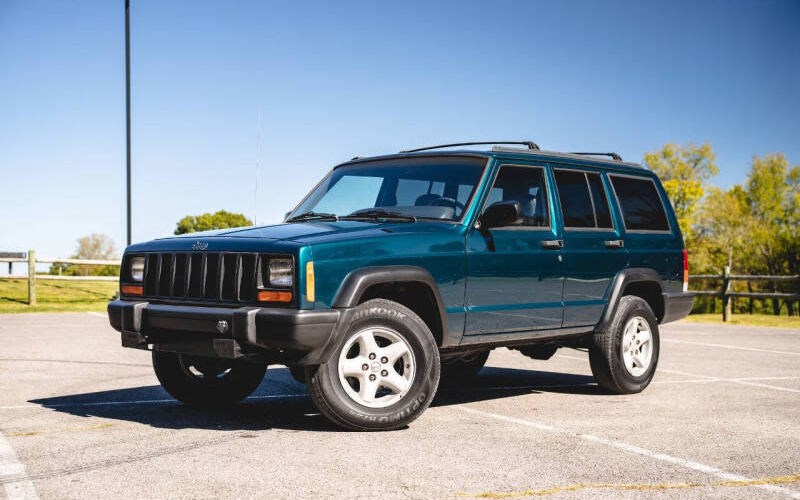
The Church of Jeep
The Jeep Cherokee XJ is a litmus test for Jeep devotion. For those willing to look past its deficiencies, the XJ-generation Cherokee is revered. Rugged yet daily drivable, the XJ Cherokee is what the SUV moniker was always supposed to mean: a weekend warrior off-roader perfectly happy to grab groceries, pick up the kids, and cruise for miles on cross-country road trips.
Like many a Jeep, addressing whatever mechanical weaknesses the XJ Cherokee exhibits are scout badges to be earned. Tales of wrenching into the wee hours, driveways stained with oil, knuckles scraped, bolts stripped, expletives cursed, are passed between Jeep owners as testimonies among the faithful. Honoring their inherent imperfections are a point of pride.
Below, we’ll explore the XJ Cherokee’s 18-year run, from 1983 through 2001, and how it has inspired such obsession despite its flaws.
From SUV to Crossover
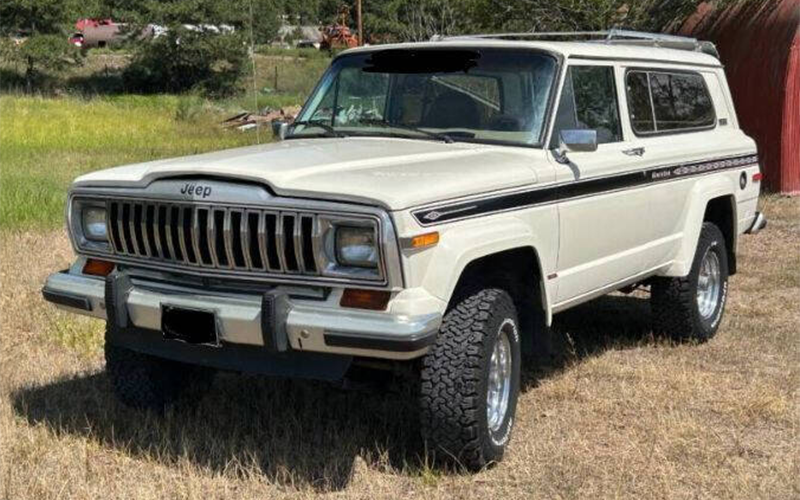
There is plenty to debate about where the SUV started. You could point to the station wagons and depot hacks of the early 20th century, the Chevy Suburban being the most famous of these. You could make a case for the Bronco, Blazer, and International Traveler Scout. But the first time a company used the Sport Utility Vehicle acronym SUV was in a sales brochure for the first-generation Jeep Cherokee in 1974.
And yet, the Cherokee wasn’t the first of its kind as it was itself a two-door version of the Jeep Wagoneer, something that dated back to the 1960s for the Wagoneer and far earlier for “wagons” like the Suburban. So, while the Cherokee’s claim to being the first SUV is at least true on paper, less disputable is the assertion that the Cherokee is the first true crossover SUV, at least in the US.
That’s because the XJ-generation Cherokee of 1983 swapped out a truck-like body-on-frame construction used for prior SUVs for a unibody, monocoque chassis. This car-like construction has, in the decades hence, become the default for most SUVs on the market today, trading off-roadability and towing capacity for comfort and fuel economy.
Some might offer the AMC Eagle, emerging in 1979, as the first crossover vehicle when it combined a car chassis with 4WD running gear. In the XJ, you had an SUV adopting a car’s chassis build to produce a crossover. In the Eagle, you had a car adopting an SUV’s 4WD system and ride height also resulting in a crossover. It was a case of automotive convergent evolution. Not coincidentally, both projects were spearheaded by AMC’s Roy Lunn.
The XJ Cherokee Experiment
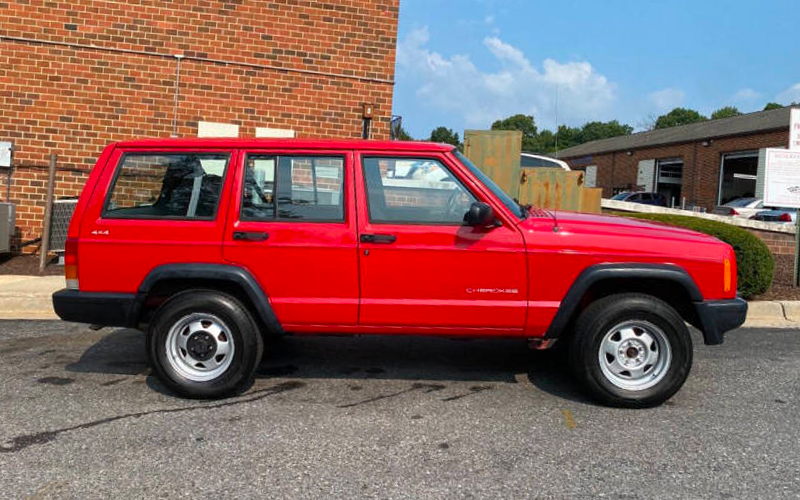
The XJ Cherokee’s novel design was born of necessity. In the early 1980s, AMC (American Motors Corporation) was in rough financial straits and sought an infusion of cash from French automaker Renault, entitling the latter a stake in AMC. As part of this partnership Renault installed Francois Castaing as the VP of Product Engineering and Development at AMC. Castaing’s urged Head of Design Dick Teague and VP of Engineering Roy Lunn to adapt the Cherokee SUV into something more family friendly.
The “experimental Jeep,” aka the XJ, did that by not only trading out the body-on-frame construction for a unibody design but also seriously pairing down the overall size of the Cherokee. The new XJ dropped approximately 1,200 lbs. from its predecessor while also cutting seven inches off its wheelbase and coming in four inches shorter. Two- and four-door versions were offered, and a two-wheel drive version added for the 1985 model year along with the introduction of the Comanche pickup variant the same year.
Engines for the XJ included an anemic 2.5L four-cylinder (105 horsepower) and a GM-sourced 2.8L V6 (110 horsepower). A 2.1L turbo-diesel inline-four was added for 1985 with 85 horsepower. All three were fairly weak, even by the standards of the day. For the 1987 model year, the addition of AMC’s 4.0L inline-six, good for 170 horsepower and 220 lb.-ft. of torque, was a major step forward for the XJ. The 4.0L wasn’t just more powerful and torquey, it also proved incredibly durable and reliable, making it one of the big attractions for XJ enthusiasts today. A new 2.5L turbodiesel I-4 was introduced for the 1994 model year making 114 horsepower.
Including the base version, the XJ Cherokee was offered in thirteen different trims across its 18-year production run. The gamut of trims ran from the Chief, Pioneer, and Wagoneer to additions like the Sport, Briarwood, and the 60th anniversary Edition appearing in the XJ’s final 2001 model year. The XJ Cherokee was also a popular fleet vehicle. The 1992 Police package included a high-output version of the straight-six motor with multi-port fuel injection. A right-hand drive version was built for the US postal service and was then also sold in Ireland and UK markets starting in 1993.
The XJ Cherokee remained remarkably unchanged over its 18-year run. The 1997 model year was its only major revision. Updates included a stiffer chassis, new door seals, and a completely reimagined and modernized interior with a new dashboard and gauges, new door cards, and *gasp* a pair of cupholders.
Production on the XJ Cherokee finally ended with the 2001 model year. A shifting brand strategy moved away from off-road capable 4x4s to more road-friendly designs (the Jeep Liberty – cue sad trombones), while leaning on the Wrangler to bear the off-roading torch.
Our Love/Hate Relationship With the XJ
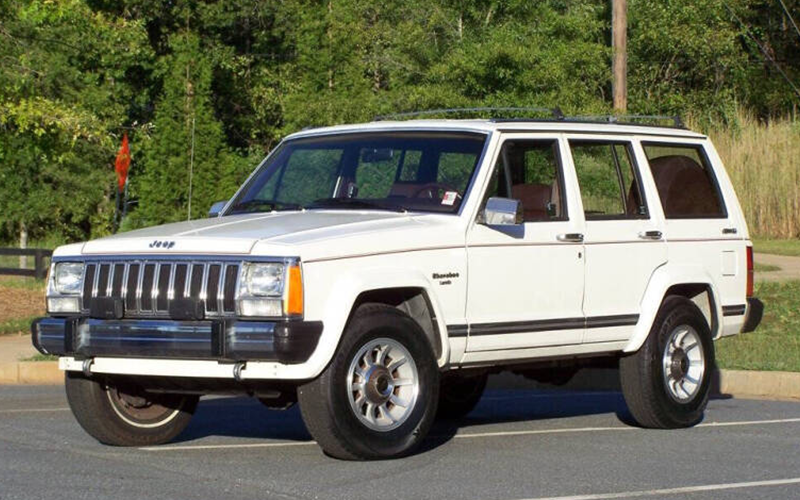
The XJ Cherokee was good enough and sold well enough to make it through 18 years of production largely unchanged. But that doesn’t mean it was not without its flaws. One issue you may be familiar with if you’ve ever seen an XJ Cherokee on the road today is rust as the frame rails, seams, fenders can all be susceptible.
XJ Cherokee transmissions are hit and miss. Ten total transmissions were offered over the years, seven manuals and three automatics. The AW-4 four-speed automatic became the default automatic starting with the 1987 model and performs ably. The AX-15 (’89 model and onward) five-speed and 2000’s NV3550 five-speed manuals are the best of the bunch for those looking to row their own way. Less desirable are the BA-10 manual (borrowed from Peugeot) that came with the six-cylinder from ’87 through ’89 and the AX-4 and AX-5 manuals mated to early four-cylinder XJs.
Those early XJs also feature middling transfer cases, the 2.61:1 Command-Trac and Selec-Trec, while ’87 and onwards versions, geared at 2.72:1, were a marked improvement. Even the laudable 4.0L six-cylinder wasn’t entirely bullet-proof. While many are happy to run well into 200,000-mile territory, the 4.0L’s rear main seal can be leaky.
Despite these imperfections, the XJ Cherokee remains one of the most beloved Jeep vehicles. A solid front axle combined with a semi-modern interior and decent on-road manners remind us of the original vision of the crossover, a best of both worlds mix of off-roader SUV and everyday utility of a station wagon.