
Latest News
2026 Porsche Macan ReviewThe Showstopping Design of the ’59 Chevy Impala
For 1959, Chevy wanted to keep pace with Ford’s and Chrysler’s latest designs. In doing so, the radical 1959 Impala became a styling icon for the ages.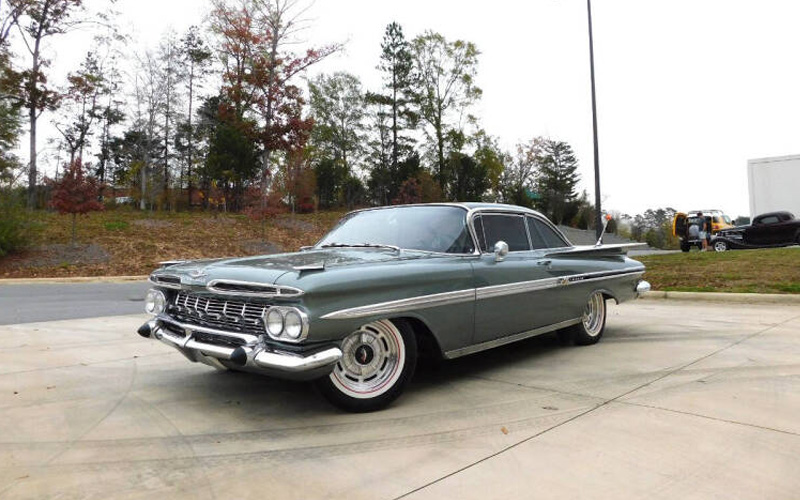
Gaudy or Gorgeous?
Throughout the 1950s, Ford, GM, and Chrysler fought tooth and nail for the attention of a fickle car-buying public. Detroit’s Big Three shifted the designs of their cars on an almost yearly basis, one-upping each other with ever more gaudy and baroque embellishments. Grilles were laden down with gleaming chrome and complex, crisscrossing lattice works. Massive fins and car-length side spears evoked the advent of the Jet Age.
The competition and a willingness to experiment produced both the era’s best and worst designs, which peaked in both respects at the close of the decade. Cars like the Buick Century, Chrysler Imperial, and Ford Galaxie took chrome front ends to almost absurd extremes. Meanwhile, the 1959 Cadillac claimed the crown for the largest and most flamboyant fins of all time. A close second in that particular race was another GM brand, Chevrolet, with its 1959 design being equally as memorable for its batwing fins and cat’s eye taillights.
Having long since passed into the realm of design icons, we sought out the best example of a 1959 Chevy, an impressive top-of-the-line Impala fitted with modern upgrades and perfectly preserving its classic styling, to explore its signature look.
How the ’59 Chevy Got Its Wings
The story of the 1959 Chevrolet Impala’s fantastical design dates back to 1956. The styling wars were in full swing when GM designer Chuck Jordan rolled past a Chrysler lot and caught sight of the new 1957 designs. Over at Chrysler, styling chief Virgil Exner’s latest “Forward Look” designs were fresh, innovative, and miles ahead of what GM was currently working on. Jordan took the news back to his boss Bill Mitchell, then heir-apparent to GM’s Art and Color Section and would-be successor to Harley Earl. Mitchell, Jordan, and the rest of GM’s styling apparatus got to work on a massive pivot from the designs already locked in for 1958. The 1959 Chevy would have to take big swings to match Chrysler’s head-turning designs.
The 1959 Chevrolet Impala’s design, shared up and down the product line, was indeed a big swing. Rather than vertical fins, which had been very much the norm, the ’59 Chevy featured massive horizontal “bat wing” fins. Legend has it, when the clay mockup for the car was being worked on, both Harley Earl and lead engineer Ed Cole would come by the office and each in turn would scrape out a bit more clay from the underside of the fins, resulting in the finished car’s deeply recessed sculpting. Below the bat wing fins were an equally striking set of “cat’s eye” taillights, basically a large sideways teardrop.
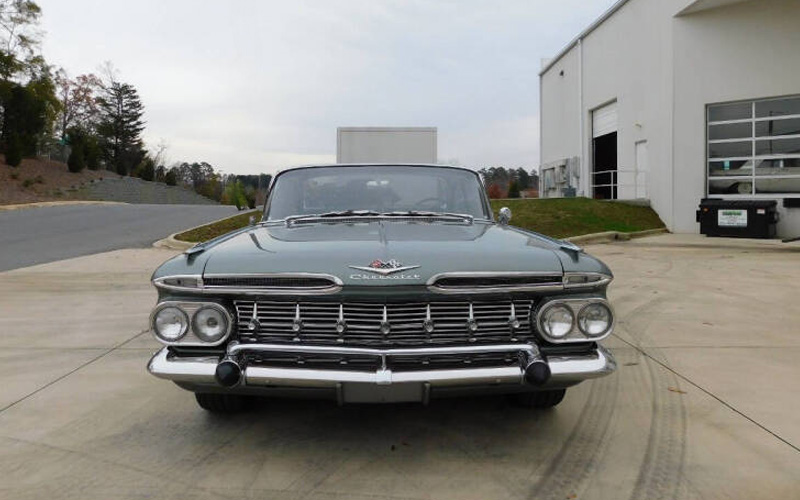
The front-end design was equally busy and featured a protruding electric-shaver grille, quad headlights, modest Dagmars, and two large non-functional intakes riding the lip of the hood. The wraparound windshield, roof, and front doors were all shared with numerous other GM cars as the company did their best to leverage economies of scale.
For 1959, the Impala not only became its own independent nameplate, spun off from the Bel-Air, but it was also made Chevrolet’s top-of-the-line offering. Body styles expanded from the 1958 model’s two-door coupe and convertible options to include a four-door sedan, hardtop, or station wagon. Engines included a base 235 cu.-in. BlueFlame straight-six, 283 TurboFire V8 (170-230 horsepower depending on the carburetor set up), and the 348 W-Series TurboThrust V8 (250-335 horsepower).
Neither the iconic rear end nor the glitzy front end survived into the next model year. Visual trends called for a pullback to simpler designs. For 1960, the Impala got its signature triple taillights and a more conservative front end.
This Fabulous ‘59 Chevy Impala
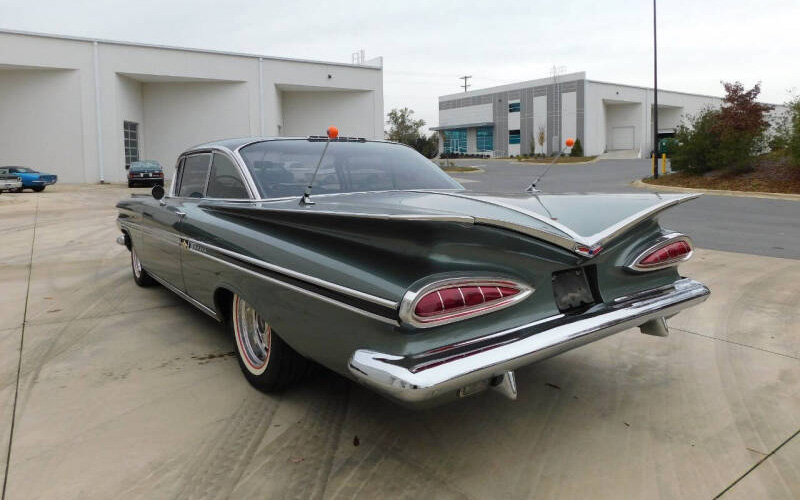
Since the look of the 1959 Impala is so singular, we wanted to find the example on Carsforsale.com that best exemplified it. The example we found not only perfectly preserves what makes this design spectacular, it modernizes much of the rest of the car to create a restomod for the ages. A Sliver Spruce green exterior is complimented by a gray interior featuring custom upholstery, a premium Jl stereo system, and updated Dakota gauges (dash and gauge cowling all preserved). Under the hood is an LS3 V8. The 6.2L motor produces between 425 and 435 horsepower stock (the exhaust appears custom, so output may be higher) and comes paired with an 4L75 automatic transmission. Stopping power is provided by performance Wilwood brakes. The car’s sizable trunk has also been completely redone with new side moldings and the same gray leather as the interior.
The 1959 Chevrolet Impala represents the cresting wave of 1950s automotive design. The fins are enormous, glittering chrome runs from front to rear, and those taillights, even in an era known for innovation and out-of-the-box designs, never fail to grab your attention. This flawless example is listed for $239,000.