
Latest News
2026 Cadillac LYRIQ ReviewHow To Identify a Fourth Generation F-100
Ford has had a long run of popular pickup trucks, but the fourth-generation F-100 is one of the most unique generations. We break down the visual differences here.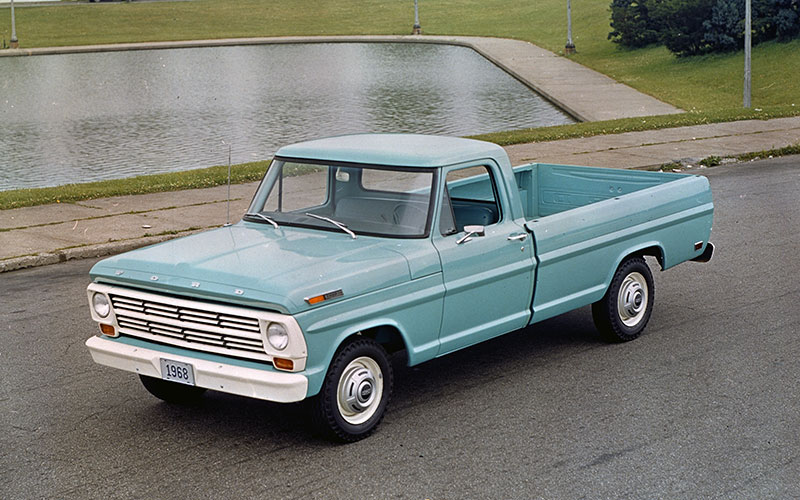
How To Identify a Fourth Generation Ford F-100
The Ford F-Series has been in continuous production since 1948 and is currently in its 14th generation. Over that nearly 80-year span, Ford’s iconic truck has seen a wide range of changes to keep it competitive. Back in the day, that meant going up against the likes of Chevy’s Apache pickup. Today, however, we’re focused on the fourth generation F-Series pickup trucks, which were in production between 1961 and 1966. There are several notable features that visually differentiate these classic Ford trucks from their stablemates, including a short-lived unibody variant. Let’s dive in.
1961-1962 F-100
Before the F-150 moniker arrived in 1984, there was the long-running F-100 in Ford’s ½-ton slot. When the fourth generation of these F-Series pickup trucks debuted in 1961, they had similar squared-off styling to the prior generation, but side-by-side, the 1961 model is notably lower, wider, and longer than its predecessor. Another easy identifier of these fourth-gen F-Series are the dual single headlights up front versus the dual twin lamps from the prior model. This design change proved popular as it remained in place for some 50 years.
Ford also rolled out a new Camper Special package for its fourth generation of the F-Series. Designed for owners of slide-in truck campers, these models featured heavy-duty powertrain components and a “Camper Special” exterior badge. While the Styleside and Flareside designs carried over from earlier F-Series, the 1961 truck offered an all-new unibody option. Dubbed the “integrated pickup”, it combined the cab and cargo bed into a single piece. The idea was to reduce assembly costs, and visually these F-Series jump out due to the lack of a gap between the cab and bed.
1963-1964 F-100
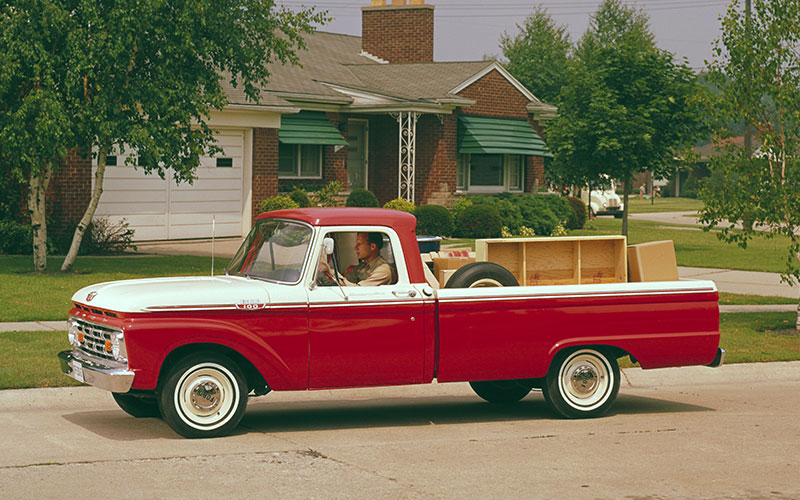
The unibody F-Series didn’t last long, with Ford discontinuing it midway through the 1963 model year due to weak consumer interest fueled by rumors that the doors could jam shut when the truck was heavily loaded. So, look to the front end for clear distinctions versus 1962 like the FORD letters moving from the center of the grille up between the grille and its surround. Additionally, the turn signals were repositioned within that grille, directly adjacent to the headlights.
By 1964, the F-Series was sporting an updated front end with two rows of four rectangular sections made from aluminum. As well, the eight-cylinder powered models received a V8 crest hood ornament, while the six-cylinder trucks kept the sprocket and lightning bolt design. Around the side, there was also a new chrome trim piece running front-to-rear on custom cab variants.
1965-1966 F-100
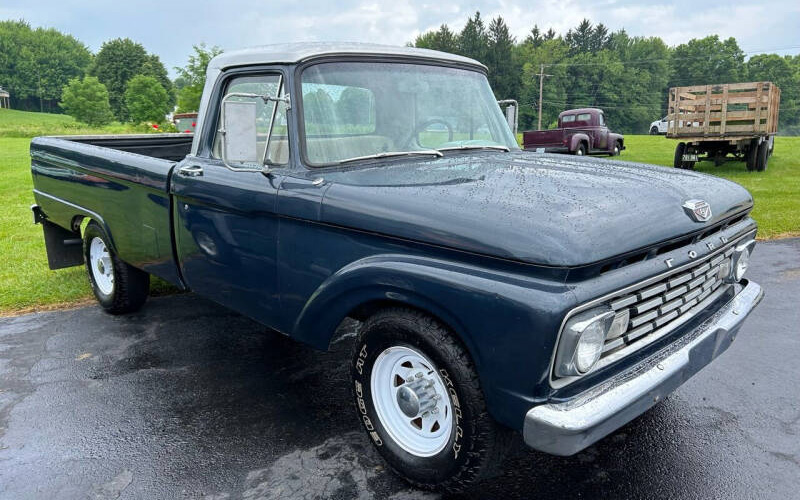
Visually, the most obvious updates for the final two years of fourth-generation F-Series pickup truck production were the turn signals being moved above the headlights and the front FORD letters pushing higher to sit between the signal lamps. Otherwise, the body looked largely similar to earlier models, but underneath there were major updates.
Along with a revised frame, Ford discontinued the straight axle up front in favor of an all-new “Twin I-Beam” design that swapped leaf springs for coils and had larger dampers mounted outside the new springs for a smoother ride and better handling. These fourth-gen F-Series trucks can be identified by the TWIN I-BEAM badges mounted on the body. There were other changes under the hood, including a new 3.9L and 4.9L straight-6 engine along with a 5.8L V8 that made 208 horsepower, marking the first time the F-100 cracked the 200 hp mark.
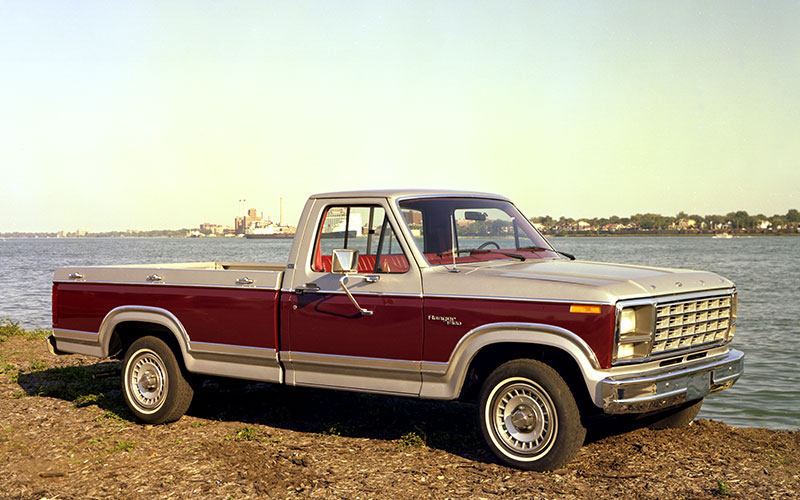
Today, the crew cab body is virtually ubiquitous on Ford’s pickup trucks, but it wasn’t until the end of fourth generation production that this body style debuted, albeit only on F-250 and F-350 variants to start. One of the last changes to these F-100s was the debut of a now-common moniker, the Ranger. Designated with a fender-mounted Ranger emblem, this trim package added bucket seats, carpeting for the floor, a fuel tank cover, and an available front center console.