Latest News
2026 Volkswagen Taos ReviewMichelin’s New Tire Outsmarted Snow, Ice, and Inclines
We got to test out the all-new Michelin X-Ice Snow+ tires at the tracks of Mecaglisse in Quebec. See why all-season tires just won’t cut it during the winter.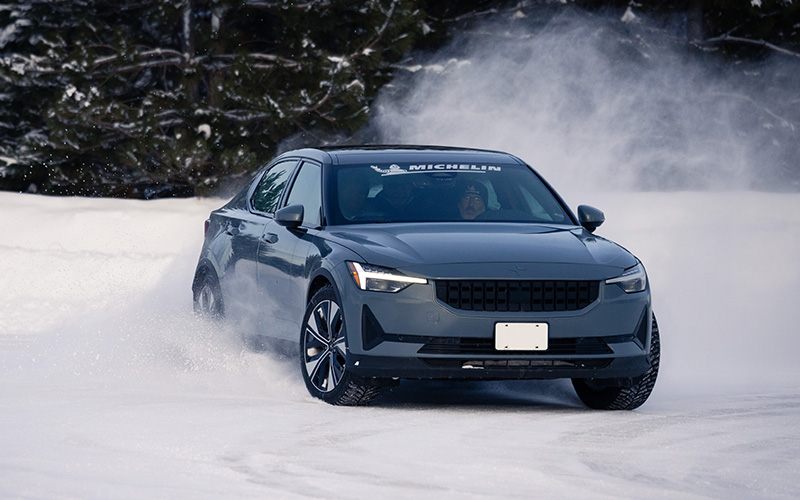
When All-Season Tires Aren’t Enough for Snow and Ice
For drivers who live in cold-weather climates that see regular winter weather, there are a couple of key considerations to make when it comes to safely navigating snow- and ice-covered roads. Outside niche applications like sports cars and serious off-roaders, mainstream vehicles tend to come from the factory fitted with all-season tires. As the name implies, this type of rubber is aimed at covering all the seasons. But if you’ve driven in a snowstorm with all-seasons mounted, you know they don’t work very well in these conditions.
It’s also important not to assume AWD makes your car safer in winter driving, especially given the proliferation of this drivetrain in the ever-popular crossover these days. While AWD systems offer optimized torque distribution to limit wheel slip as much as possible, it is ultimately limited by the tire’s contact patch. Enter the dedicated winter tire and its Three Peak Mountain Snowflake (3PMSF) designation. Tires with the 3PMSF sidewall icon – a tri-peak mountain with a snowflake – have passed a standardized test that proves it will deliver better traction on the white stuff than a typical all-season.
Why You Should Invest in Winter Tires
If you live in the Snow Belt, it can be worth investing in a set of snow tires to both increase your car’s capabilities in foul weather and reduce wear on the tires used for the other 3 seasons. However, if you’re going the winter rubber route, be sure to look for the 3PMSF icon along with the Ice Braking icon. Represented by a single-peak mountain shape, this additional designation means the tire has passed a standardized test for braking on a polished ice surface.
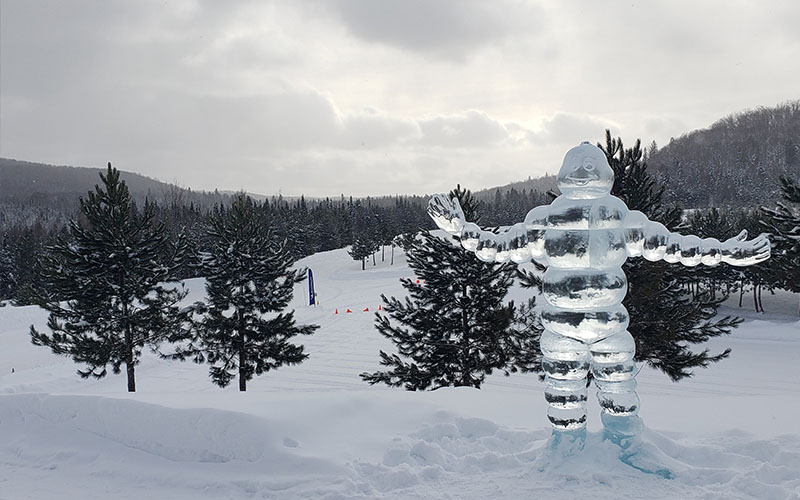
As David Griese, Michelin Product Category Manager, Winter, said in a recent interview*, the ice grip symbol means “You have an elite level of performance. Not just on snow…but also on ice.” Which he would know having previously spent more than a decade as a Michelin tire designer and currently helping lead the launch of the company’s latest winter tire, the X-Ice Snow+. Unveiled at the Mecaglisse, a proving ground north of Montreal that was covered in snow and ice during my visit in early February, this new Michelin tire is impressive.
*You can listen to the full interview courtesy of Niel’s podcast, the Knocking Rod
I live in New Hampshire and am something of a winter tire geek who enjoys preaching to friends and family on the virtues of snow tires. The cars in our household are currently swaddled in cold-weather rubber and I like to investigate their efficacy, with highly unscientific methods, whenever Mother Nature sees fit. But I was totally unaware of this Ice Braking designation, and learned a few other interesting facts about the X-Ice Snow (XIS)+ during my visit up north. For one thing, Michelin designed it to be suitable for all vehicle types, including EVs. Meaning, there is no special version of these snow tires for heavy SUVs or electric vehicles.
Instead, it’s the same tire regardless of whether you have a gas-powered car, a hybrid, or a full electric. Michelin does this mainly to avoid consumer confusion, which I appreciate. The tire market can be fairly hard to make sense of with the mix of all-season, all-weather, and dedicated snow setups vying for attention. As for how the X-Ice Snow+ tires perform, I did get behind the wheel of a few vehicles shod with them, and the results were positive.
Testing the New Micheline X-Ice Snow+ Tires
On an ice handling course, I drove an Equinox EV with the Michelin XIS+ followed by the same vehicle fitted with Nokian Hakkapeliitta R5 EV tires and another identical Chevy wearing Continental VIkingContact 8 rubber. It was tough for me to discern a measurable difference in this test. Some of that can be chalked up to the test surface becoming progressively more friction-free as the thin coating of snow was pushed aside during ongoing testing, leaving nothing but ice. The Continentals seemed to slide a bit more readily, while the Nokians felt strong.
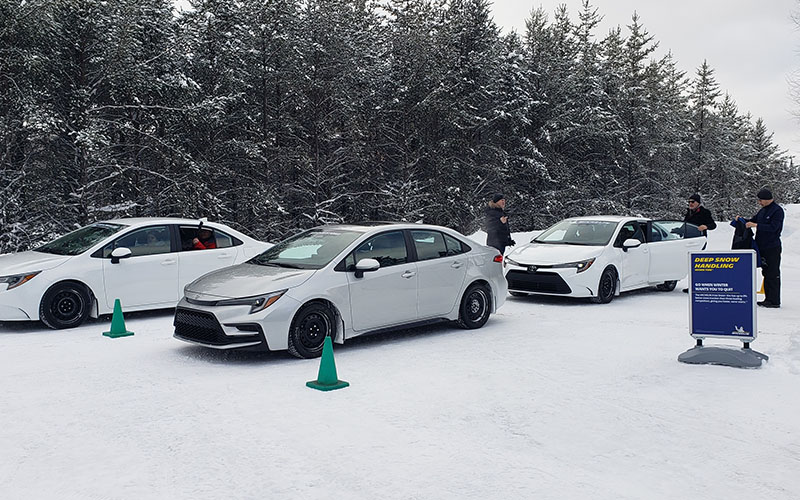
Then we took Toyota Corollas wearing both the XIS+ tires and Bridgestone Blizzak WS90 tires for a jaunt through deep snow in the forest. In both cases, the tires had been mechanically shaved to a 4/32” tread depth as a way to simulate long-term wear. Here, the Michelin shone in both its ability to more effectively traverse the loose snow, but perhaps more importantly to the average buyer, starting from a dead stop.
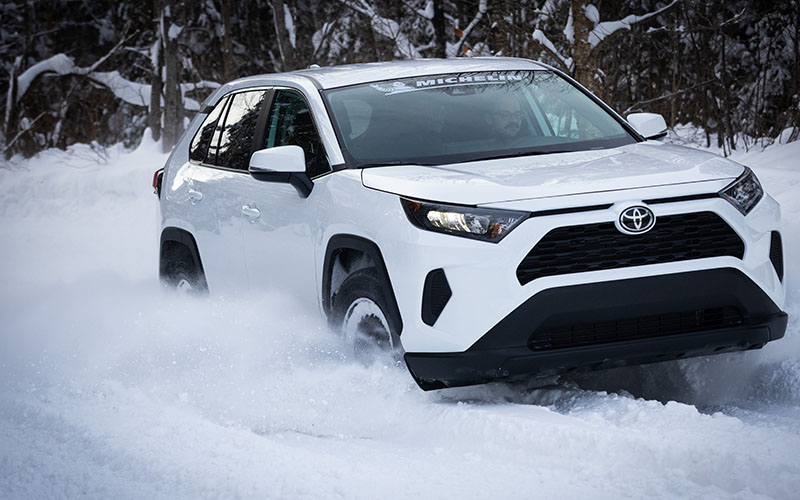
Specifically, a dead stop on an icy incline. With gentle throttle application, the Corolla sporting the X-Ice Snow+ easily got moving, while the Blizzak-ed model had a fair amount of fishtailing as it struggled for grip. There was also an extra-deep snow run using Toyota RAV4s and untouched, new tires. For this test, the Michelin XIS+ was pitted against Continental’s VikingContact 8 winter tires. After several runs, the ruts were deep and the RAV4 with the Michelins was happy to sling sideways across those ruts to keep moving. In the Toyotas wearing Continentals, forward momentum was maintained, but with the distinct – and unsettling sensation – that the ruts were driving the car, not the other way around.
Getting the Most Out of Winter Driving
Michelin says the X-Ice Snow+ has a 26% longer tread life and offers 34% better fuel efficiency than leading competitor tires based on independent testing. These are strong metrics and speak to the upgrades in chemical grip – elastomers, plasticizers, and fillers – the company baked into its new tires, as the mechanical grip aspects – tread block design, sipes, and grooves – remain the same as the previous generation tire.
But I’d say that for the typical consumer looking to upgrade their car for winter driving, at least consider dedicated snow tires. As Griese notes, AWD “does give you an additional level of traction,” but “it doesn’t allow you to stop faster” when it comes to driving in the snow. Certainly, there are plenty of options to choose from, but I can tell you that I’ll be giving the Michelin X-Ice Snow+ tires a hard look when its time for a new set of snow tires.
Related Articles