Latest News
2026 Ford Maverick ReviewFord’s CEO Farley Impressed with Chinese EVs
Ford’s top executive has been driving around a Chinese EV, the Xiaomi SU7, for the past few months hoping to learn the secret to their success.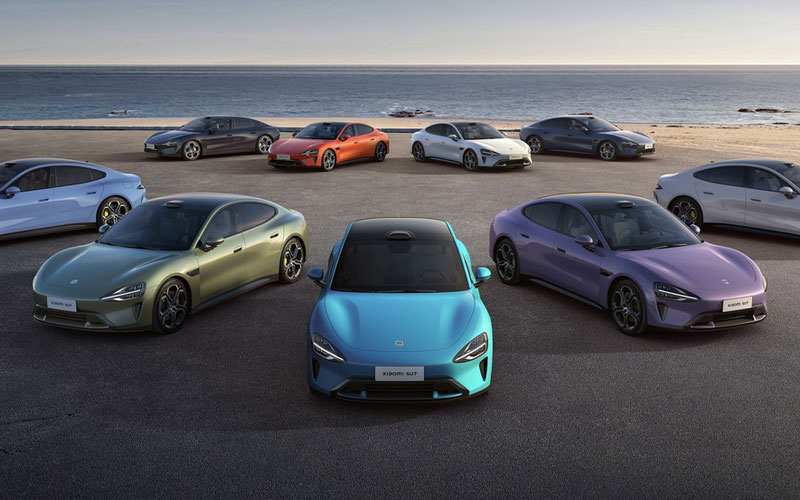
Chinese EVs Wow US Carmakers
On a recent episode of the Everything Electric Show podcast, Ford CEO Jim Farley outlined the challenges faced by US carmakers in transitioning to EV production. Exhibit number one: the Xiaomi SU7 Chinese electric sedan Farley has been driving around Chicago for the past few months. “[It’s] fantastic,” Farley said. “…I’ve been driving it six months now, and I don’t want to give it up.”

While it might seem odd for an automotive CEO to gush over another company’s product, it’s widespread practice, and has been for decades, for carmakers to purchase competing autos for research purposes. Reportedly, Rivian’s CEO RJ Scaringe has also brought a Xiaomi EV over to the States for evaluation.
It turns out, Xiaomi’s SU7 electric car is a good one. Xiaomi is one of China’s largest electronics companies, producing smartphones, TVs, e-scooters, appliances, and more. Now they’ve leveraged that electronics expertise for their first EV to stunning effect. The SU7 has already sold out its entire allotment for 2024, taking reservations for all of its 100,000-unit production run in the first 24 hours.
The Xiaomi SU7 is priced between $30,300 and $42,100 USD and boasts premium features like air suspension, adaptive dampers, and a zero to sixty mph run of less than three seconds (available with 295 or 664 horsepower). It appears Chinese carmakers like Xiaomi have cracked the code on high-quality, affordable, profitable EVs, aided in no small part by China’s investments, both private and public, in EV battery supply chains and related manufacturing. Building a quality automobile to house those batteries was the big challenge for Chinese EV makers, one they appear to have now met.
The Long and Complicated Road to EV Profits
Scaling EV production to the point of profitability remains a major challenge for US automakers, with Tesla currently the only US firm in the black on EVs. For its part, Ford’s EV division posted losses of $1.3 and $1.1 billion in the first and second quarters of 2024, respectively. Meanwhile, the EV-friendly regulatory environment in China has coupled with a massive and EV-friendly domestic automotive market to make companies like BYD (a long-time player in battery tech) newfound automotive titans.
So competitive are Chinese EV makers that the Biden Administration took the step of imposing a new 100 percent tariff on Chinese EVs. Even with the tariff in place, some Chinese EVs are still cheaper than anything currently for sale in the US as BYD’s Seagull EV sells for around $9,000 USD. Doubling that price to $18,000 is still less than the most affordable EV in the US currently, the Nissan Leaf at just over $28,000.
Ford’s own EV efforts are a microsome of the challenges facing legacy automakers as they look to electrify their lineups. This year Ford pivoted some of their EV plans to focus more on hybrid vehicles, which has seen a surge in popularity at the same time that enthusiasm for EVs appears to be plateauing. Given Chinese automakers have figured out scaling EVs to profitability as US carmakers continue to struggle to do the same, perhaps Jim Farley and his cohort could indeed learn a few things driving around a Chinese EV for a while.