Latest News
2026 Ford Maverick Review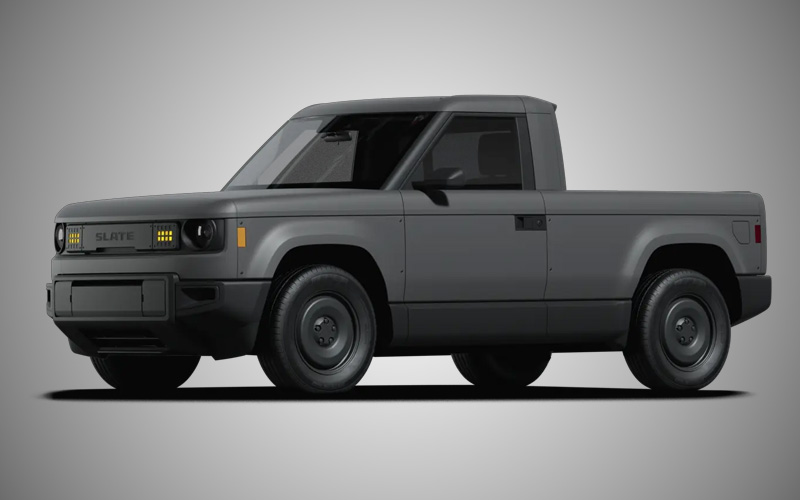
The Tabula Rasa of EVs
It seems like every other week were treated to a new EV startup, here in the US or over in China, that is intent on rattling the status quo of electric vehicles. But to call the Slate Truck just another EV start up would gloss over their genuinely revolutionary approach to the EV. With backers like Amazon’s Jeff Bezos and founders like Jeff Wilke (former Amazon exec) and CEO Miles Arnone, Slate comes with the business and automotive bona fides to make a serious go of it.
The Slate Truck’s unique angle of attack is affordability. The success of the Ford Maverick, a small, affordable (sorta), hybrid proved the market was ripe for the return of small pickups and yearning for cheaper options. The key to achieving a $27,500 starting price was making the Slate Truck as simple and barebones as possible. Slate’s trick is to strip away all the non-essentials (there’s still a federally mandated rearview camera) and then allow owners to option back their desired features a la carte.
Slate’s emphasis on smallness and simplicity stands in contrast to EV startups like Rivian and Lucid that entered the market with halo versions of their respective EVs that aimed to both capture the attention of fickle car shoppers and on a trajectory toward profitability on the back of luxury-level price tags. But before we talk about Slate’s compelling gambit, let’s look at the Slate Truck itself.
The Basics of the Slate Truck
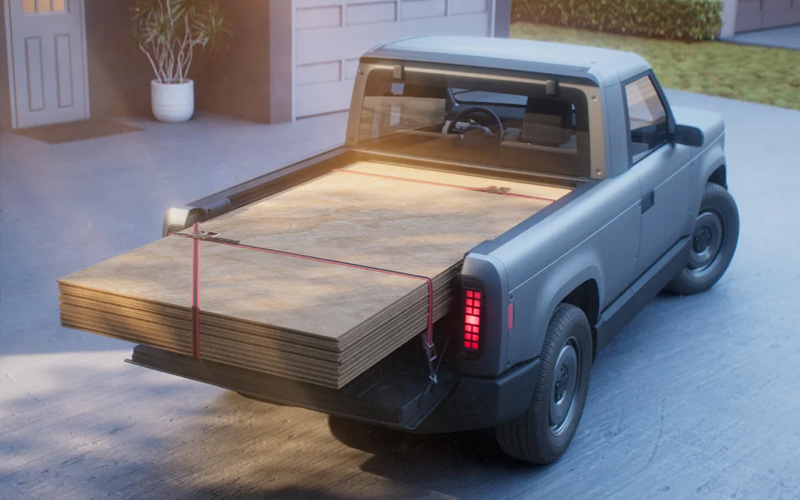
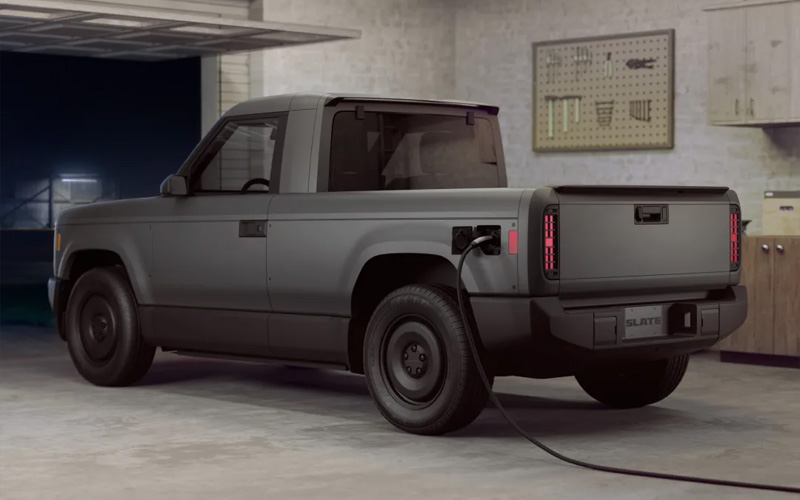
The Slate Truck is about as simple as a new vehicle can get. Fashioned after the light trucks of yore like the Toyota T-100 and original Nissan Frontier, the Slate Truck comes as a two-seater with a four-by-five-foot bed. It’s smaller than the Ford Maverick by a good margin. The Slate Truck has a 108-inch wheelbase compared to the Maverick’s 121-inch wheelbase and measures 174 inches in total length while the Maverick is just over 199 inches.
The windows in the Slate Truck are crank operated, the side mirrors manually adjusted. There are no speakers or infotainment screen, though there is a phone port. Safety equipment includes a rearview camera (displayed on the four-inch digital gauge screen), active emergency braking, and a collision warning system.
The Slate Truck will come with one of two battery packs. The standard 52.7-kWh battery pack will power the rear wheels to the tune of 201 horsepower and 195 lb.-ft. of torque and allow for up to 150 miles of range on a single charge. A larger optional 84.3-kWh battery doesn’t offer more power but does allow the Slate Truck to hit an estimated range of 240 miles. Payload is a respectable 1,433 lbs. while towing, not an EV strong suit, comes in at a maximum of 1,000 lbs.
Factory colors are limited to slate grey and…that’s it. Instead of factory paint jobs, Slate is opting for an array of colorful wraps starting at $500.
Accessories Galore
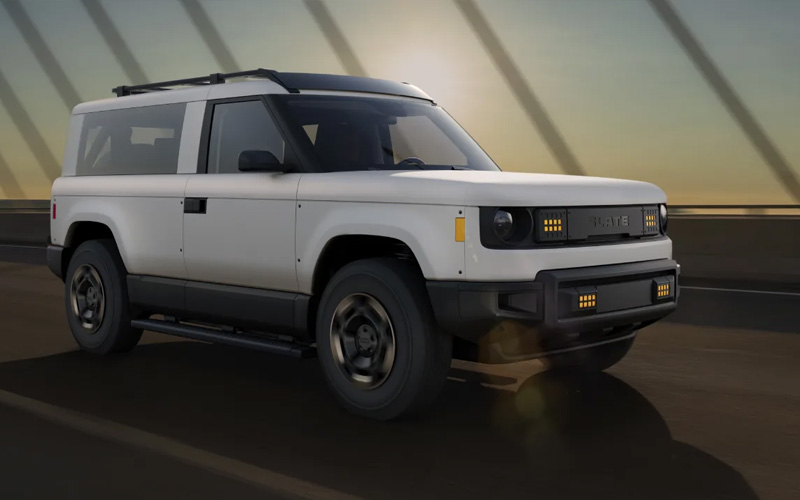
The essence of the Slate Truck is modularity with more options and accoutrements on offer than even the notoriously expansive Porsche configurator. Slate’s configurator includes options for over a dozen different wraps, interior accessories like a center console, speakers, and a tablet mounting bracket. You can get heated seat covers, a power module for those windows, all-terrain tires, and either a lift or a lowering, depending on your preference.
The biggest option of all is a conversion kit to turn your little EV pickup into a little EV SUV with the addition of a second row of seats and a rear roof cover, the latter available in regular or sport back designs.
Slate plans to host a “Slate University” website as a free online resource of tutorials and walkthroughs for DIY-minded owners keen to configure their Truck on their own time/dime. Slate will also support open-source 3D printing of accessories for interior and exterior trim.
This level of personalization will ideally allow owners to build a Slate Truck to best suit their needs and tastes whether they’re looking for a sport truck, surf truck, work truck, or overlanding SUV.
How We’d Spec One
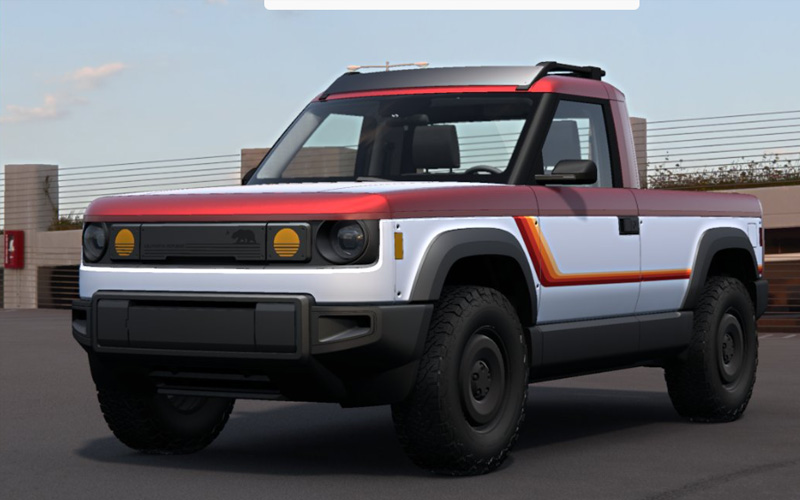
Since the Slate Truck is all about customizability, we went ahead and spec’d a build of our own on their website, www.slate.auto/en. For this exercise, we eschewed the optional SUV configuration for the pickup version. Rather than stick with the default grey we landed on the “Whole Lava Love” wrap with a partial “Snow White” two-tone and “Throwback” ‘80’s style hockey decal. Additional exterior accessories included a roof rack, fender flares, a lift kit, all-terrain tires on the standard 17-inch steel wheels, and the “Surf Break” grille cut out.
I’m as much of a fan of minimalism as anyone when it comes to automotive interiors, but the Slate Truck begs for upgrades and so I obliged by ticking boxes for the matching “Throwback” interior decals, a center console, door cubbies as well as the “Magma Orange” key fob, lower dash accenting, and right and left speakers.
The total number of options is too many to list here. Again, check out their configurator to get a sense of just how many different ways you could build a Slate Truck.
The Promise and Challenge of a Cheap EV
The Slate Truck’s biggest selling point is also its biggest challenge: a low price point. Slate says they Truck will start at roughly $27,500. Once you factor in the federal EV tax credit, assuming that remains in effect, buyers could conceivably get a Slate Truck for less than $20,000, a price point unheard of on a new car in quite some time.
With Bezos’ backing, Slate says they’ve already raised some $111 million dollars, which sounds like a lot of money, and it is, just not for a fledging EV start-up and in a world where similar ventures like Lucid and Rivian keep having to go back to the venture capital and sovereign wealth fund well as they continue their quests to finally slay the elusive and ephemeral dragon of profitability.
Will the Slate Truck’s configurability and affordability be enough to make a dent in a sluggish EV market? We’ll have to wait until 2026 to find out, but if nothing else, it’s certainly got originality on its side.