
Latest News
2026 Chevrolet Tahoe ReviewIs the 2026 Passport Worth the Upgrade?
The new Honda Passport has just hit car dealers. We look to see if it's worth buying the 2026 model, or to save money and buy last year's model.
New Features for the Updated Honda Passport
Once upon a time, the Honda Passport was a true SUV, as in 30 years ago. After a long hiatus, Honda brought the Passport back in 2019 as a crossover with inoffensive styling and a touch of ruggedness in TrailSport guise. For 2026, the Honda Passport aims at a return to its roots with brawnier looks, more off-road capability than the outgoing model, and a heavy dose of new technology.
But in a 2026 vs. 2025 Honda Passport comparison, the question is whether or not it’s worth the upgrade. Along with a more squared-off vibe, Honda says chassis rigidity is up 72% in the front and 50% out back. Stronger suspension components have been fitted along with larger brakes, a new AWD unit, a more powerful V6, and a more impressive roster of standard content. Let’s see if all this newness, and associated costs, are worth it.
Powertrain Specifications

Though the 3.5L V6 in the 2026 Passport is technically more powerful than the version in last year’s model, it only makes an additional 5 horsepower. The real news on the powertrain front is how this third-gen Passport uses that power. For one thing, the 9-speed automatic has been swapped for a 10-speed transmission, which helps bump the highway fuel economy figure up by 1 mpg to 25. City and combined ratings of 19 and 21 mpg, respectively, remain the same. AWD was standard on the prior Passport and remains so for 2026, but this is the first application of Honda’s second-gen i-VTM4 system that has a stronger rear drive unit, a 40% higher torque capacity, and a 30% faster response time.
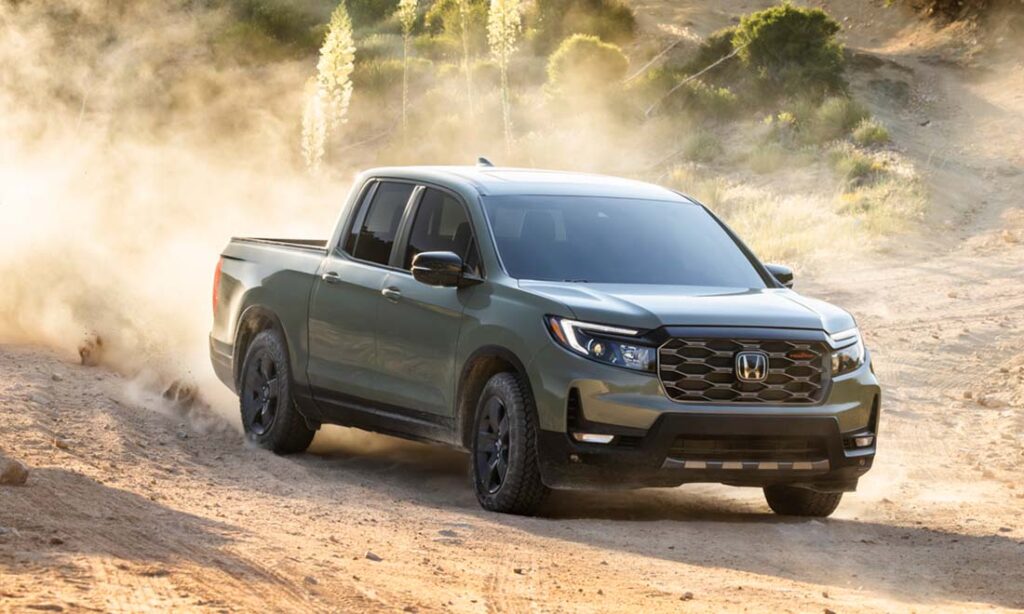
The 5,000-pound towing capacity doesn’t change, but an extra 2.75” between the wheels and slightly wider front and rear tracks should improve the Passport’s ride quality on the road. For the off-roading set, a heavily revised TrailSport variant features a retuned off-road suspension, steel skid plates, heavy-duty recovery hooks, 31” all-terrain tires designed exclusively for this model, and an improved approach angle.
Comfort and Interior

Thanks to the increased footprint of the 2026 Passport, it brings an extra 1.3” of rear legroom, 6 more cubic feet of cargo space behind the first row, and an extra 3 behind the second row. Up front, Honda’s new Body Stabilizing Seats are aimed at reducing occupant fatigue, while thicker carpeting and added sound-deadening insulation are all designed to deliver a quieter, more comfortable Passport cabin.
As with the 2025 Passport, leather upholstery, heated front seats, and tri-zone automatic climate control come standard on the 2026 model. But the new Passport replaces the previous 8” infotainment touchscreen with a 12.3” display and adds Google built-in with a complimentary 3-year unlimited data plan.
Moving through the 2026 Passport trim lineup, other all-new upgrades include a panoramic moonroof, a Bose 12-speaker audio system, and a TrailWatch camera system with tire path graphics to help drivers navigate obstacles.
Is the New Passport Worth the Price?

So, the big question in this 2026 vs. 2025 Honda Passport comparison is whether the new model is worth it or not. Without a doubt, the all-new third-gen Passport is impressive. Sure to be a more pleasant daily driver on paved surfaces, the comprehensively overhauled TrailSport trim promises a higher degree of rough road competence, bringing it a bit closer to serious off-roaders like the Toyota 4Runner that we compare to the Honda here.
Of course, price is perhaps the main factor in making a decision like this, and the 2026 Passport is indeed more expensive. The base 2026 Passport RTL is $2,350 more than a 2025 base model, the TrailSport variant sees a $3,450 increase over last year, and the new TrailSport Elite range-topper is almost $4,000 than last year’s top-spec Black Edition.
This all-new Honda Passport is certainly a compelling member of the incoming crop of 2026 vehicles, but those are pretty steep jumps in price. Factor in the likelihood that Honda dealerships will be looking to clear out 2025 Passport inventory, which could mean good deals, and at the moment you may be better off going with last year’s Passport as it remains a very solid all-around crossover.