
Latest News
2026 Ford Maverick ReviewA Breezy 1958 Edsel Pacer Convertible
This 1958 Edsel Pacer convertible proves time can turn a commercial debacle into a beloved classic with a unique story and even more unique looks.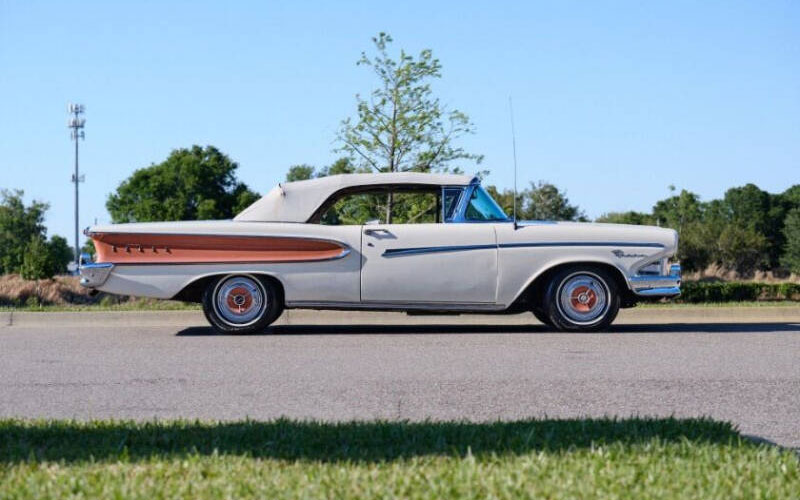
The Enduring Edsel
For those familiar with the Edsel, Ford’s short-lived mid-level brand from the late 1950s, the conventional narrative has long been cemented. Today, Edsel is a byword in the auto industry for managerial hubris, over-hyping and under-delivering, and disastrous design-by-committee debacles. It’s right up there with the Pontiac Aztek and DeLorean DMC-12 as one of the biggest flops of all time. But the internet loves contrarian hot takes. If you wanted, it’s not too hard to make the case that the Edsel was a victim of bad timing and poor execution, more than it was a bad car or a bad brand.
It turns out both things can be true, at least in part. Flash forward nearly 70 years and the Edsels left on the road are few and rapidly aging. So, when you run across a 1958 Edsel Pacer convertible, as we did this week, it’s hard not to take notice. But before we examine that particular example, he’s the story of the Edsel, in brief.
The Edsel Emerges
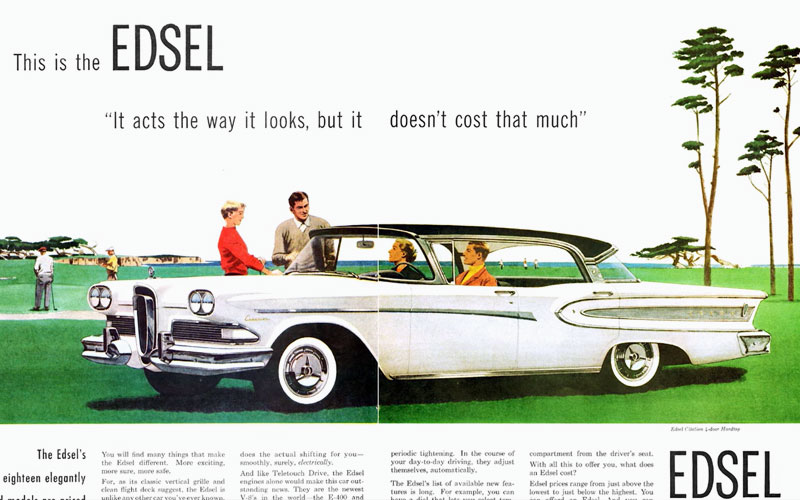
The invention of the Edsel brand had everything to do with Ford’s decades-long rivalry with GM. GM in the 1950s leaned on its array of brands, including Chevrolet, Pontiac, Oldsmobile, Buick, and Cadillac, to deliver a car for practically every pocketbook. Ford was sufficing with three, Ford, Mercury, and Lincoln, the latter of which had been losing ground to Cadillac in both prestige and sales. In order for a reimagined Lincoln to succeed up market, Ford executives, including Henry Ford II, felt they needed another mid-level brand to squeeze in between Ford and Mercury.
Initially, suggestions the new car be named after Henry Ford Sr.’s son Edsel, a well-liked executive at the company who died young, were nixed by none other than his son Henry Ford II. After rounds of brainstorming that included thousands of possibilities, four names floated to the surface, Ranger, Pacer, Corsair, and Citation. An overall brand name remained a sticking point. In exasperation, the Edsel name was suggested once again and ultimately won approval. The engineering, design, and marketing of the car were all similarly exhaustive, some might say overthought.
When Bold Becomes Weird
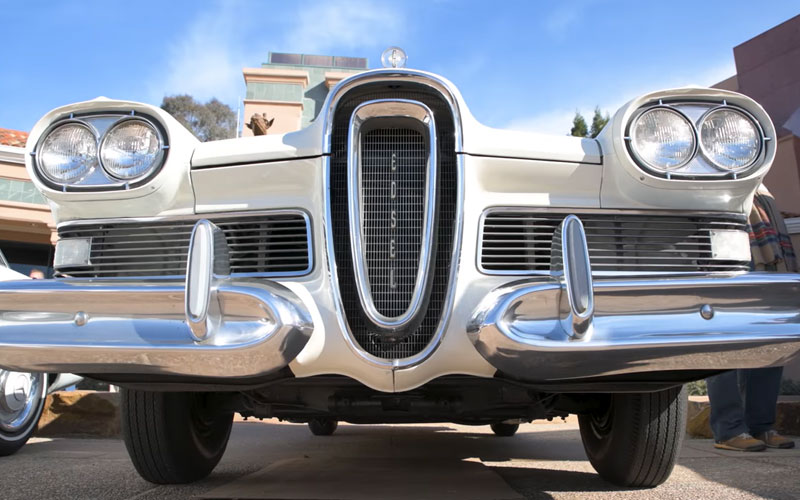
The car’s styling was easily its more controversial feature, then and today. Launched in September of 1957, the Edsel was a mix of current aesthetics and wild innovative ideas. Sizable chrome bumpers and quad headlights were fairly conventional but the chunky batwing taillights and infamous vertical horse-collar grille were big swings that ended up as clear misses for both critics and the car-buying public. To be fair, the design wasn’t taking larger stylistic risks than average in the era of chrome and fins, take the ’58 Pontiac or the ’58 Continental for examples of equally audacious looks that year.
The Edsel brand offered seven iterations of their new car. The Edsel Ranger and Pacer rode the short wheelbase, 118 inches, while the Corsair and top-trim Citation rode the long wheelbase, measuring 124 inches. Three wagons were also available, the two-door Roundup and four-doors the Villager and the wood-trimmed Bermuda.
Two engines were offered for the Edsel line, a 361 cu.-in. V8 making a respectable 303 horsepower and 400 lb.-ft. of torque and a 410 cu.-in. V8 with 345 horsepower and 475 lb.-ft. of torque. Curiously, the valve covers featured E 400 and E 475, referencing the torque number rather than either horsepower or displacement.
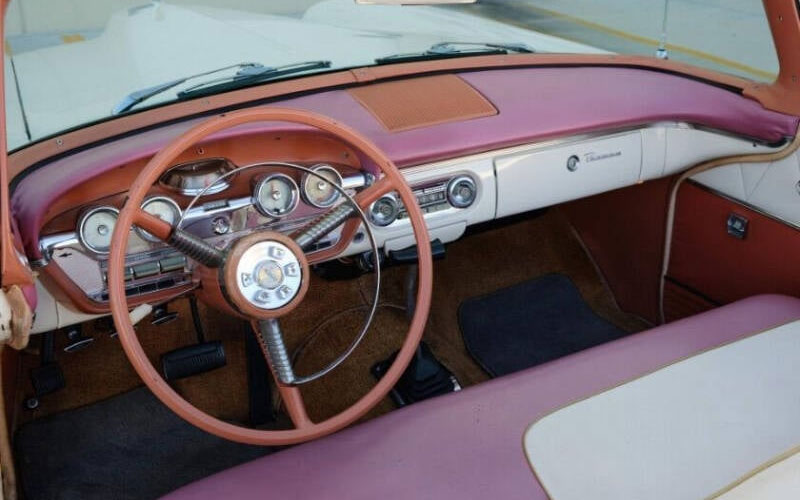
Oddities included the car’s floating speedometer was fashioned after a compass and came with an excessive speed warning light. Equally novel was the Teletouch push-button automatic transmission which located those buttons on the center of the steering wheel. Not only were drivers in danger of accidentally shifting when they tried to honk the horn (designed to only be shiftable at less than 5 mph, but still), but the relay box in the engine bay could overheat and damage the critical wiring.
The Edsel’s Troubles Pile Up
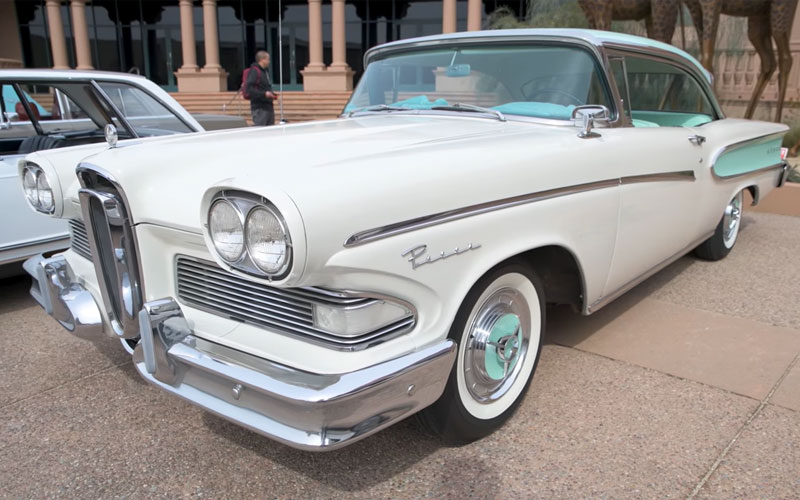
Why did the Edsel, with so much money and effort behind it, fail? The first of many problems was quality. Rather than build the Edsel on its own dedicated line, Ford made the decision to recruit existing Ford and Mercury lines to assemble the cars resulting in quality control issues as unfamiliar workers confused parts or botched assembly tasks. Some cars came off the line and into showrooms with squeaks and rattles.
The middling, overwrought design didn’t help matters. The horse collar grille was compared unflatteringly to a steel toilet seat. The 1959 version saw major exterior revisions. A new side spear adorned the sides, the quad headlights were moved down and integrated into a new grille design that updated but did not eliminate the horse collar element. The rear end was redesigned as well, including the addition of triple taillights.
Despite millions spent marketing the new Edsel brand, consumers remained confused. Ostensibly slotting between Mercury and Lincoln, the prices of Edsel models significantly overlapped with Mercury and even Lincoln models. The Pacer and Ranger ($2,400-$2,900) were in direct competition with the Mercury Medalist and Monterey ($2,500-$3,000) while the top-level Edsel Citation was priced up to $3,700, not too far from the Lincoln Park Lane at $4,200. It wasn’t just price either. Ford and Mercury had bankable names that consumers had grown to trust, Edsel was a new, unproven brand.
The massive up-front investments Ford had made in developing and launching the Edsel line meant there was enormous pressure for the car to deliver robust sales. It did not. Ford’s break even on their roughly $350 million dollar investment was selling 200,000 units a year. The 1958 Edsel sold around 68,000 units, which dropped to just under 45,000 units for 1959, the conservatively redesigned 1960 model year Edsel sold a mere 2,846 units before production was halted entirely in November of 1959.
This 1958 Edsel Pacer Convertible
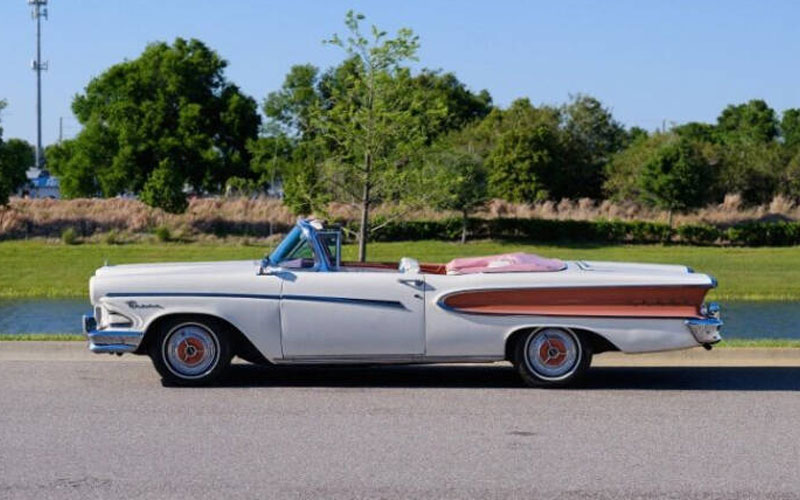
Brand confusion, quality control issues, and odd styling doomed the Edsel line. But what makes for a good story of hubris and failure also makes for a compelling classic car today. To wit, this 1958 Edsel Pacer convertible in White and Sunset Coral with matching interior. With just over 100,000 Edsels produced, every running example is a special car. As a 1958 model with its distinctive styling and being a convertible as well, this car is a special find. Under the hood is the 361 cu.-in. V8 (note the E 400 valve cover) sending power to an automatic transmission, converted to a floor shifter (though retaining the original Teletouch buttons on the steering wheel).
The interior is a bit sun-faded, but the modest asking price of $32,900 makes this classic Edsel convertible an excellent restoration candidate.


The Edsel was positioned between Ford and Mercury, not Mercury and Lincoln. That convertible is Sunset Coral, not red, and it has quite a few issues for the asking price.