Latest News
2026 Chevrolet Tahoe ReviewSpotted – 1964 Bill Thomas Cheetah Racecar
The Bill Thomas Cheetah was built to beat the AC Cobra. Though short-lived, the Cheetah managed to carve its own unique niche in racing lore.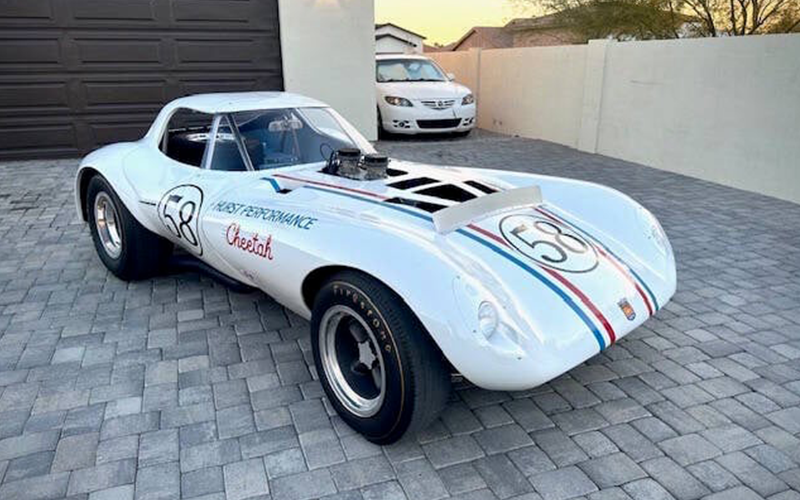
Another Cobra Killer?
My fellow writers and I have an unhealthy obsession with rare and unusual cars. The best part of scouring a listing site like Carsforsale.com is finding those diamonds in the rough. Some cars are special just for their rarity, others for their provenance, and others for their modern-day obscurity. Today’s find combines all three of these qualities because it’s one of eleven of the famed Bill Thomas Cheetah racecars from the early 1960s. The Cheetah was a clandestine Chevy project built to take on Shelby’s AC Cobra and done under the shadow of the AMA racing ban. The brief but electrifying competitive run for the Cheetah has become the stuff of automotive legend today.
A Chevy, But Not in Name
The Cheetah racecar was the brainchild of Bill Thomas, who’d made a reputation in California’s racing circuit, putting Corvettes to the test at Lake Mead in the 1950s. Thomas founded Bill Thomas Race Cars in 1960 and was subsequently hired by GM to work on hopping up the Corvair’s performance. It was this “in” with the company that helped Thomas when he got the idea of building the Cheetah, originally envisioned as a test bed to entice more work from GM.
In the early 1960s, GM was an adherent to the AMA racing ban and while Ford and Chrysler were beginning to break in more and more public ways with the agreement, GM was officially holding firm (even as Pontiac worked hard to push the performance envelope). GM’s reluctance had a lot to do with pressure the company was under from the Feds. Anti-trust probe into the company threatened a break-up of the automotive giant and the potential bad press associated with racing was seen as too risky by the company’s top brass.
But telling a bunch of car guys they can’t go racing just meant they’d get more creative. That meant a de facto skunkworks in order for Chevrolet to answer Ford’s own racing ban workaround, Carroll Shelby’s AC Cobra. Rather than allow company engineers to do the tinkering, Chevy’s Ed Cole and “Bunkie” Knudsen, gladly took up Bill Thomas’ suggestion of building a Chevy-based Cobra-beater. One might pause and note that Chevy already had a race-worthy car, the Corvette, one that engineer Zora Arkus-Duntov had been hard at optimizing just for that task in the form of the Z06, L88, and Grand Sport. But in fact, the latter Grand Sport was itself a skunkworks project that was promptly shuttered when GM executives discovered it, evaporating the C2 Corvette’s factory support for racing.
With the help of his mechanic Don Edwards, Thomas designed the Cheetah using the powertrain, obtained from Chevy, the same 377 cu.-in. small block V8s as the canceled Grand Sport Corvette tuned to over 500 horsepower and paired with a Muncie four-speed manual. With the engines earmarked, Thomas and Edwards set about designing their Cobra-killer.
Unique Oddities of the Cheetah
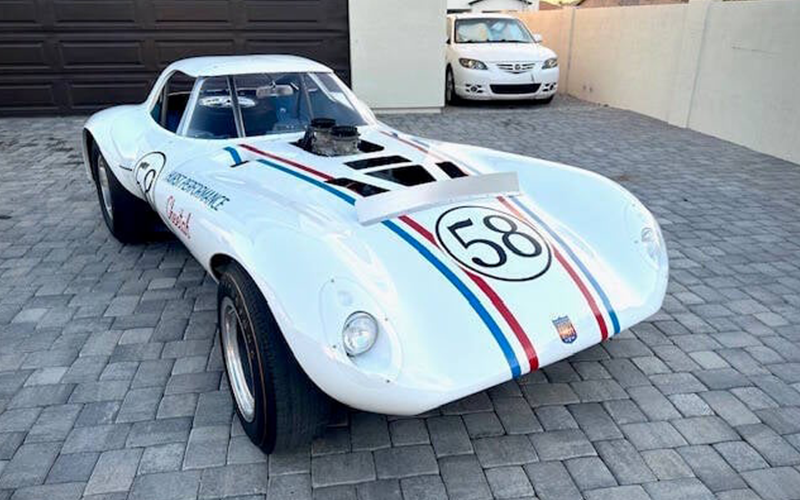
The Bill Thomas Cheetah is an odd-looking car, even by the standards of the day. It looks a bit like contemporary Ferraris like the 250 GTO, but with more extreme proportions. Those proportions, the elongated hood, and extremely short rear end were the result of the engine placement. Thomas and Edwards knew to achieve the best weight distribution they needed to position the engine as close to the center of the car as possible. They did just that, shifting the engine back to a front mid-engine placement. Of course, there was a cascade of consequences to go with this choice.
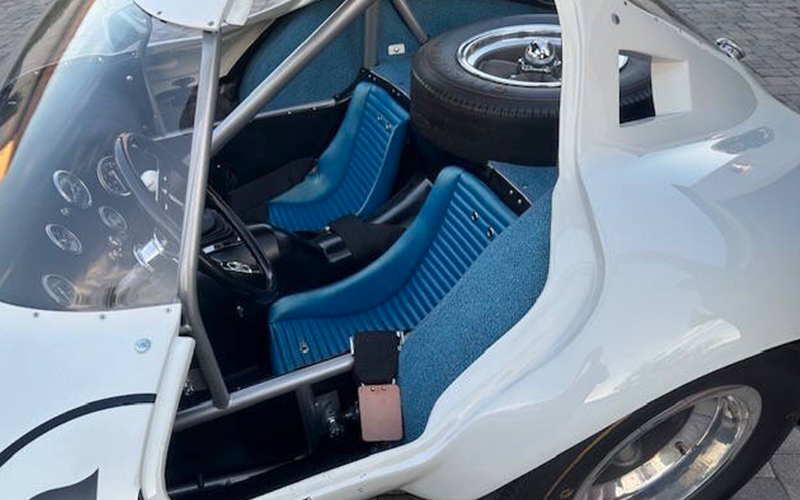
Moving the engine backward meant moving the transmission back as well, positioned directly in between the two occupants. So far back was the transmission that the Cheetah doesn’t have a traditional drive shaft and instead a basic U-joint connecting the transmission and the rear differential. The rearward shift also applied to the seating position, so far back one is practically riding atop the rear axle.
Most consequential of all was the positioning of the exhaust headers. These fed out and over the foot box of both occupants before shunting to the rear. This meant the driver’s legs were enveloped in heat with the engine itself to the right and hot exhaust running above and to the side of their legs. The result was an excessively hot cabin.
The Cheetah’s major advantage against the Cobra was, surprisingly, its weight. Even as the AC Cobra was a light-weight British roadster with an American V8, the Cheetah’s tubular chassis and fiber-glass body (the first two were aluminum-bodied) was even lighter, between 1,500 and 2,000 lbs. (depending on the specific car). Total numbers on the Cheetah vary as sources differ, citing between 11 and 20 cars. At least eleven were finished with another half dozen or more with body shells or chassis in various stages of completion. The entire project came to a close in 1965 when a fire damaged Thomas’ garage.
Racing the Cheetah
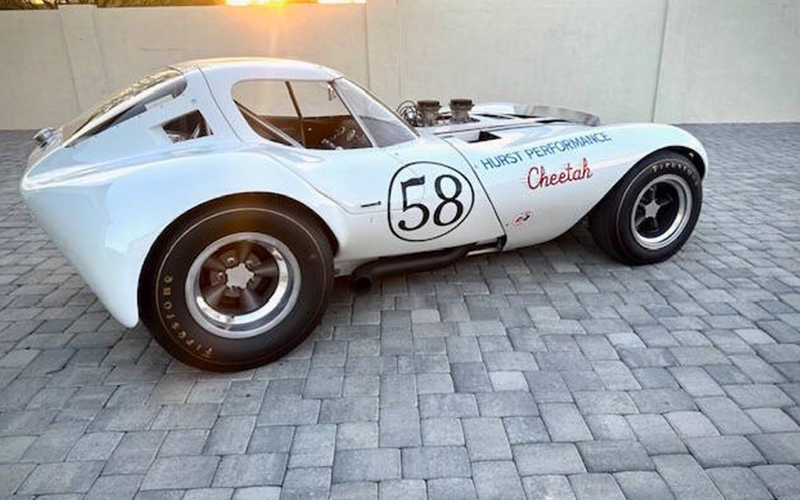
The Cheetah was first raced at Riverside Raceway by Jerry Titus in February of 1964. The Cheetah did not finish the race but went on to decent success in 1964 and ’65. The most success with the Cheetah was had by Ralph Sayler, whose mechanic modified the car by chopping the top and converting it into a roadster to alleviate the heat issues common to the car. The result was 11 race wins for Sayler and his modified Cheetah.
Because the Cheetah was built in such low numbers, not even meeting the 100-car homologation requirement, it competed in the SCCA’s C-Sport/Modified class against Lolas and McLarens rather than against the Cobra which competed in A-Production class. New homologation rules put things further out of reach when the homologation minimum was raised from 100 to 1,000 units, practically impossible for a small shop like Thomas’ to meet. Between the rise of newly competitive cars like the Ford GT40, challenging homologation rules, and then the shop fire, the Cheetah’s brief time in the racing limelight drew to a swift close.
This 1964 Bill Thomas Cheetah
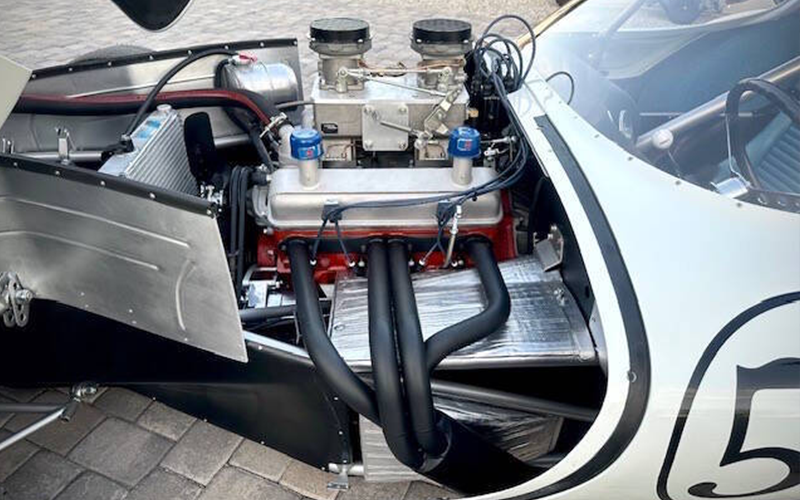
As I wrote at the outset, the occasion for this article is the 1964 Bill Thomas Cheetah racecar currently listed on Carsforsale.com. The example in question features the original 377 V8 (fuel-injected version) and was fully restored as of July 2024. The seller lists it as one of eleven completed Cheetah racecars, this being the #58 car. That makes it the car raced by Jerry Titus, later owned and raced by Jerry Entin, and featured in the Elvis movie Spinout.
Between the racing history and extreme rarity, this Bill Thomas Cheetah is priced reasonably at $550,000.



As a race car, perhaps more successful than the Griffith 200, but Griffith sold more cars than Thomas and the Griffith was potent enough to put a Cobra back on the trailer in any match up. I was just not raced enough.
A cobra killer, which didn’t race against cobras, but rather Lolas and McLarens in the SCCA’s C-Sport/Modified class
True! The Cheetah did not make it into the A-Production class that the Cobra was in. Too bad GM did not build enough to meet the homologation requirement.