Latest News
2026 Cadillac LYRIQ ReviewToyota Camry Through the Years
In the US, no sedan matches the Toyota in raw sales numbers. We look back through the years at all the Camry generations to find what’s made it popular.The Humble Champion
Carrying superlative titles like fastest, fanciest, toughest is usually attended by a degree of swagger. Jeep, Rolls-Royce, and Bugatti all built their brands around being the best in their given domains. And yet the title of most popular flies under the radar. Some champions feel the need to proclaim their greatness from the roof tops, yet Toyota’s Camry is content to let the record books tell the tale. Reflect a moment on the Camry’s record, over 12.5 million cars sold in the US, an annual average of over 300,000 units sold, and a decade and half plus as the number one selling passenger car.
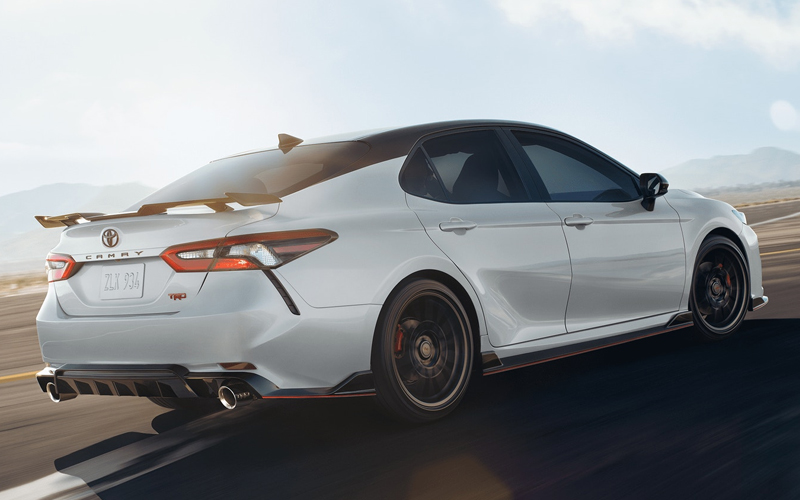
2021 Toyota CamrTRD – toyota.com | Shop new Toyota Camry on Carsforsale.com
The Toyota Camry won’t wow the neighbors like a new C8 Corvette. But then, curb appeal has never been the primary pursuit of the Camry. Instead, the humble Toyota Camry became the sales champ based on practical concerns like affordability, fuel economy, and reliability. For the great masses who just wanted to get from A to B and not worry, or really care at all, about their car, the Camry became the go-to choice. We look back at the evolution, generation-by-generation, of the modest sales juggernaut, the Toyota Camry.
First Generation 1983-1986
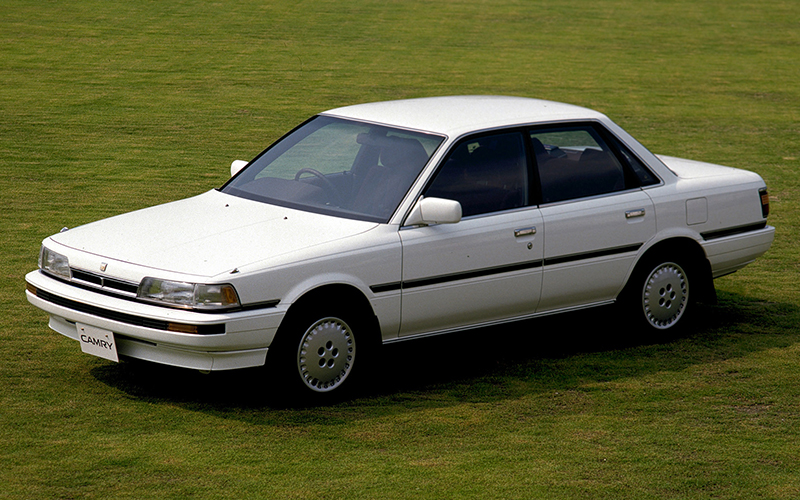
1983 Toyota Camry – toyota.com | Shop Toyota Camry on Carsforsale.com
- With the onset of the 1973 Oil Crisis, Japanese manufacturers specializing in small, fuel-efficient passenger cars began to make significant inroads in the US automotive market, including Toyota.
- Toyota’s compact Corolla saw tremendous success in the 1970s as automotive demand in the US and abroad shifted from bulky sedans with oversized gas-guzzling engines to smaller cars with more efficient low displacement engines.
- The Camry nameplate debuted in Japan as an offshoot of the Toyota Celica (though it shared more mechanically with the Toyota Carina).
- In 1982, the Camry began production in Japan for the 1983 model year.
- The first-generation Camry came in two body styles: four-door sedan and five-door hatchback.
- Two engines were initially offered: a 1.8L four-cylinder making 90 horsepower and a 2.0L producing 107 horsepower. Both engines could be optioned with either a five-speed manual or four-speed automatic transmission.
- In 1984, a 1.8L turbodiesel engine option was added. It came exclusively with a five-speed manual transmission.
- The emphasis on affordability, reliability, and comfort proved to be a winning formula for the Camry, Toyota, and Japanese brands in the US as a whole (with the likes of the Honda Accord also seeing huge sales successes).
Second Generation 1987-1991
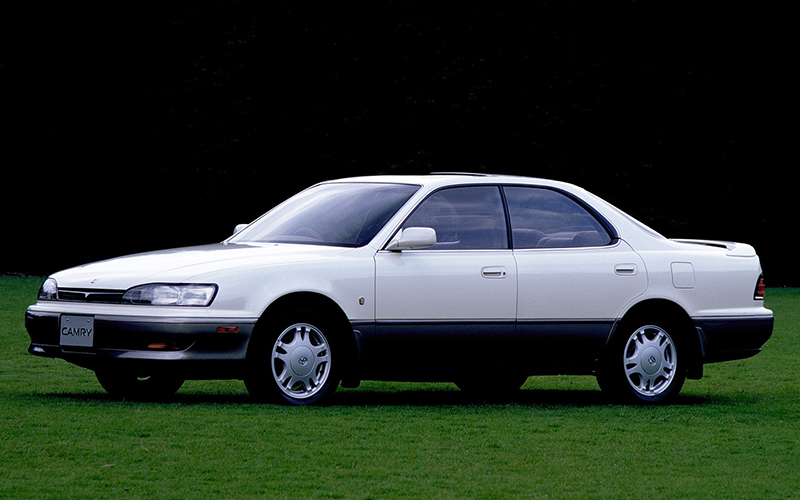
- As the beginning of a long-running trend with the Camry, the compact car got slightly longer, adding interior and cargo space.
- For 1988, the Camry added an all-wheel drive option dubbed “All Trac.”
- Another new addition was a 2.5L V6 which saw the Camry jump up to a full 160 horsepower.
- The second-generation Camry dropped the hatchback option in favor of a wagon version.
- Both in 1988, sales of the Camry crested 200,000 units in the US and independent North American manufacturing began at Toyota’s new plant in Georgetown, Kentucky.
- The second-generation Camry served as the basis for the Lexus ES 250 sedan.
- A 1989 refresh brought new bumpers front and back as well as updates to the suspension and steering.
Third Generation 1992-1996
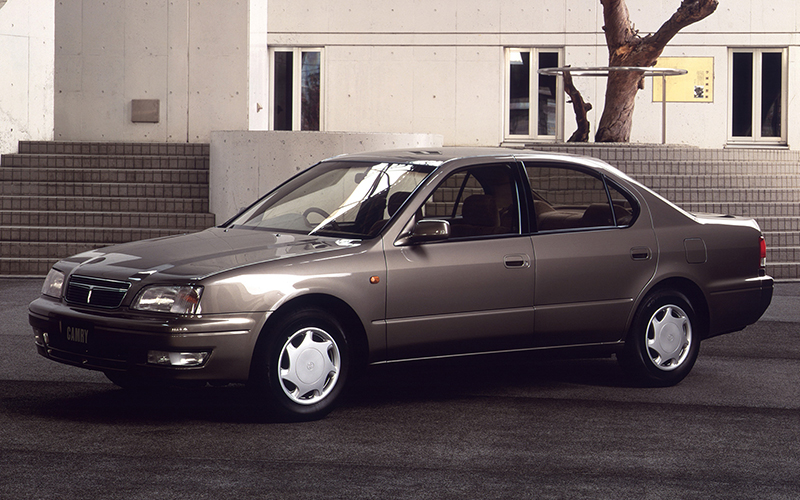
- In a significant shift, the Camry was moved to a widebody configuration. It was now considered a mid-size rather than a compact car.
- Like most vehicles in the 1990s, the body lines of the third-generation Camry were smoothed over and aerodynamics improved.
- The Camry continued to share underpinnings from the Lexus ES. Though some within Toyota worried that the line between the brands would be blurred as the Camry moved up market.
- Replaced the prior iteration, a new aluminum-block V6 was introduced. Making 188 horsepower, it could be optioned alongside the base 2.2L four-cylinder.
- A two-door Camry coupe debuted for the 1994 model year and came with either the I-4 or V6 engine. This coupe version only lasted through 1996, but it wouldn’t be the last two-door Camry.
Fourth Generation 1997-2001
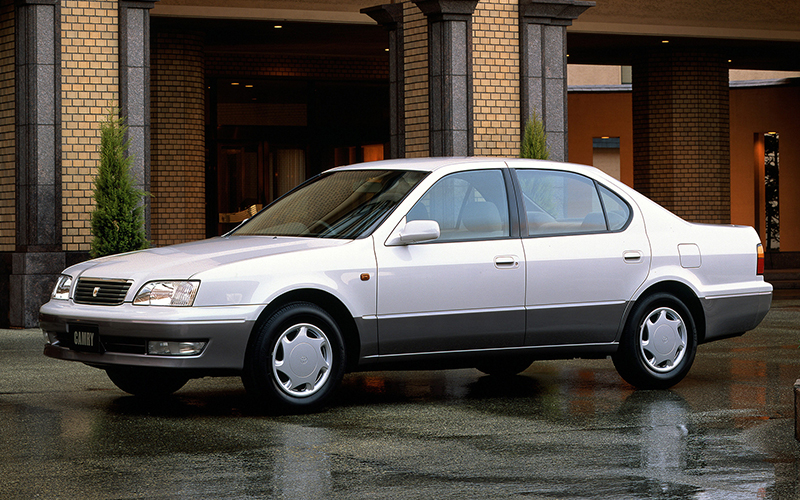
- The Camry continued to grow, adding two inches in length for its fourth generation.
- In 1997 the Camry took the crown as the best-selling car in America, the beginning of a decades-long trend.
- Two new engines entered the mix, a new 2.2L I-4 and a new 3.0L V6 now making 192 horsepower. Despite the uptick in power, this generation of Camry was slightly slower than the previous one.
- Manual transmissions could still be found in the Camry, available in conjunction with the V6 at both the base CE and LE trim levels.
- The Camry continued to grow into its mid-sized body and shed its formerly boxy body style. Lines were further smoothed over and the front end became sleeker.
- Sadly, the wagon body style was dropped for the fourth generation.
- In 1999, a two-door body style returned for the Camry with the introduction of the Solara. Coming in both coupe and convertible bodies, the Solara departed significantly from the Camry’s conventional looks with a long sloping hood, short rear deck, and unique grille design.
- Equipped with the V6, the Solara coupe was actually faster than its sedan counterpart with a zero to 60 time just under seven seconds. The heavier, less aerodynamic convertible moved in the opposite direction, weighed down to a dawdling 8.4-seconds to 60 mph.
Fifth Generation 2002-2006
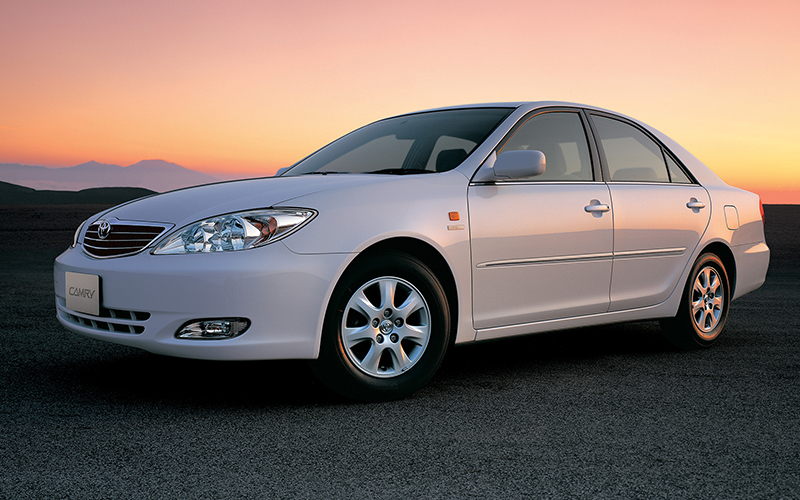
2012 Toyota Camry – toyota.com | Shop Toyota Camry on Carsforsale.com
- The Camry continued to gain size in its fifth generation, becoming both taller and longer and offering increased interior room.
- The base engine was upgraded to a 2.4L 4-cylinder producing 157 horsepower.
- Styling on the Camry continued to be nondescript on the outside, setting the design bar for “generic sedan.” Emphasis remained on comfort and ease of use, with the Camry still delivering a high-quality interior relative to the price of the vehicle.
- In 2004, the Solara received its own revamping. The design was evened out, with a less radically sloping front end and a greater balance in proportions. Both the coupe and convertible versions got a bit faster, the latter clocking a new zero to 60 time of 7.1 seconds.
- Also in 2004, a new 210-horsepower 3.3L V6 was introduced for the returning SE trim level.
Sixth Generation 2007-2011
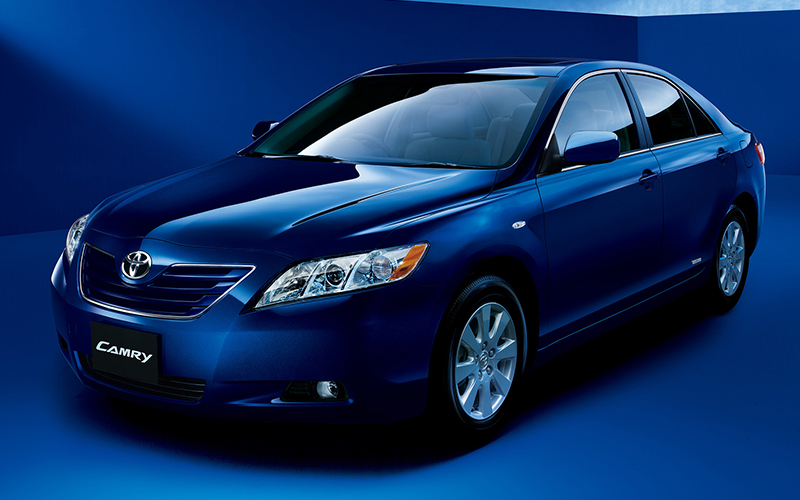
- The sixth generation of Camry grew in size yet again.
- In 2007, the Camry hit another sales milestone by notching over 400,000 units sold in a single year.
- Replacing the 3.3L V6 was a new 3.5L V6 making an impressive (for the Camry at least) 286 horsepower. This made the Camry considerably faster, nearing a mere six seconds to 60 mph. Even the four-cylinder of this generation was getting up to highway speeds in roughly eight seconds.
- Also starting in the sixth generation, the Camry became available with a hybrid powertrain. The new hybrid system consisted of a 2.4L four-cylinder engine and an electric motor making a combined 187 horsepower and hitting 33 city mpg.
- 2009 saw the cancellation of the two-door Solara coupe and convertible.
Seventh Generation 2012-2017
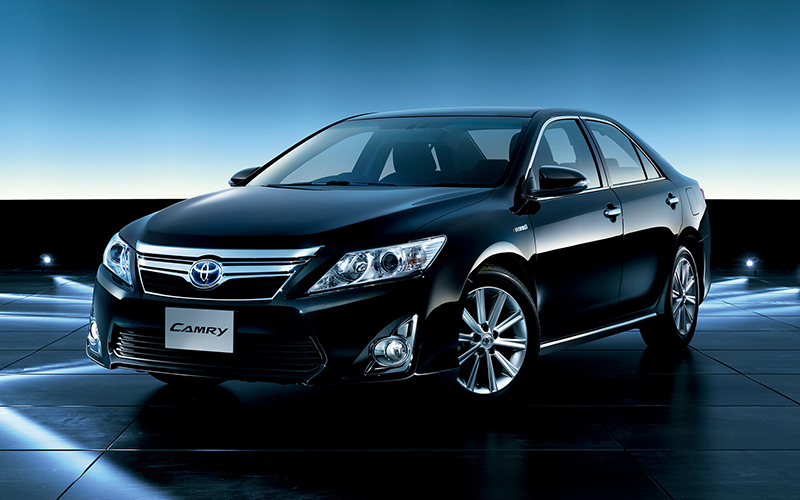
- The seventh-generation Camry received the sedan’s most thorough styling refresh to date. In a departure from its long running ho hum design language, the 2012 Camry gained an aggressively sporty front end that included a front spoiler, upturned grille, and mischievously arched headlights.
- The manual transmission was finally dropped from the Camry.
- A revamped 3.5L V6 produced slightly fewer ponies at 268 horsepower, but improved the Camry’s acceleration to just under six seconds from zero to 60 mph.
- The hybrid also received retooling and now pushed to 200 horsepower and a respectable seven second zero to 60 time.
- The already comfort oriented Camry also improved its ride quality and interior.
- A mid-cycle refresh in 2015 brought a larger, lower grille along with additional chrome accenting and restyled headlights and fog lamps.
Eighth Generation 2018 – 2024
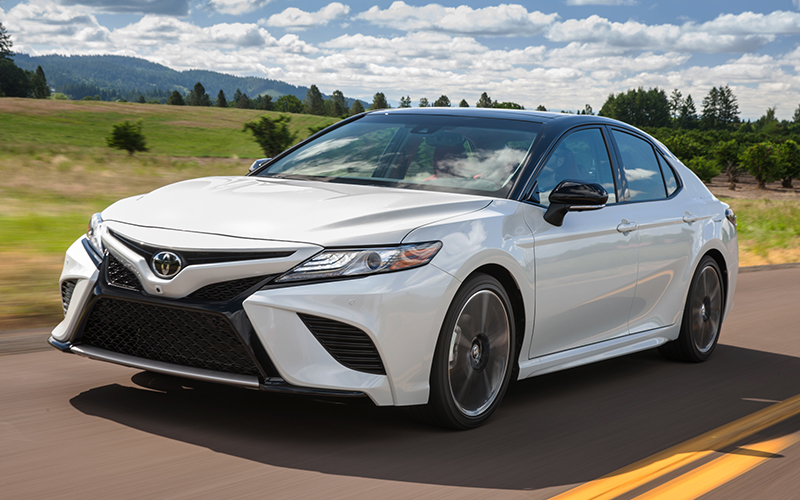
- The Camry doubled down on the new styling hinted at with the 2015 refresh. For the eighth generation the Camry got a modern, chic design that included a radical new grille and sharp body lines.
- The eighth-generation Camry migrated to Toyota new modular TNGA platform, shared with the likes of the Corolla, Avalon, Prius, RAV4, the Highlander, and, bringing things full circle, the Lexus ES.
- The Camry also got new powertrains in the form of a more powerful 2.5L I-4, now speeding up to 60 mph in 7.6 seconds. The Camry also topped 300 horsepower for the first time with the new 3.5L V6 making 301 horsepower.
- For the 2020 model year, Toyota re-introduces all-wheel drive as an option for the Camry, available only in conjunction with the 2.5L and eight-speed automatic (i.e., not available on the hybrid).
- For 2020, the TRD (Toyota Racing Development) trim was added. Aside from an updated suspension, this was largely a cosmetic upgrade (including a rear spoiler and blacked out wheels) as the TRD shared the same V6 powertrain as the XSE and XLE trims. Still, the 5.8 second zero to 60 was impressive.
- For 2021, the Camry received a mid-generation refresh with even more aggressive styling and additions to its already generous suite of safety features.
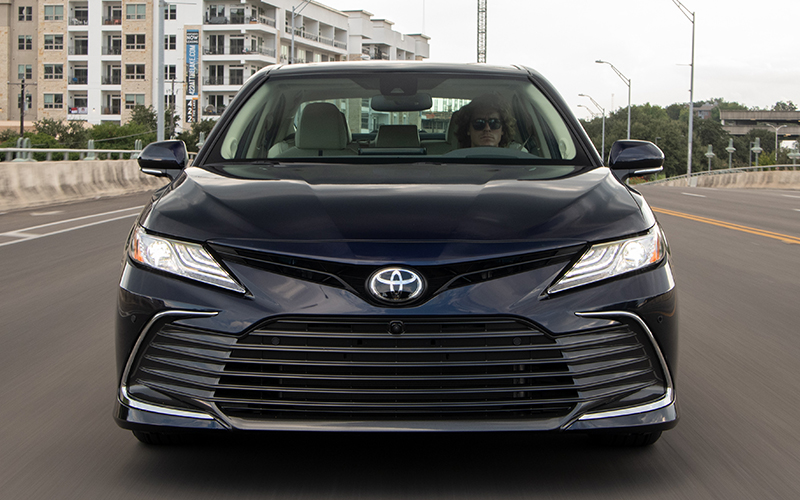
2021 Toyota Camry – toyota.com | Shop new Toyota Camry on Carsforsale.com
Ninth Generation 2025 – Present
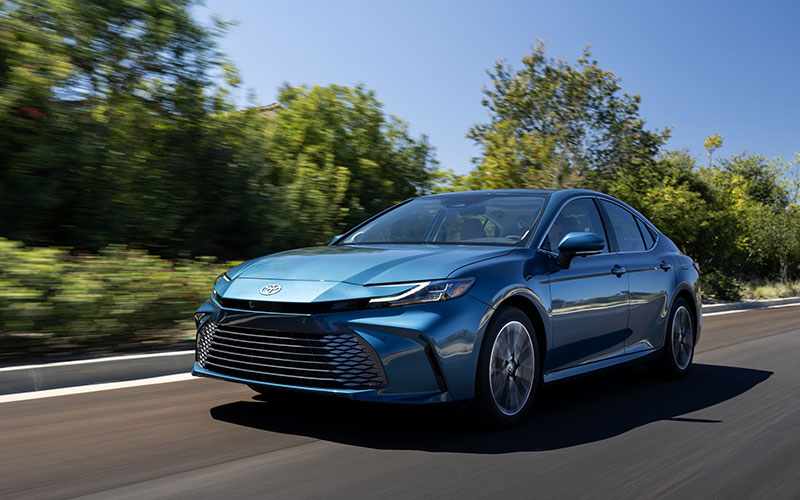
2025 Toyota Camry – pressroom.toyota.com | Shop new Toyota Camry on Carsforsale.com
- The ninth-generation Toyota Camry receives another visual overhaul. This time the design is less aggressive. The more buttoned-down look adds a premium air to arguably the most sophisticated Camry yet.
- For the first time in its history, the 2025 Camry goes hybrid only. Marking the first time Toyota did not offer a V6 option for the Camry since its first generation.
- Toyota offers two versions of its new hybrid powertrain. The base set up consists of a 2.5L four-cylinder working in tandem with two electric motors for 225 horsepower. A more powerful version adds a third electric motor for a total of 232 horsepower.
- Thanks to the default hybrid, all-wheel drive and hybrid power are no longer mutually exclusive (as they were on the eighth-generation Camry).
- The Camry gets near-Prius levels of fuel economy with the front-wheel drive version offering 53 city / 50 highway mpg while the all-wheel drive version dips slightly to 51 city / 49 highway mpg.
- The Camry comes with Toyota’s latest suite of advanced safety systems, Toyota Safety Sense 3.0 which includes features like adaptive cruiser control, blind spot monitoring, lane keep assist, and more.
- Among its many interior accoutrements the Camry offers acoustic-laminated glass, a heated steering wheel, and leather upholstery.
- For more on the current Toyota Camry, click here.