Latest News
Hands on With Hyundai’s Flagship Electric SUVHands on With Hyundai’s Flagship Electric SUV
The 2026 Hyundai Ioniq 9 Calligraphy offers 3-rows of luxury, impressive battery capacity, and lots of great cabin features. How does this premium EV stack up? We go hands on to find out.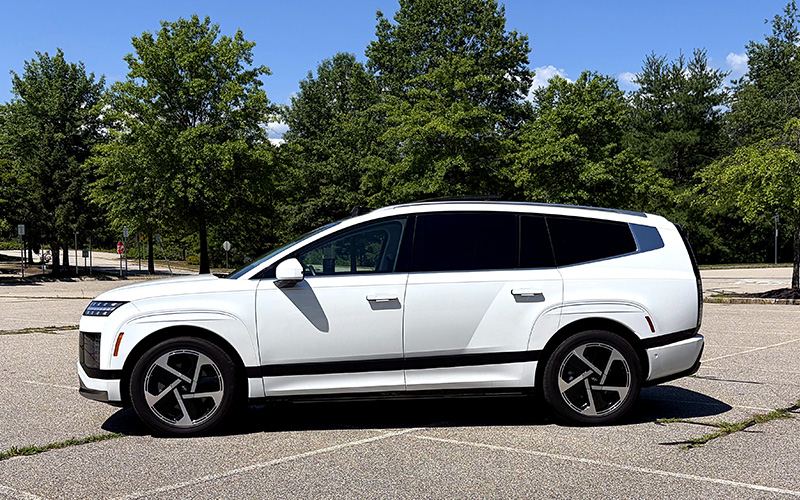
Hyundai’s All-Electric SUV
The options for battery-powered 3-row SUVs from mainstream automakers is pretty thin at the moment, making the Hyundai Ioniq 9 seemingly ripe for success. It has the looks to stand out, with Hyundai pitching it as something of a spaceship and backing that up with striking lines. Across the 6-model lineup, the Ioniq 9 is rated for 300+ miles of range, which ought to help those with anxiety around this metric.
But at $60,555 to start and a top-end price tag that creeps on 80 large, some may question just how mainstream this luxury-leaning EV SUV really is. What I can tell you is that should those figures be within your budget and a 3-row EV SUV be a priority, the 2026 Hyundai Ioniq 9 needs to be on your shopping list. After a week spent driving the Calligraphy trim line, I came away largely impressed.
A Futuristic Exterior
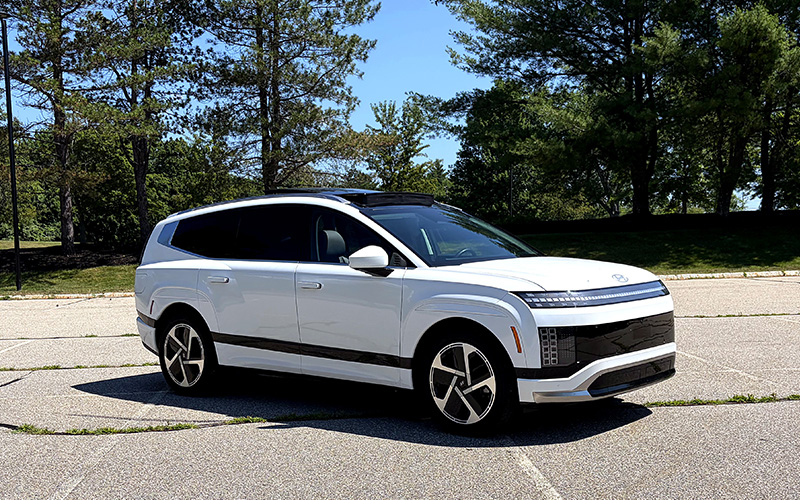
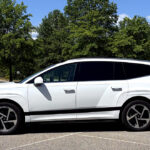
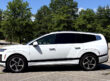
Forget what you think of as a typical two-box SUV design. The Ioniq 9 is utterly different. Hyundai calls it “aerosthetic” with a boat-tail rear end. Between the pixelated lighting elements, sloping roofline, and flush door handles, the Ioniq 9 is unlike most anything else on the road. Per the TV ads, the automaker suggests its latest EV belongs in outer space and most folks I talked to agree – this larger cousin of the 2026 Ioniq 5 has serious spacey vibes. Those looks help with the slippery 0.27 coefficient of drag, as do active front air flaps and a 3D contoured underbody cover.
For reference, the anodynely styled Tesla Model X has a Cd of 0.24. I’ll take the Ioniq’s galactical lines every time. Neat features include the letter H (for Hyundai) being broadcast in Morse code via the front light bar on startup and a power-operated charging port door. Hidden touches include noise-reducing tires lined with foam, triple door seals, and acoustic laminated glass running from the windshield to all four side windows. It works, the Ioniq 9 has tomb-like levels of cabin quietness.
A Luxury Interior Made for Family
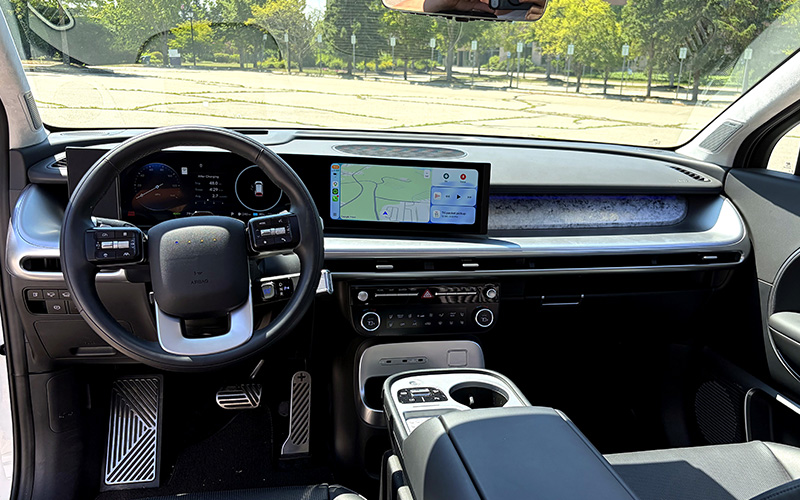
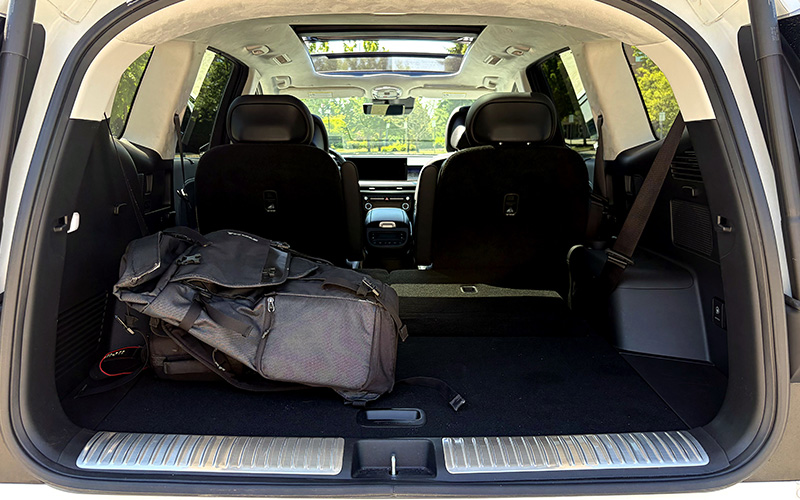
The first thing that jumps out at you when inside the 2026 Ioniq 9 is how airy it feels. Chalk that up to the flat floor, front to back, and large windows. Visibility outwards is excellent in all three rows as is legroom. It measures 43” in the second row and 31” in the third. Getting back there is a breeze in the Calligraphy model thanks to captain’s chairs enabling a walk-through space. But even with lower trimlines featuring a bench seat, Hyundai makes access from the outside as easy as pressing a button.
Upholstery ranges from cloth on base Ioniq 9s to H-Tex faux leather on the range toppers as part of Hyundai’s stated push toward sustainable manufacturing practices with this EV.
On odd callout is the silver dashboard trim that is likely supposed to look futuristic, but ends up looking like a splotchy spray paint job instead.
Things that are quite nice range from standard heated front seats to available climate-controlled seats for the first and second row, a panoramic moonroof, and a sliding front console.
Technology Is Big Highlight
The 2026 Hyundai 9 is a bonanza of the latest automotive technology. Most of this is fabulous, but there is one area it comes up lacking. That being the rear automated braking system. It’s sensitive and makes backing out of a parking space into a road with oncoming traffic an exercise in patience. You can, fortunately, turn it off. Now for all the good stuff. The curved panoramic digital gauge cluster and infotainment interface has a matte finish, eschewing the usual high-gloss effect and glare in the process.
Bluelink+ is complimentary and features remote-controlled functionality for systems like the HVAC and the surround-view monitor, plus an SOS emergency function. Seven 100W USB-C ports dot the cabin and the bi-directional charging cable is the leading edge of Hyundai’s plan for V2X integration with the Ioniq 9 that would allow for capabilities like powering your home in a blackout. Limited models and above bring a 14-speaker Bose audio system and biometric identification pad, but the head-up display and remote smart parking assist system is reserved for the Calligraphy.
A Big SUV Made for the EV Era
The Ioniq 9 rides on Hyundai’s E-GMP platform with an 800V electrical architecture. This means it can be charged from 10-80% in as little as 24 minutes using a 350kW DC ultra-fast charging station. With a 250kW Tesla V3 Supercharger, that time increases to 40 minutes. All Ioniq 9s come with the same 110-kWh battery pack, but only the base S variant has a single electric motor good for 215 horsepower and 335 miles of range. With dual-motor-enabled AWD, you can select an Ioniq 9 SE or SEL that bumps power to 303, but drops range to 320.
Or you can go full-tilt with the Limited and Calligraphy trim lines that make 422 hp and 516 lb-ft of torque. This setup pushes range down to 311 miles, but if you’re in search of the crazy EV thrust everyone talks about, this is the Ioniq 9 for you. Going from 0-60 with a 6,000-pound vehicle in seconds is as wild as it sounds. Speed aside, the self-leveling dampers work wonders on keeping this massive EV feeling composed, even with 21” wheels.
That said, there was a subtle sideways hop-like sensation from the rear end after impacts with harsh road imperfections, like recessed storm drains. And you have to press unlock on the key fob twice to release the charging cable, which feels overly complex. But it’s a small price to pay for such a comfortable ride and well-tuned 1-pedal driving system that can be adjusted on the fly.
Final Thoughts
At $76,590, the 2026 Hyundai Ioniq 9 Calligraphy is not cheap. Fortunately, you can get into a base model for some $16,000 less. That’s actually on the low side when your 3-row electric SUV competition includes nameplates like Lucid, Volvo, and Cadillac. Should you go the base model route, you would of course miss out on high-end frills like perforated soft-touch door panels and a suede headliner.
But the best driving range of the bunch is only available in Ioniq 9 S guise, and you’re still getting the same cavernous cabin as a Calligraphy. For those looking to get into a genuinely family-friendly EV and ditch the gasoline habit, there are plenty of reasons to take a hard look at Hyundai’s latest foray into the EV space.
Related Articles