
Latest News
Cars in Taylor Swift Music Videos
The early Toyota Land Cruisers were among the most rugged vehicles of their time. That legendary toughness has made them automotive icons today.
Toughest of the Tough
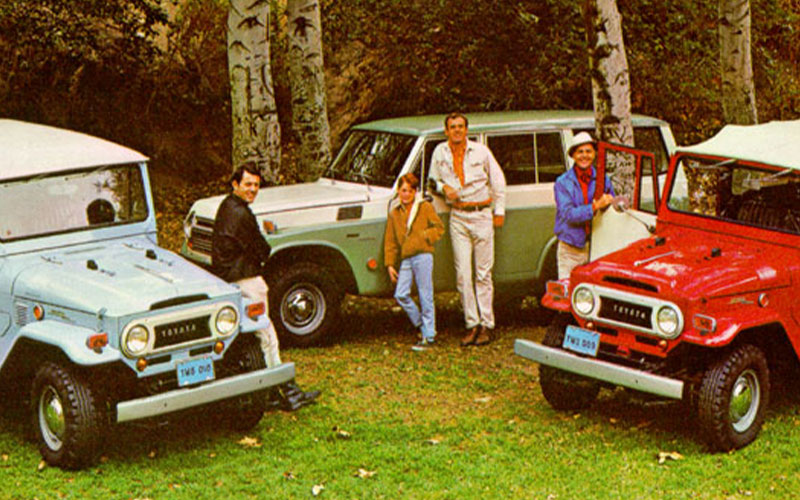
1968 Land Cruiser –. pressroom.toyota.com | Shop Toyota Land Cruiser on Carsforsale.com
The Toyota Land Cruiser is the company’s longest running nameplate and arguably its most renowned worldwide. When you need a vehicle to tackle the roughest terrain, from Saharan sand dunes to Amazonian jungle, when you need a vehicle to last you a literal lifetime of rough and tumble abuse and keep ticking, you need yourself a Toyota Land Cruiser.
Originally born of the jeep designs of WWII, the Land Cruiser has gone on to become the definition of rugged, durable, and reliable the world over, all while gaining in levels of comfort and daily livability as the years have gone on. So much so, that today, the Land Cruiser is almost as posh as its Lexus analogue, the LX.
In consideration of this long and steady evolution, we wanted to look back at the early days of the Land Cruiser, when Toyota was a new brand on the world stage, making their name off a tough little 4×4.
Early Days
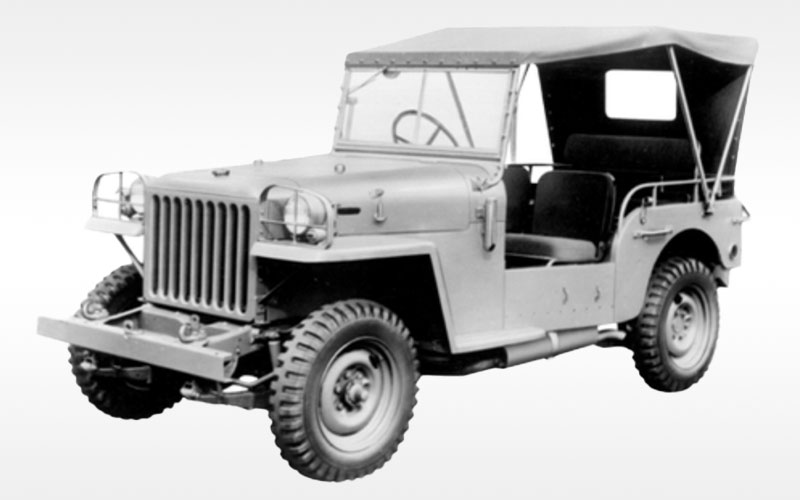
The Land Cruiser’s story begins in 1950 with the Korean War. The US military solicited contracts for Japanese manufacturers to build a jeep-like vehicle to supplement the Willys Jeep being used by the US Army in Korea. Though Toyota’s prototype was not chosen for the contract, a test drive up to the sixth stage of Mt. Fuji (the furthest any truck had climbed to that point) proved Toyota’s jeep was certainly a capable machine. And so, in 1951 when the newly formed Japanese National Police Agency (NPA) sought a tough and reliable vehicle as their official patrol car, Toyota’s new BJ was a natural fit.
The BJ was a parts bin vehicle borrowing its suspension from the Toyopet, its chassis from the Type SB pickup, and its engine from the Type B four-ton truck. That engine was large and more powerful than what the Willys Jeep of the day carried. The 3.4L straight-six made 84 horsepower and 159 lb.-ft. of torque. However, unlike the Jeep, the BJ lacked a transfer case.
The BJ’s name combined the B Type engine and jeep. In 1954, Willys-Overland successfully copyrighted the name Jeep, and Toyota was forced to find a new official title for their 4×4. The Land Cruiser name was chosen partly as a reference to another jeep-like competitor, the Land Rover, while the “cruiser” portion touted the vehicle’s ability to cruise over rough ground.
FJ20 – The First “Land Cruiser”
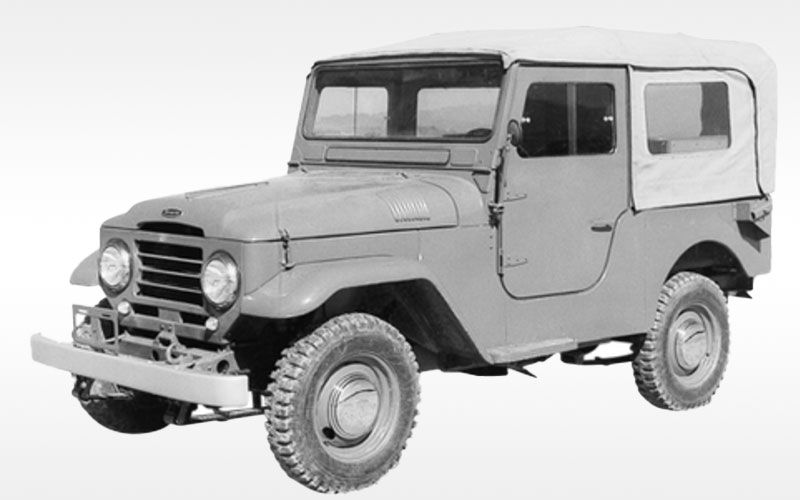
Starting in 1955, the Land Cruiser was given extensive revisions and updates. Changes were made to the body, including a new grille, the interior was made more comfortable (relatively), and new leaf springs improved ride quality.
As with the BJ, the new FJ’s naming would reflect the engine, in this case a new F-Type 3.9L straight-six making 133 horsepower and paired with a three-speed manual transmission. The cast iron F-Type has gone down in automotive history as one of the most rock-solid, durable engines ever made. Toyota produced it for over forty years, finally discontinuing production in 1992. It was the F-Type engine that justified the early Land Cruiser’s tag line: “We’ll know how long it lasts when the first one wears out.”
Starting in 1957, Toyota began exporting the Land Cruiser to overseas markets including Australia and the US. In fact, the Land Cruiser made up 38 percent of all vehicles exported from Japan that year. Also in 1957, a four-door wagon body style joined the two-door hard and soft tops and the pickup. Additional special variants of the Land Cruiser included vans and fire trucks.
1958 was the first full year for Toyota in the US market, where it sold a total of 288 Toyopets and one Land Cruiser. Production also began that year in Brazil, where the Land Cruiser was known as the Bandeirante.
FJ40 and FJ55
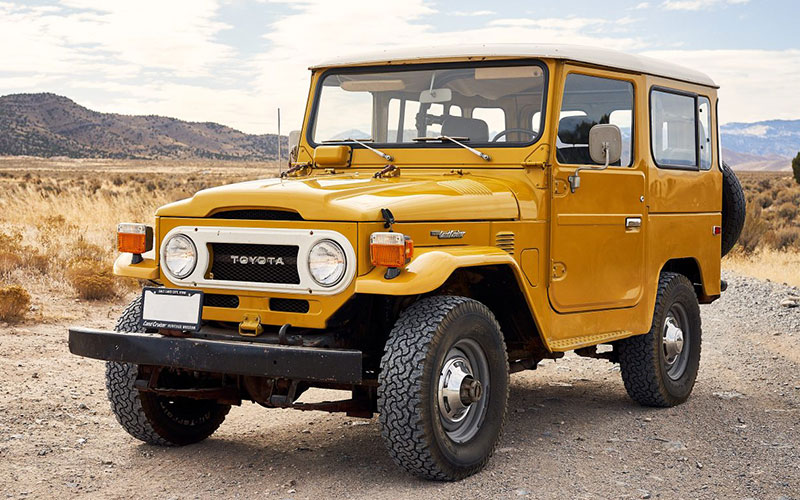
As tough and durable as the FJ20 was, the Land Cruiser saw major revisions with the debut of the FJ40 model in 1960. A new grille gave the FJ40 its now iconic front end directly echoed by the FJ Cruiser. The changes were not just cosmetic, however. The Land Cruiser was still a purpose-built off-road warrior and as rugged as ever with a two-speed transfer case added for greater off-road capability. By 1965, the Land Cruiser was the best-selling Toyota vehicle in the US.
Short (90”), medium (95.7”), and long (104.5”) wheelbase versions were offered. Body styles continued to include two-door hardtop and pickups (the latter offered in the US from 1963 through ’67) as well as a four-door SUV/station wagon, the FJ45V. The latter was replaced by a new design, the FJ55 station wagon in 1967.
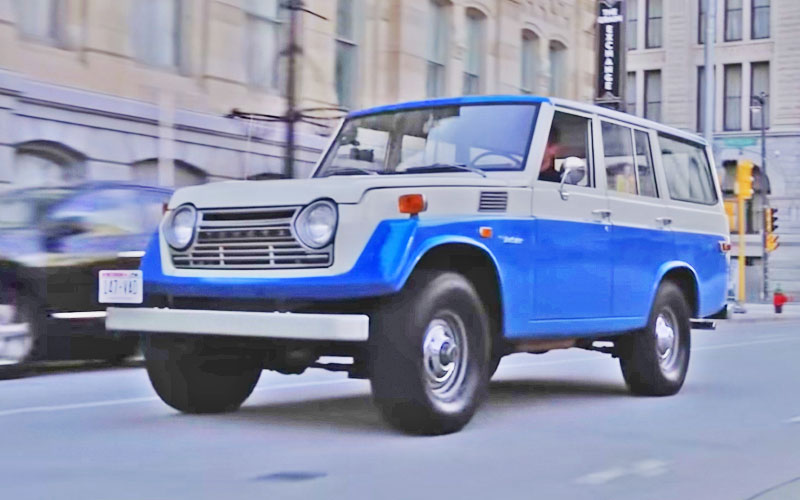
The FJ55 wagon was built to compete with the likes of the Chevy Suburban and Jeep Wagoneer and served as a precursor to the four-door SUV the Land Cruiser would eventually evolve into. The FJ55 is most famous for its new look, a two-tone paint scheme and scrunched grille, saw it affectionately dubbed the “Iron Pig.”
New diesel engines debuted outside the US market, starting with the Type H 3.6L straight-six diesel in 1973 and followed by the B Type 3.0L inline-four diesel in 1974. It is from these engines you will see Land Cruisers with HJ and BJ naming. The Land Cruiser writ large was given a new petrol engine starting in 1975, a larger 4.2L straight-six (the 2F engine) that made 135 horsepower and came paired with a new four-speed manual transmission.
Other additions included a barn door style rear hatch in the US market in ‘75, as well as front disc brakes debuting in ’76, and, for F models, power steering and optional AC in 1979. The FJ55 was discontinued after 1980, but the FJ40 remained in production through 1983 before being succeeded by the new J70 Series. The Bandeirante, however, continued in production in Brazil all the way to 2001.
Classic Toughness
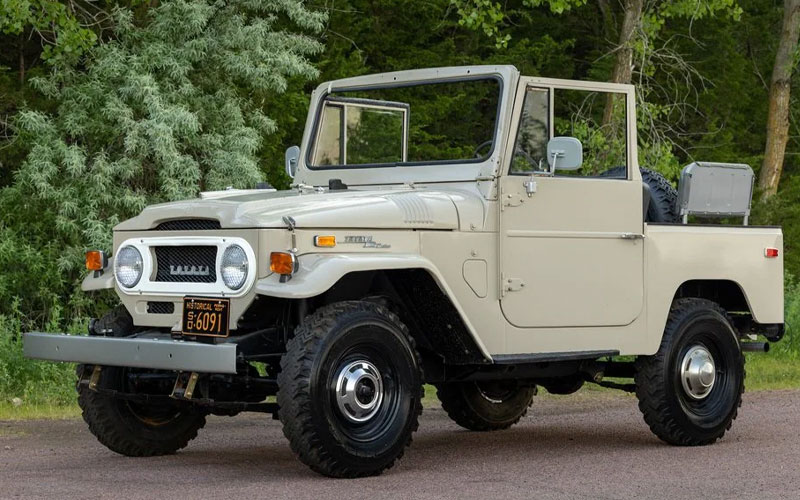
1970 Toyota Land Cruiser – carsforsale.com | Shop Toyota Land Cruiser on Carsforsale.com
As cool as old Jeeps, Broncos, and Scouts are, the old school FJ Land Cruisers remain at the pinnacle of the classic off-roader mountain top. The venerated, nigh unkillable F-Type straight-six deserves a good deal of the credit, as well, another example of Toyota’s penchant for “over-engineering” that just might suggest the rest of the automotive industry has been under-engineering all along. The early FJ Land Cruisers were built with a mixture of simplicity and exactitude to produce otherworldly toughness and unmatched longevity.