Latest News
Famous Cars: Patton’s Willys Jeep1968 Ferrari Dino 206 GT
Though not officially a Ferrari, the Dino 206 GT reimagined what a Ferrari-built car could be and became an icon in the process.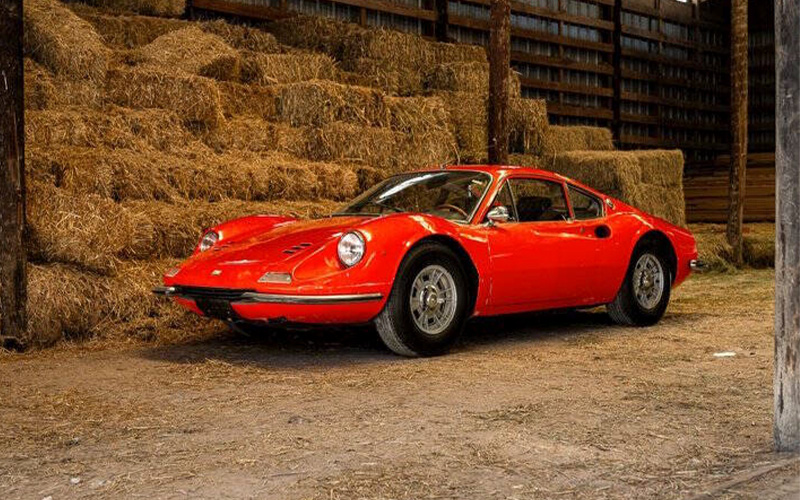
A Ferrari by Any Other Name…
The sales brochure called the Dino 206 GT “Tiny, brilliant, safe … almost a Ferrari.” Indeed, the Dino was at once a Ferrari in all but name while also being something radically different. The Dino broke new ground for Maranello thrice over as Ferrari’s first road-going midengined car, their first V6 road car, and their first to feature rack and pinion steering. With a well-heeled racing engine for a thundering heart and a sensuously curved body styled by Pininfarina, the Dino became Ferrari’s best-selling model to date through the early 1970s despite never carrying the iconic prancing horse badge.
The occasion to discuss the Dino comes curtesy of an especially rare example currently listed on Carsforsale.com: a 1968 Dino 206 GT, one of just 153 built in the Dino’s initial production run. This largely unrestored car sports a distinctive Russo Dino (orangish red) paint job with a black and orange interior along with the original, numbers-matching engine and gearbox and 206 signature Cromodora knock off wheels. After nearly six decades, this Dino 206 GT remains as gorgeous and compelling as it was the day it rolled out of Ferrari’s workshop.
Why Dino and Not Ferrari
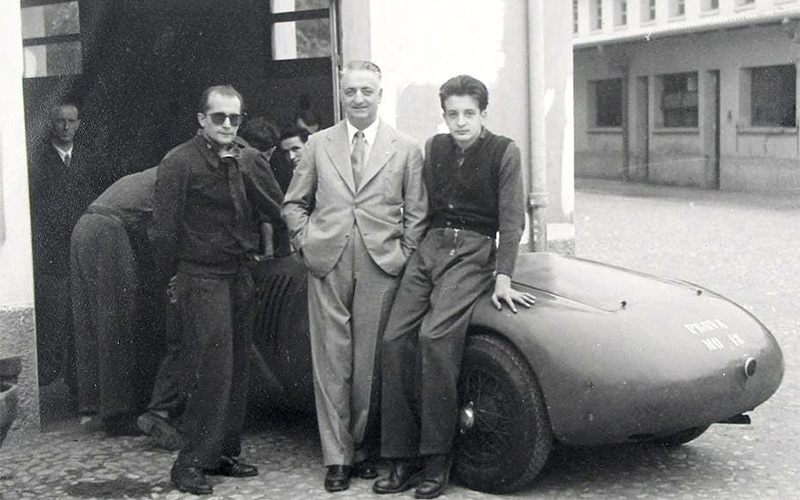
Both the car’s name and its V6 engine trace back over a decade prior to the debut of the Dino itself. The name derives from Alfredo “Dino” Ferrari, Enzo Ferrari’s first-born son. As a young man, Enzo had been a mechanic and racecar driver back when the latter meant racing at top speed in an open cockpit with little more than goggles for protective equipment. But when Enzo’s wife became pregnant, Enzo foreswore the perilous pursuit of racing lest he orphan his child. Enzo was sensitive to this prospect, having lost both his father and older brother to the Spanish flu. Both, incidentally, were named Alfredo.
As a young man, Alfredo worked for his father at the family business as an engineer. Under Vittorio Jano, Dino helped develop Ferrari’s first V6 racing engine. When Dino died from complications relating to muscular dystrophy in 1956 at the age of 24, Enzo denoted the V6 and subsequent derivations (including V8s and V12s) as Dinos. Enzo Ferrari is often remembered as a prickly and competitive man. He was also a man beset by great personal tragedy who, following his son’s death, for those decades thereafter wore dark sunglasses and a black tie to signify his mourning and visited his son’s grave daily.
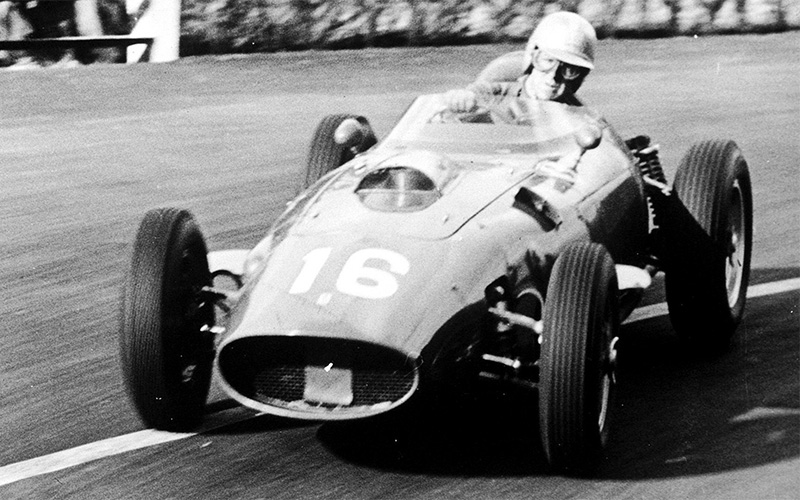
The Dino V6 engine made its racing debut in the Dino 156 F2 in 1957’s Formula Two racing series. The Dino V6 would prove potent, making waves in Formula One, Formula Two, and Grand Prix. But when Formula Two homologation rules were changed in 1967 to require 500 production cars Ferrari’s ability to continue racing was imperiled. Since Ferrari was at the time producing roughly 750 cars total in a year, it was clear they’d need a partner to help build the road cars. Enter Fiat, with whom Ferrari had a long working relationship. Fiat would build the V6s for the Formula 2 homologation and get an engine for a new road car themselves, the Fiat Dino.
Back in 1965, Sergio Pininfarina, whose design house was responsible for the majority of Ferrari bodies, had been nudging Enzo to build a road-going mid-engine car. An initial concept, the Ferrari Dino Berlinetta Speciale, debuted at the 1965 Paris Motor Show and was followed up with the Dino 206 S for the Turin Motor Show a year later. Mid-engine designs had become de rigueur in competitive racing and the next logical step was to bring the superior layout to the road (indeed, the Lamborghini Miura was doing just that in 1967). Enzo was reluctant to make the switch in his road cars, believing the average driver wasn’t capable of handling the sometimes tricky dynamics of a midship design. The Formula Two rule change, however, forced him to reconsider.
Dino 206 GT
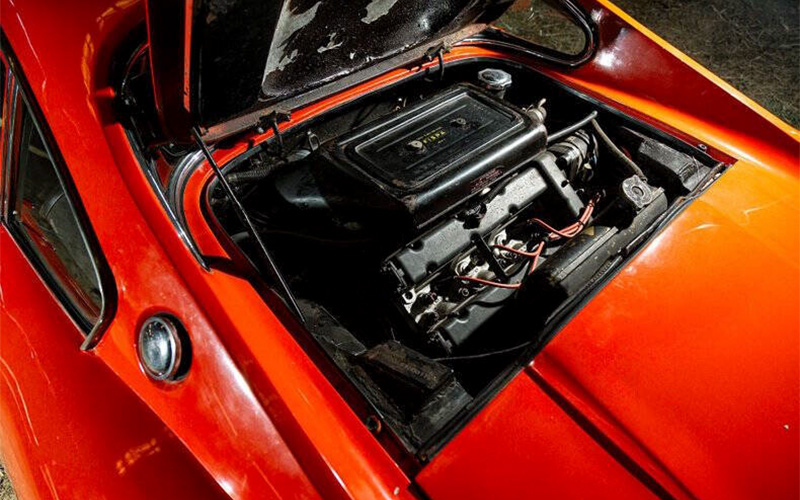
The Dino 206 GT debuted in 1967 as one of the most remarkable works from Ferrari before or since. The car was built with a weight-saving aluminum alloy body. The transversely-mounted 1,986-cc V6 was likewise aluminum, produced 178 horsepower and 138 lb.-ft. of torque, and revved to 8,000 rpm. The 206 GT came equipped with disc brakes and double wishbone suspension at all four wheels. The Cromodora knock off wheels and aluminum alloy filler cap accented what is among the most beguiling designs of the 20th century with the Dino’s low stance and swooping front fenders making the car look at once lithe and powerful. The Dino 206 GT weighed in at a svelte 1,984 lbs. dry. The Dino badge’s script was taken from Alfredo’s signature. Just 153 Dino 206 GTs were built before Ferrari decided the car needed more grunt, necessitating a jump in displacement.
Dino 246 GT & GTS
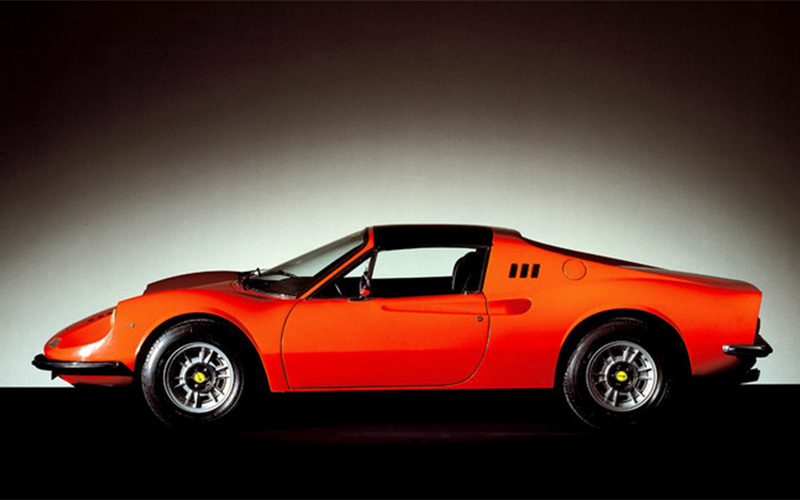
The follow-up Dino 246 GT arrived for the 1969 model year with a larger 2.4L V6. The new engine was cast in iron rather than the more expensive (and lighter) aluminum. It also produced 14 more horsepower for 192 in total along with 166 lb.-ft. of torque. The 2.4L V6 would go to more great things as it saw duty in the Fiat Dino 2400 and the Lancia Stratos. Materials for the body changed as well with a switch to steel construction. Two inches were also added to the wheelbase to improve handling. In all, the changes added some 400 lbs. to the car. A targa topped version, the 246 GTS, was introduced in 1971 (for the 1972 model year).
Numbers vary depending on the source, but right around 3,914 Dino 206s and 246s were produced between 1967 and 1974, the majority being 246 GTs.
Contrary to popular lore and the suggestion of the company’s own marketing, the Dino is not not a Ferrari. Given the sentimentality of its naming, its now classic design, and its best-selling ways, it could be argued the revolutionary Dino was more than, not less than.
This 1968 Dino 206 GT
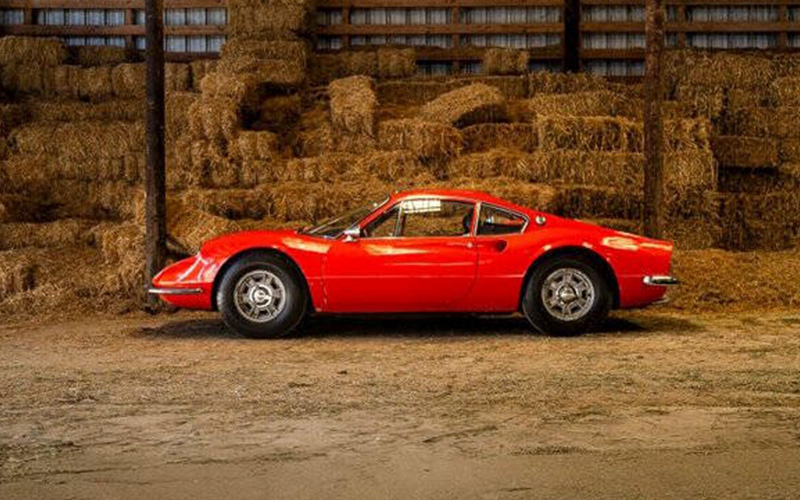
As noted above, very few Dino 206 GTs were built, just 153 (some sources cite 152) with even fewer still extant. This car, chassis number 00178, was completed in October of 1968 and has remained largely unrestored since. The car is finished in Russo Dino, a reddish orange with a black and orange interior. Flourishes include the wooden steering wheel and shift knob, the original Cromodora knock off wheels, and exposed alloy gas cap. This car was imported to the US in 1973 by Dr. A.E. Carlloti Jr. who kept it until 2014. It has since been owned by other devoted collectors. Currently, the car has been sitting in storage for a few years and, according to the seller, “will require a recommission of consumable items, along with a tune up for any road use.”
Even with that proviso, general condition is good, and this 1968 Dino 206 GT unquestionably deserves the consideration of serious Ferrari collectors at $585,000.