Latest News
2026 Chevrolet Suburban ReviewA History of the Original Willys Jeep
From the battlefields to the cornfields; the Willys-Overland Jeep managed to win WWII and then conquer America, influencing all 4x4s that followed.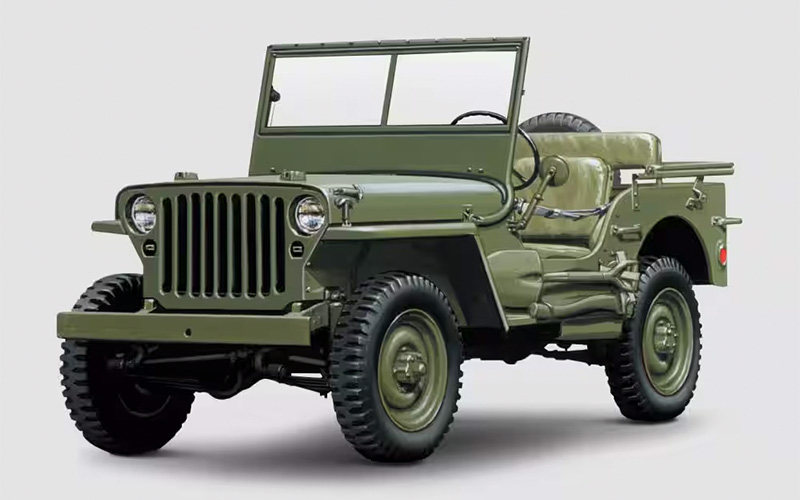
Destiny Calls the Jeep
Necessity is the mother of invention, so the saying goes. Most cars, including the most beloved, are born of commercial interests; a carmaker builds what consumers want (and advertising helps them realize what it is they want). But the jeep’s origin is far different, and consequently its history and influence have been far different as well. In the early 1940s, on the precipice of entering the war in Europe, the US Army needed a capable, tough-as-nails, transport vehicle if it was to prevail. That vehicle eventually became the MB Jeep built by Willys-Overland.
It would be enough for the jeep to enter the pantheon of historical vehicles if its only legacy were as a critical component in the fight against fascism, but the jeep’s influence on global automotive design and its transition from wartime to peacetime both greatly expanded its significance and made it one of the most consequential vehicles of the 20th century.
From Bantam Jeep to Willys Jeep
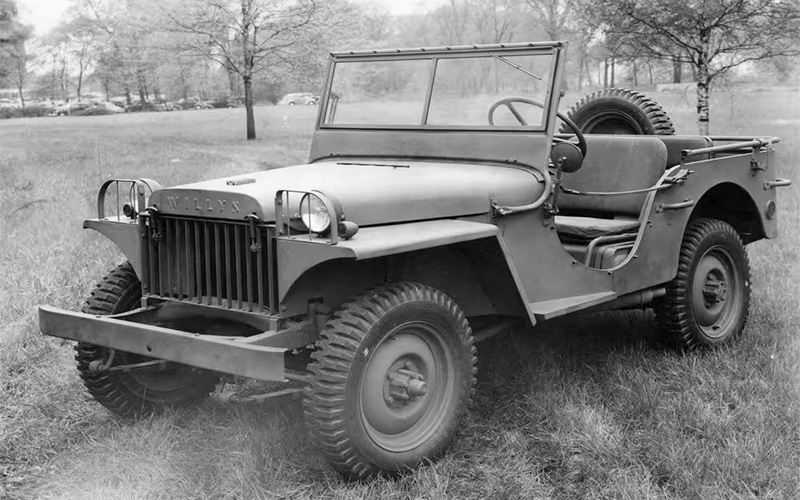
Before the jeep, advanced militaries like those of the US, Britain, Japan, and Germany, were mostly using motorcycles and horses for basic field mobility. For example, Germany used roughly 2.75 million horses through the course of WWII for transportation and logistics. Motorcycles traded carrying capacity for speed while horses required additional resources i.e., feed and water, and lacked the speed, durability, and power of mechanized transport. Trucks were heavy and bogged down in mud and snow.
So as the US was gearing up to join the fight against the Axis powers, the US Army approached 135 US companies in the summer of 1940 requesting designs and bids to build a new transport vehicle. Specs for the new vehicle were exacting and included 4WD, a 660 lbs. payload, and, most difficult of all, a maximum weight of 1,300 lbs.
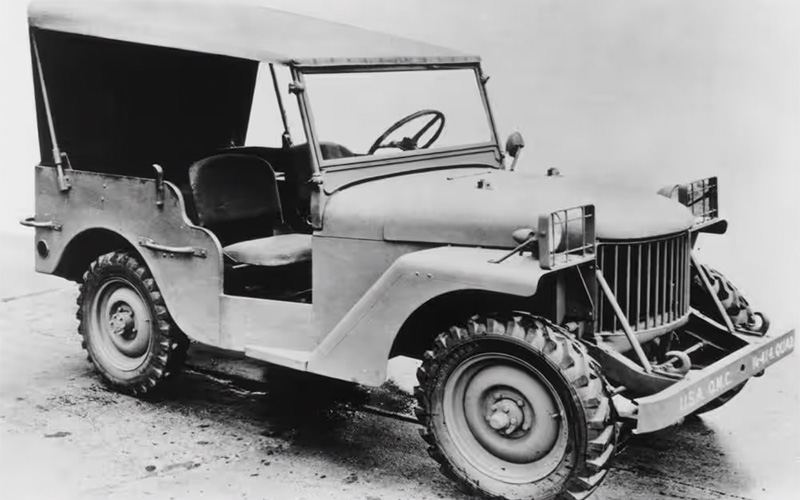
Of those 135, just two companies submitted specs and bids in time: American Bantam and Willys-Overland. Bantam was just able to get their submission in within an hour of the Army’s deadline, yet it was their design that the Army endorsed. The next problem, the Army wanted a working prototype within 49 days.
Astonishingly, Bantam managed to get a prototype completed in time, the BRC-60. Because Bantam would be unable to meet the production numbers necessary (75 units per day), both Willys and Ford submitted their own prototypes as well, the “Quad” and the “Pygmy,” respectively. Willys powerful 134 cu.-in. “Go Devil” four-cylinder was capable of nearly 60 horsepower, making it the most powerful of the three prototypes and helping win them the contract to build the Army’s jeep. Even with their greater capacity, Willys, like Bantam, would not be able to meet the production numbers needed on their own. Ford stepped in to fill the gap.
The Willys War Machine
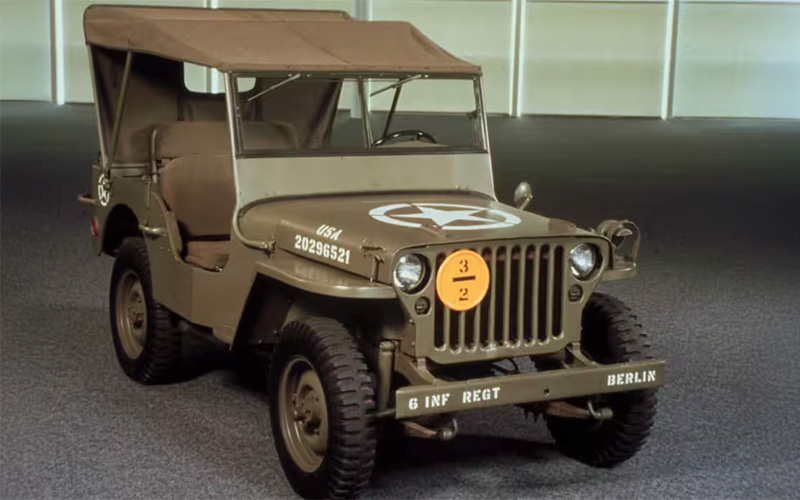
Production commenced in 1941 on the Willys MB (military, second issue) jeep. The Willys “Go Devil” 134 cu.-in. four-cylinder made 60 horsepower (54 at the wheels) and 105 lb.-ft. of torque sending power to all four wheels via a three-speed manual transmission. The tough-as-nails suspension consisted of live axles front and rear with leaf springs. A final wet/curb weight came in at 2,453 lbs., a long way from the initial plan for under 1,500 lbs., but still a light vehicle.
The jeep’s durability was matched only by its versatility. Jeeps performed in innumerable roles as reconnaissance vehicles, field ambulances, troop and personnel transports, and more. Jeeps could be fitted with .50 caliber machine guns or railway wheels. They were truly all-terrain, making short work of even the roughest of conditions from mud, snow, water, heat, and sand; they could even be modified into semi-amphibious vehicles.
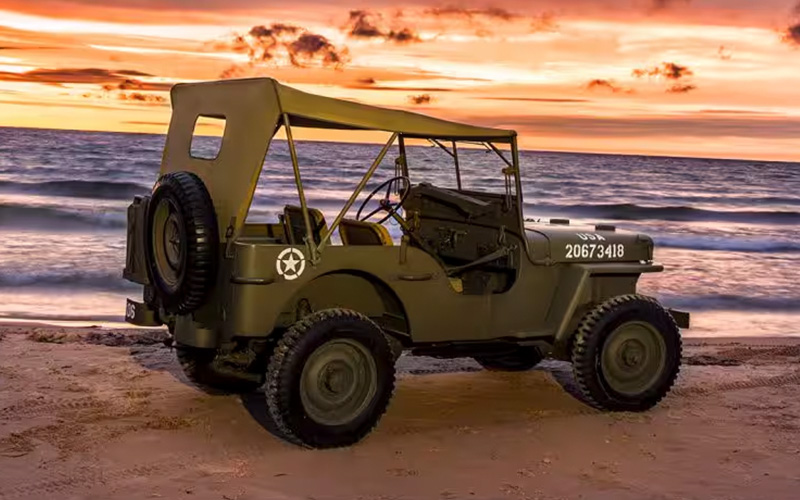
The origins of the jeep name are murky at best. One theory posits “General Purpose” or GP as the source. Another common story is that jeep is a reference to the Eugene the Jeep character from Popeye. Still others point to much earlier usages of jeep as military slang dating to at least WWI.
In all, Willys and Ford built approximately 640,000 jeeps for the European and Pacific theaters of war, some 30 percent of those going to British and Soviet allies. The jeep was lauded as invaluable to the war effort by servicemen and general alike.
From MB to CJ
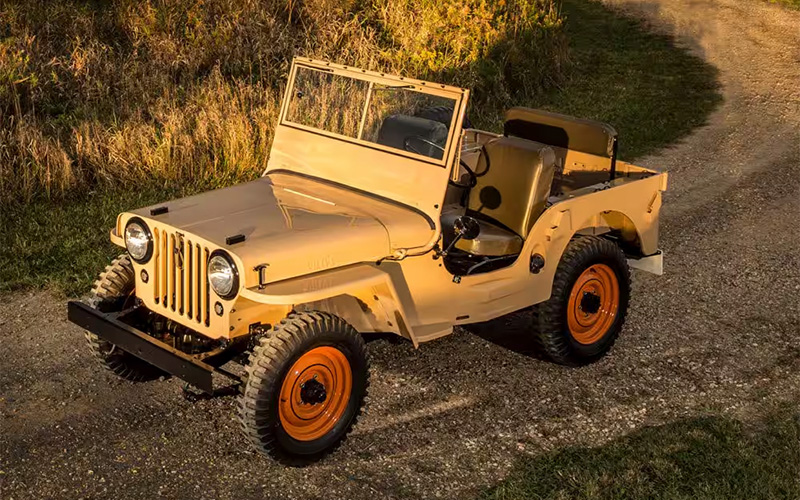
Following the war, Willys was well equipped to build jeeps and … not much else. While Ford and GM had the means to pivot back to building civilian vehicles, the costs of R&D, retooling, and marketing were daunting for the modestly sized Willys. It was much easier to modify the MB jeep into something for civilian use.
To that end Willys built a new, modified version of the jeep, the CJ (for civilian jeep), for commercial sale in the US. The new CJ was marketed to farmers, ranchers, or anyone else who could use a small yet exceptionally durable 4×4 vehicle. The CJ-2A began production in 1945 still powered by the same “Go Devil” four-cylinder as the MB. As in war, the civilian jeep was a jack-of-all-trades ready-built for whatever it was tasked with. A belt driven power-take-off (PTO) could be used for the numerous add-ons Willys offered including a snowplow, welder, mower, winch, and generator. The jeep was also given bright new colors for its domestic version, including blue, red, yellow, green, grey, and beige.
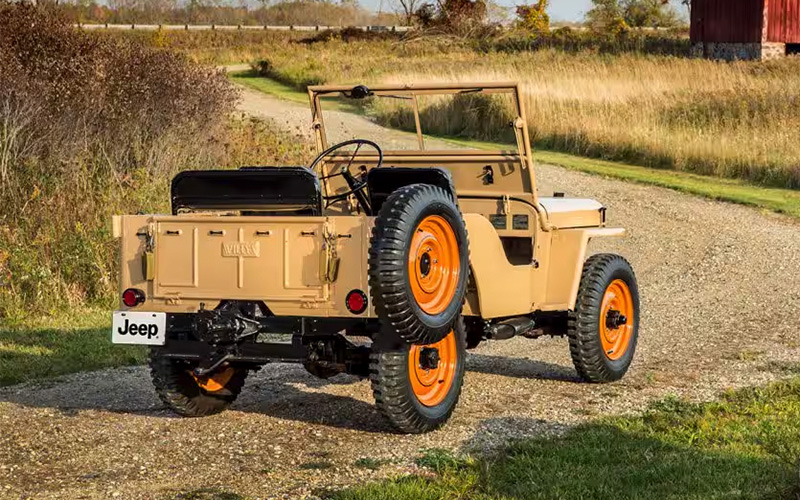
Incidentally, while the jeep name had been used in marketing the vehicle for years, the name was finally made official with a trademark by Willys in 1950, taking it from jeep to Jeep, proper. The Jeep remained with Willys-Overland through 1953 until a merger with Kaiser Motors formed Willys Motors Inc., the name changed again in 1963 to Kaiser Jeep Corp.
Jeep (both the vehicle and the brand) was eventually sold to AMC (American Motors Corporation) in 1970, who grew expanded the brand to new vehicles like the Wagoneer and Cherokee. AMC in turn sold Jeep to Chrysler in 1988 where it has remained since.
The Other “Jeeps”
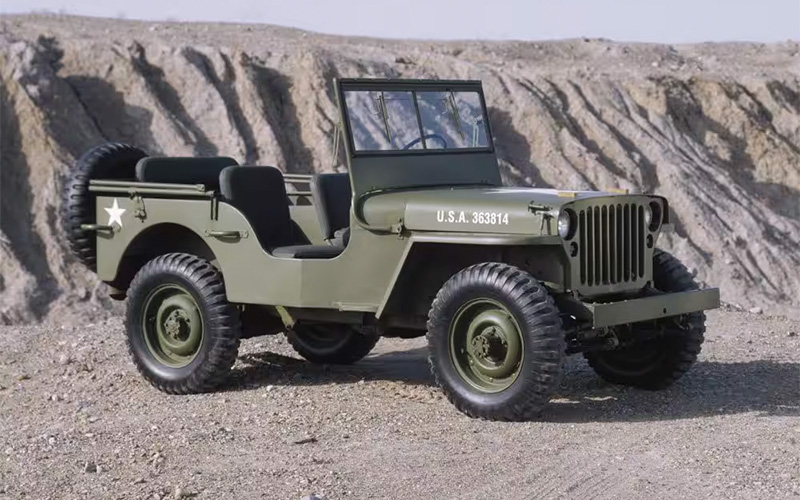
The original MB jeep didn’t just help win a war. Not only did it spawn the CJ, YJ, and Wrangler Jeeps it inevitably inspired imitators. In England, the Rover Company developed the Brits’ equivalent of the American jeep, launching the Land Rover in 1948. Over in Japan, Toyota had been asked by the Imperial government to develop a prototype jeep based on captured American examples. In 1950, the US Army came to them asking that they build jeeps for the Korean War effort. The subsequent BJ Land Cruiser, like the jeep and the Land Rover, has gone on to become one of the longest running and most storied of 4x4s.
Indeed, the MB jeep inspired latter day imitators like the Ford Bronco and International Harvester Scout, which in turn lead to the Chevy Blazer and the litany of 4x4s that have followed decades down the line. Even the most commuter-friendly crossovers and many a luxurious SUV are pitched as rugged, off-road-ready vehicles. We can thank the war-winning MB jeep for raising the bar, perhaps unrealistically, for all 4x4s that followed.