Latest News
2026 Ford Maverick ReviewThe ’69 Plymouth Roadrunner was Muscle for the Masses
Affordable and powerful, the Plymouth Roadrunner infused the muscle car segment with a mix of performance and playfulness.Democratizing the Performance Car
Whether you attribute it to John DeLorean and the Pontiac GTO or Lee Iacocca and the Ford Mustang, the key marketing insight of muscle cars was offering a 2+2 performance car that young people could afford to buy new (I know that sounds crazy today, but this was a real thing in the middle 1960s). Democratizing automotive performance was what created the muscle car craze, and while the GTO and Mustang had both done their part for GM and Ford, it was the Plymouth Roadrunner that made speed accessible for Chrysler fans.
The Roadrunner helped define MOPAR as the confluence of serious performance and serious fun. A popular Saturday morning cartoon branding tie-in and a stock 383 V8 made clear the Roadrunner’s free-wheeling sensibility and staked out a clear niche within the segment. The Roadrunner name persisted beyond its first generation and into a second and then further on with a trim-level redux in the 1980s, but like the rest of the muscle car segment, its performance capabilities were nerfed by tightening regulations and insurance premiums in the early ‘70s and the car was never really the same.
With that said, the first generation and the 1969 model year in particular defines the Plymouth Roadrunner and perhaps the best of MOPAR from the muscle car’s golden era.
The Roadrunner Speeds onto the Scene
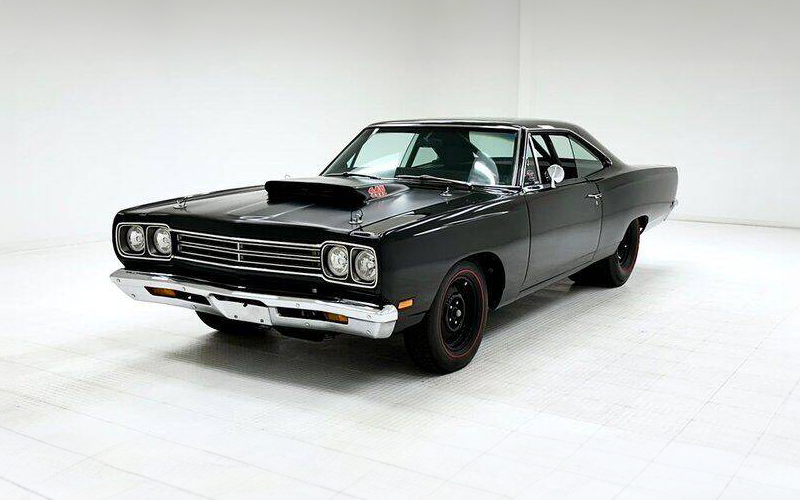
Debuting in 1968, the Plymouth Roadrunner was one of a series of mid-size B-body cars from Chrysler. The Roadrunner, based off the Plymouth Belvedere, was the more affordable counterpart to the Plymouth GTX which took the high-trim Satellite as its basis. The Roadrunner’s formula was simple. Unlike other muscle cars that offered six-cylinder engines and fancy interiors, the Roadrunner was about simplicity, fun, and fire-breathing V8s.
Whereas the Plymouth GTX was “the gentleman’s muscle car,” the Roadrunner lacked even carpeting (just rubber floor mats) and came with a cartoon tie-in right in the name. In fact, Chrysler paid Warner Brothers $50,000 for the licensing to use the Roadrunner and Wile E. Coyote images and name and another $10,000 to license the Roadrunner’s “beep, beep,” used for the car’s horn. The Roadrunner was offered in coupe or hardtop, the latter dropping the B-pillar.
Of course, the Roadrunner had to live up to its moniker and thus Plymouth gave the car a standard 383 cu.-in. V8, no economical straight-sixes to be seen. The 383 equipped with a four-barrel carb put out a very healthy 335 horsepower and 425 lb.-ft. of torque. Like its MOPAR cousins, the Roadrunner was also given access to the “Elephant” 426 Hemi V8. This motor gave the Roadrunner a full and likely underrated 425 horsepower and 490 lb.-ft. Thus equipped, the Roadrunner could net a zero to sixty time of 5.1 seconds, making it one of the quickest muscle cars of its day. The ’68 Roadrunner sold 44,599 units, topping sales among the B-body cars including the Belvedere on which it was based.
’69 Roadrunner Goes “Beep, Beep”
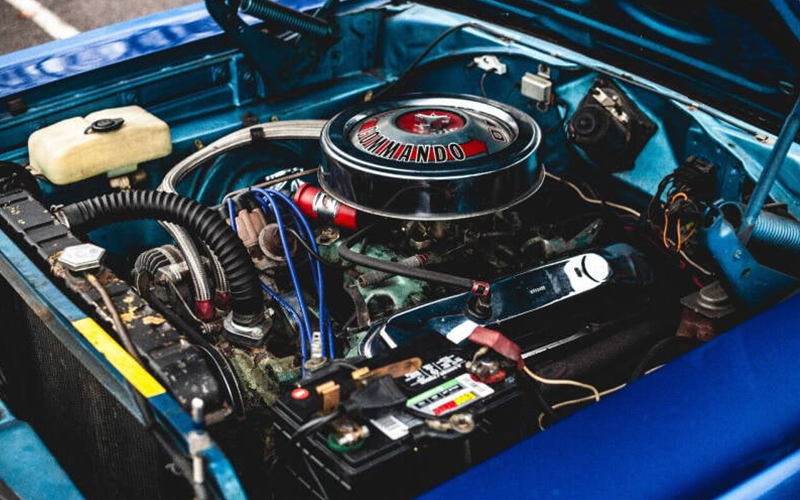
It might be a controversial statement among fans of the Superbird (which we’ll get to below), but the 1969 Plymouth Roadrunner is arguably the car’s pinnacle model year. The ’69 Roadrunner added a number of features, including a new engine, to the mix and refined the car’s looks as well. A new A12 package saw the introduction of the 440 Super Commando V8 with three two-barrel Holley carbs good for 390 horsepower and 490 lb.-ft. of torque as well as stamped wheels and a lighter fiberglass hood with Air Grabber hood scoop.
The Air Grabber was another new addition to the Roadrunner. It funneled air to the “Coyote Duster” air cleaner which came in orange with a Wile E. Coyote decal. Those decals and the other Roadrunner decals did add a distinctive air of whimsy to the car. That playfulness was best expressed with the car’s signature Roadrunner “beep, beep” horn, painted purple and with its own “Voice of the Roadrunner” sticker.
Also new for ’69 was a convertible version for the Roadrunner. Unlike other muscle cars, like say the Mustang, the Roadrunner’s ethos of affordable simplicity meant it did not get the same kinds of special editions and rare variants. But the rarest and most collectable of production Roadrunners are those 1969 convertibles equipped with a Hemi V8, of which only 10 were built.
The 1969 Roadrunner’s impressive mix of accessibility and performance did not go unnoticed as Motor Trend named it their Car of the Year. Buyers likewise swooned, sending sales of the Roadrunner skyward to over 84,000 units, making 1969 the car’s best-selling year by a wide margin.
The Superbird and Cool Roadrunner Concepts
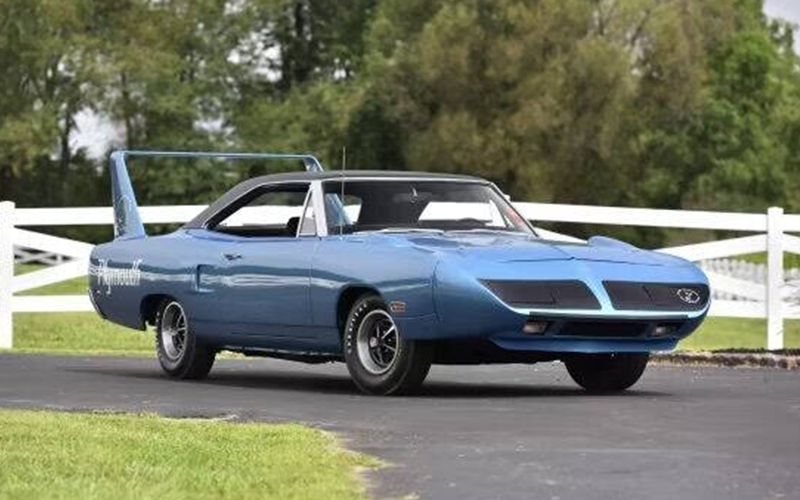
The Roadrunner got a handful of updates for 1970, including tweaks to the front and rear of the car and the addition of a vacuum servo to actuate the Air Grabber hood scoop (now with fighter-plane shark’s teeth).
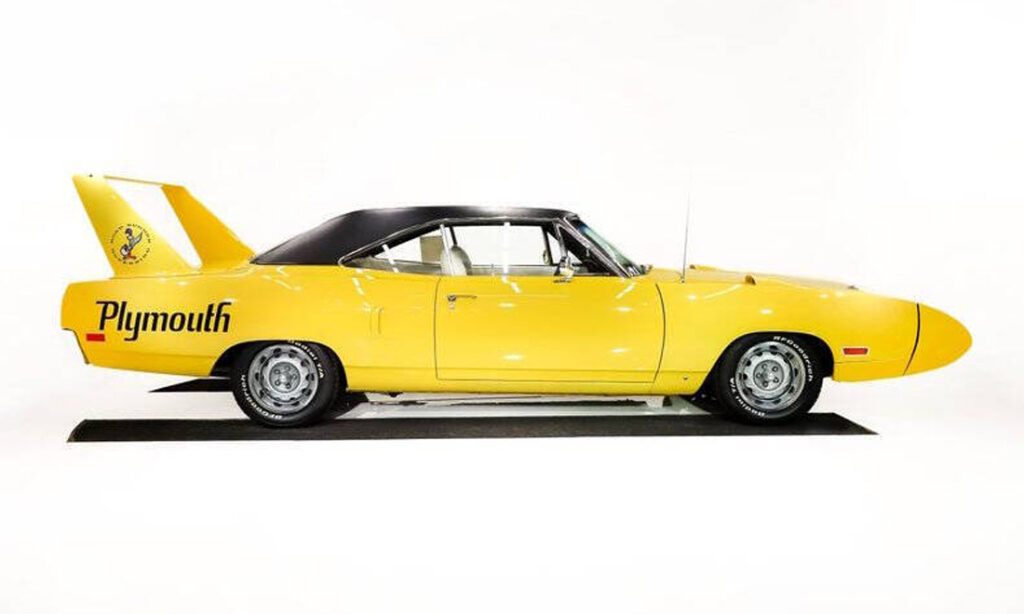
Most significant for the 1970 Roadrunner was the debut of the homologation special Superbird. The year prior, Dodge racing engineers had taken NASCAR by storm with the advanced aerodynamics on the new Dodge Charger Daytona, characterized by its large nose cone and giant rear wing. Plymouth wanted in and got their own version, the Superbird for the 1970 NASCAR season.
So dominant were the Charger Daytona and Roadrunner Superbird, winning 38 of 48 races, that NASCAR officials changed the rules for the 1971 season, limiting displacement on aero-equipped cars to 305 cu.-in., rendering the Chrysler aero cars competitively obsolete.
The Superbird wasn’t the only awesome Roadrunner variant. The car was also the basis for two compelling concept cars. The first was the 1969 Roadrunner Duster I concept. The roofless design positioned a spoiler directly behind the two seats (not a 2+2) and featured a strangely wrought front lip spoiler. The car’s racing stripes hinted at the powerful 426 Hemi under the hood. The other Roadrunner concept was the 1970 Rapid Transit System. This car was more conventional compared to the Duster I, but it was no less head-turning with its tri-color paint scheme, rear spoiler (properly located at the back of the car), and Pro-Street stance. The Rapid Transit’s grille presaged the next gen Roadrunner’s wraparound design.
As we noted above, the next-gen Plymouth Roadrunner saw its horsepower drop, alongside those of other muscle cars, with the advent of new regulations and sky-high insurance rates on performance cars. But that trajectory only makes those first-generation Roadrunners all the more special.