
Latest News
2026 Subaru Crosstrek ReviewThe Cars from Beverly Hills Cop
A beat-up Chevy Nova, fancy sports cars, luxury sedans, big rigs, and more! These are the cars from the Beverly Hills Cop movies.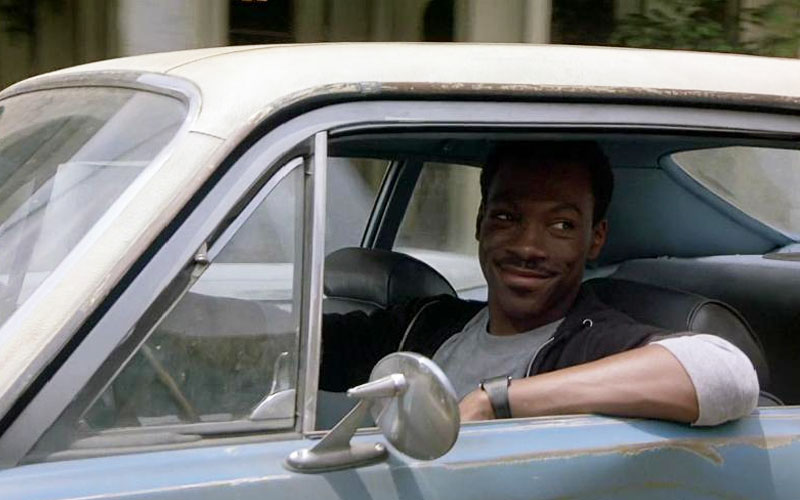
A Cop and a Bunch of Cars in Beverly Hills
It was the 1980s. Ford was on top of the car market with three of the top four best-selling cars of the decade, and Eddie Murphy was on the top of his game as Axel Foley in Beverly Hills Cop. Murphy had just wrapped up 48 Hrs. and Trading Places in the previous couple of years, but this time he was the headliner. Some of the cars may have been the real headliners of the Beverly Hills Cop movies, however.
There were dozens of cars featured between the three movies. Right away, in the first movie, there was a high-speed chase involving several 1979 Chrysler Newport police cars and a 1980 GMC Astro tractor-trailer. A 1976 Dodge Aspen wagon, a 1975 Ford Granada, a 1975 Chevy Impala, and a 1972 Volkswagen Beetle all suffer damage in the opening scene. From there, cars are in the background, are the center of attention, and are sometimes even plot points. That continued on into the second and third movies, too. This summer, Netflix will introduce a fourth movie in the series: Beverly Hills Cop: Axel F. Before that, though, look at some of the cars from the first three movies. We’ve got the most memorable, the most unique, and even some Easter eggs that you had to be on the lookout for.
1970 Chevy Nova
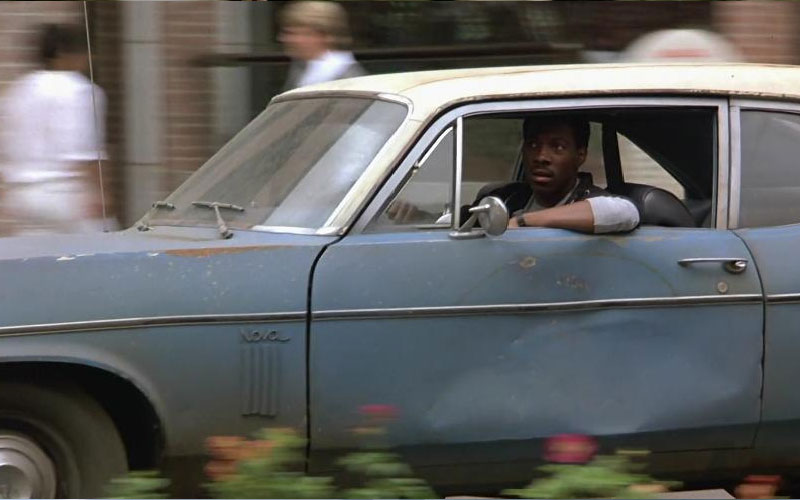
First up, Axel Foley’s car in the first Beverly Hills Cop. He was driving around Detroit in a 1970 Chevy Nova. It wasn’t too out of place for the time and location, but then Foley is driving that same ‘70 Nova when his case lands him in Beverly Hills. The Nova helped further the fish-out-of-water story. It’s not a fancy, slick, new sports car. The 1970 Chevy Nova has some respect to it. After all, it was the last high-performance Nova before the Clean Air Act of 1970 changed things, but Foley stood out in the older model Nova while driving around the gated communities and fancy mansions of Beverly Hills. That 6.4-liter engine still made 375 horsepower, but it wasn’t exactly humming in Beverly Hills Cop. The Nova had seen better days.
1977 Plymouth Fury / 1982 Plymouth Gran Fury / 1979 Chrysler Newport
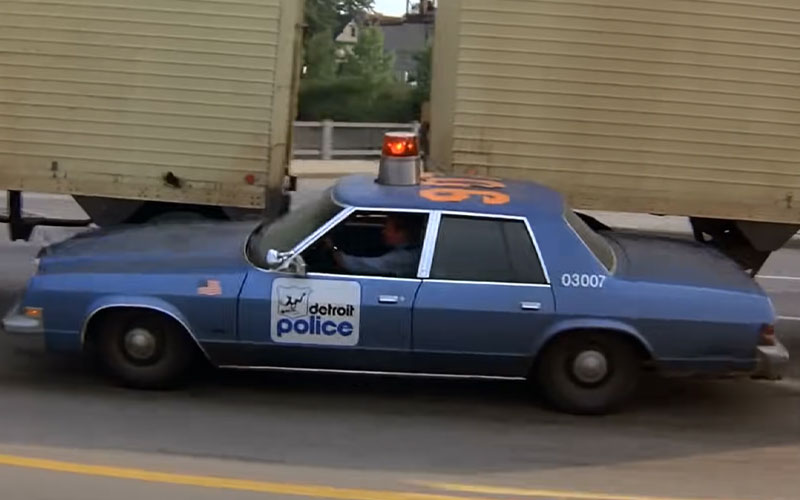
It wasn’t just one kind of cop car that was used as Detroit police cars for the opening chase sequence. It was a bunch of them! If you’ve got a keen eye, a high-definition TV, and a good Pause button, you’ll notice a few differences between the various cop cars in different parts of the chase. Pay attention to the trim around taillights, 1982 Plymouth Gran Fury models can be seen before the chase begins and as one of them is reversing. Other times, though, it’s a 1979 Chrysler Newport or a 1977 Plymouth Fury being used. So, was that just editing continuity issues, or did the producers just get a good deal on some actual retired police cars? Using the Fury and Gran Fury wasn’t just a movie decision.
The Michigan State Police and the Ohio State Patrol ordered a huge fleet of the R-Body Gran Fury models in the early 1980s. As a result, the 1980 Gran Fury reached 18,750 models sold, the highest number for any R-body that year. Since the Michigan State Police did own and use Gran Fury models, some Detroit Police badging was likely slapped onto a few real Michigan State Police cars. The Plymouth Fury and the Chrysler Newport weren’t the only popular cop cars in the 1980s. Makes and models differed by region and state, but many departments also used the Chevrolet Caprice and Ford Mustang Special Service Package.
1982 Chevy Impala
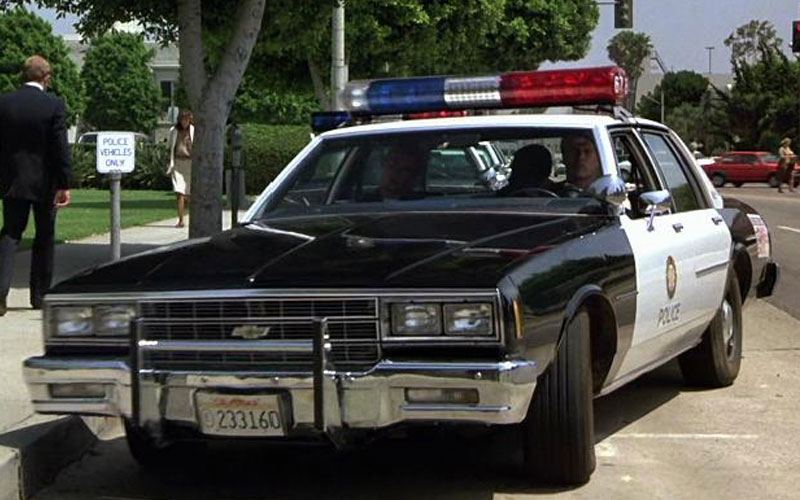
In Detroit, the police were using Chrysler and Plymouth. In Beverly Hills, the cops were riding around in a fleet of 1981 Chevy Impalas. It was a smart contrast from Detroit to Beverly Hills. Contrasting the Detroit police cars to the more polished, newer Beverly Hills Impalas was smart. The contrast was even mentioned by Foley himself, saying, “This is the nicest and cleanest police car I’ve ever been in,” as he was riding in the back seat of the Impala.
In terms of police chases, the Impala did come with a 3.7-liter V6 that delivered 110 horsepower, so it could keep up with some vehicles, but probably not most of the sports cars in Beverly Hills. Other engine options on the ‘82 model included a 4.3-liter V8 with 115 horsepower, a 4.9-liter making 145 horsepower, and a 5.7-liter that made 150 horsepower.
1980 Mercedes-Benz 450SL
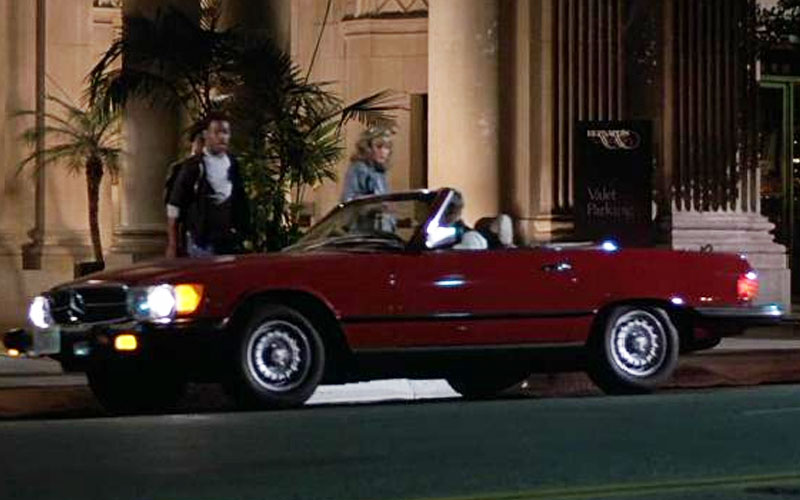
What does a woman who is working at a successful Beverly Hills art gallery drive in the 1980s? Yeah, a 1980 Mercedes-Benz 450SL convertible sounds about right. Jenny, Axel Foley’s friend, bails him out of jail. That’s when we see the red 450SL (with a nice glossy finish) for the first time. It’s used here and there throughout the first half of the movie, but it’s only used for a few driving scenes. This Benz wasn’t involved in any high-speed pursuits, so there’s no damage done. It’s one of the few cars that escaped filming without needing repairs. 1980 ended up being the last model year of production for the Mercedes-Benz 450SL, replaced by the 380 and 500 models, so this red 450SL was the end of an era.
1983 Mercury Marquis
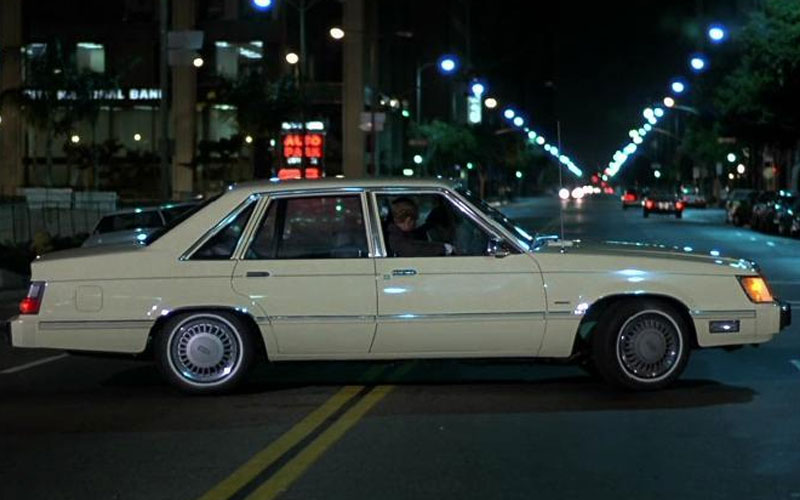
That drive from the police station to the hotel leads us right into the next car of Beverly Hills Cop. As Jenny is driving, Foley notices that the Beverly Hills police are following them in a, “beige Ford.” Even though it’s called a Ford several times, this car was actually a 1983 Mercury Marquis. Though the two models were quite similar, it’s a Mercury grille and there’s a Mercury logo on the hubcaps. This could be a case of a beige Ford being written into the script and a beige Ford not being available for filming. For whatever reason, the Mercury was used instead.
The vehicle provided a funny moment, too. In response to being followed, Foley sends them a meal from the hotel (including a shrimp salad sandwich). As they’re being served their food, Foley stuffs bananas into their tailpipe. So much for following them! The Marquis really did fit the personalities of the two blundering Beverly Hills cops. The beige color tops it off.
1984 Mercedes-Benz 500 SEL W126
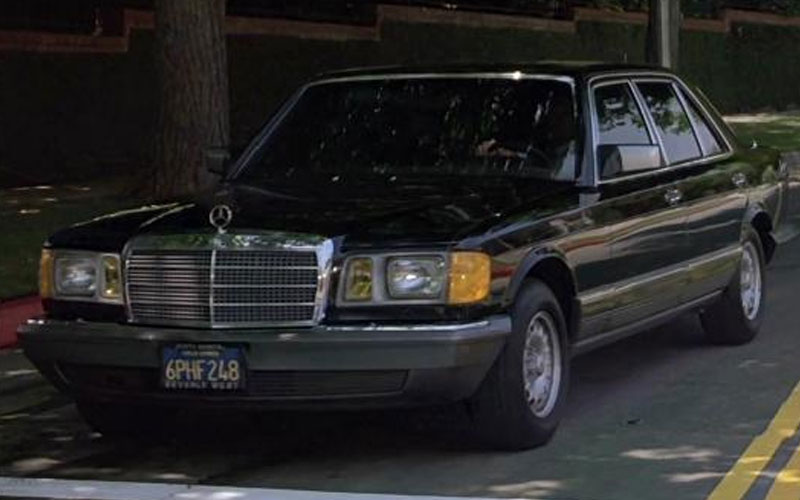
Another Mercedes-Benz in the movie was a black 500 SEL. This Mercedes belongs to the bad guys, though. To be exact, it belongs to the rich, art-dealing, bond-smuggling bad guy. There wasn’t any specific action-heavy scenes involving the 500 SEL, but there were several shots of it as Detective Foley tailed it to a private country club. It was used in a handful of other scenes, too, but it wasn’t damaged or used in any chases. The black coloring, the Mercedes hood ornament, and the tinted windows all made it a memorable movie vehicle, even without any action scenes.
It wasn’t just anyone driving this car around in real life at the time. The 500 SEL was considered the best of the lineup between 1979 and 1985, but Mercedes-Benz USA didn’t sell the 500 SE or 500 SELs in the U.S. About 22,000 of them were imported and they had a limited number of features to avoid officially selling them in the U.S. Most of the W126 500 SELs were modified after they left the Mercedes factory in Germany, many times at a custom shop. Buyers could choose upgrades, including a 5.4 or 6.0-liter engine, but they had to get three or more upgrades to get the AMG badge.
1978 Ferrari 308 GTS
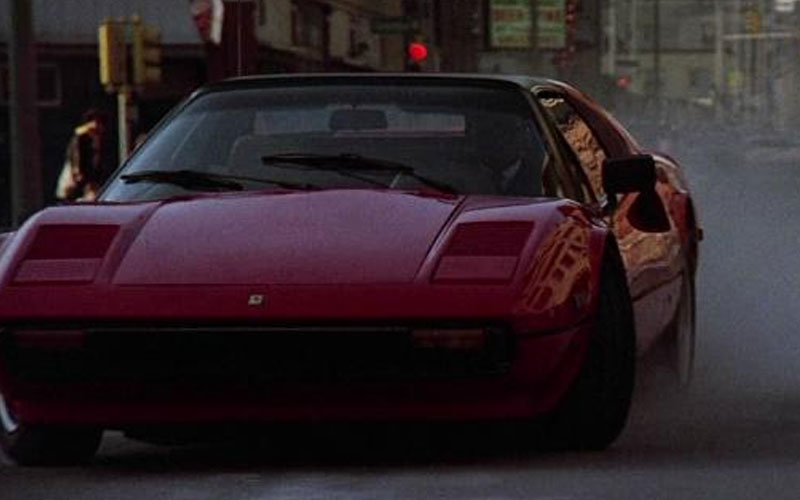
After solving his friend’s case in the first movie, Detective Foley must be big time, right? Well, that’s what you’d think based on the opening credits. Foley rolls out of his garage in a red 1986 Ferrari 308 GTS. It turns out that he only had the car as part of another undercover operation, but it sure looked fun to drive! The Ferrari wasn’t involved in any kind of chase, but it didn’t need to be. Foley showed off the Ferrari capabilities just driving down the street, engine roaring and tires squealing while taking corners in an instant and stopping on a dime. It should be able to stop on a dime, too. The GTS had a 2.9-liter Tipo F106 AB V8 engine good for 240 horsepower and 195 lb.-ft. of torque with the help of a five-speed manual transmission.
1986 Ferrari 328 GTS
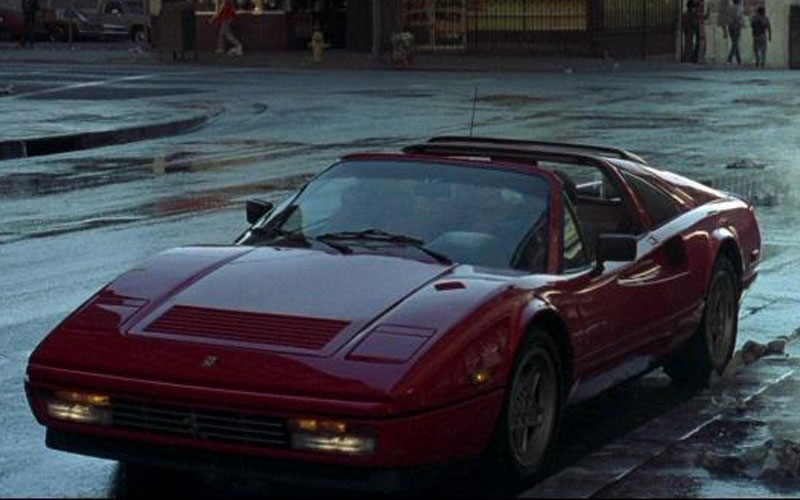
So, this was supposed to be the same Ferrari as earlier in the movie, but moviemakers used two different models throughout the movie. In fact, the opening sequence switches a couple of times between the 1978 308 GTS and 1986 328 GTS. The 328 was used for the scene-setting and regular driving shots, while the 308 was used for the fun, burning rubber scenes. It’s hard to say why this happened. Maybe it was something Ferrari insisted on? Perhaps the 328 wasn’t available so they used the 308 instead? In any event, two cars were used as one car in Beverly Hills Cop II.
1986 Chevrolet Camaro IROC
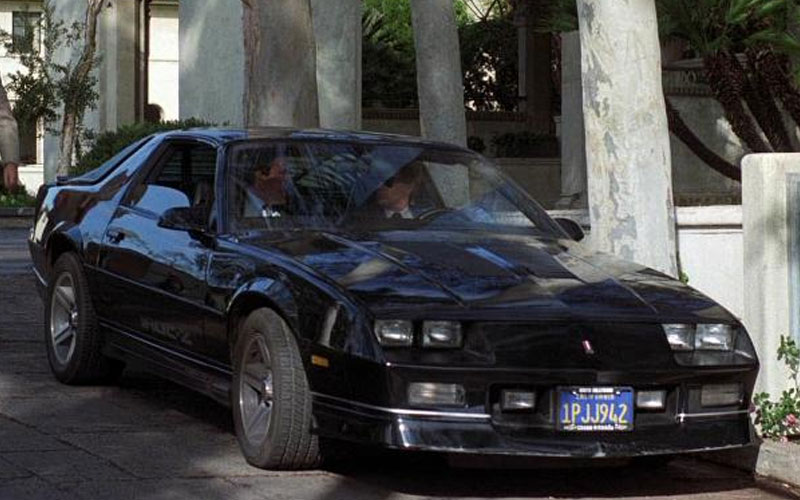
The bad guys in the first movie were driving a black Mercedes-Benz. This time around? They were still in a black car, but it was a stylish 1986 Chevrolet Camaro IROC-Z28. Although this Camaro was used in a few scenes, it wasn’t used in any action sequences. It could have been though. It was capable of it. The IROC name stemmed from the International Race of Champions racing circuit, where all cars are equipped the same. Contestants use the same car and need to rely on their skills to win.
Starting in 1985, the IROC-Z came with the Z28 package for only $696. From 1985 to 1990, that package was offered, adding an upgraded suspension, Goodyear eagle GT tires, and 5-spoke wheels. The base engine in the ‘85 model was a 5.0-liter V8 with 155 horsepower and 245 lb-ft of torque. That was mated to a four-speed automatic or five-speed manual transmission. The 1986 model, however, lost 25 horsepower due to emissions regulations and a camshaft change. Sales for the 1986 IROC-Zs dipped to 49,000. This IROC wasn’t the only Camaro featured in the movie, though.
1978 Chevrolet Camaro
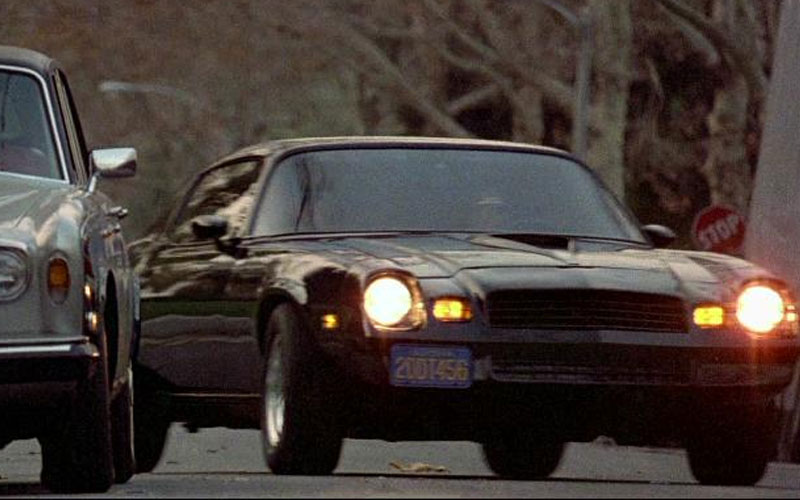
Wait, two Camaros in the same movie? Well, kind of. This 1978 Chevy Camaro is supposed to be the same as the 1986 Camaro above. Two different cars used as the same car again? What were these movie producers doing, especially when it’s plainly obvious the license plates are in different places? Maybe the hitmen had a breakdown with the first Camaro and swapped it out for the second one? Either way, this version of the Camaro was used in an action sequence.
While trying to take out Detective Foley, the henchmen did some damage to their own car, hitting large outside potted plants, the car door of a 1986 Lincoln Town Car, the front of a 1977 Cadillac Seville before eventually hitting a fire hydrant, and an electric pole. The second Camaro didn’t last long in the sequel, but it was cool to see the car featured even if it was a puzzling switch.
1984 International Harvester S-Series
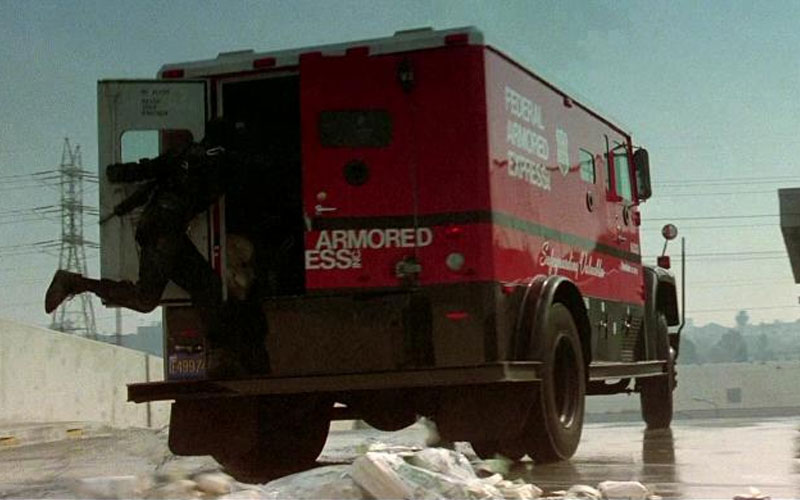
After starting the first Beverly Hills Cop off with a bang, the sequel had to be bigger and better, right? Well, that’s what the movie producers hoped for with a chase that involved a 1984 International Harvester Dunbar armored vehicle, a 1966 Mack RS-600 L cement truck, a 1979 Buick Riviera, and several 1979 Chevrolet Malibu police cars. The International Harvester wasn’t the only armored vehicle in the movie, though. A 1980 Ford F-Series truck was also used at the beginning of the movie.
Meanwhile, in true sequel fashion, the end of the movie involved even more action with some additional 1981 Chevy Impala police cars, a 1977 Cadillac Fleetwood Limousine, and a 1971 Ford W-9000 that catches fire and goes, ‘Boom!’ If you’re a car enthusiast, the second Beverly Hills Cop may be better than the original between amped up action, a wider variety of large vehicles, and the additional sports cars.
1991 Dodge Stealth R/T
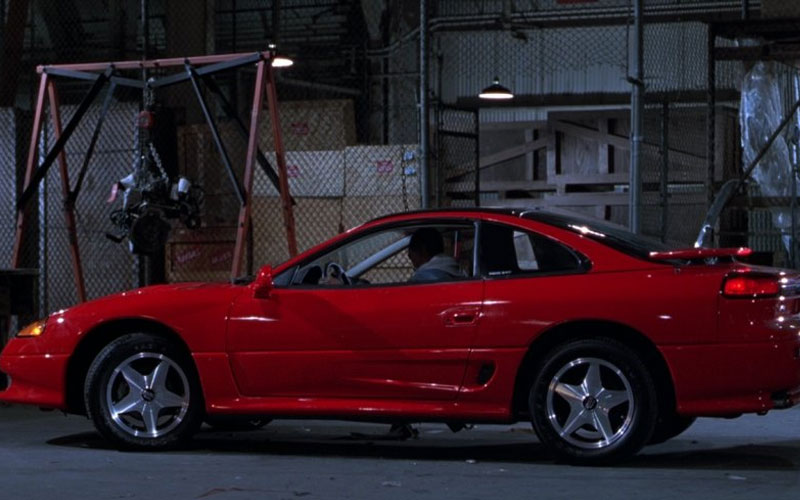
There weren’t necessarily as many car movie moments in the third movie, but Beverly Hills Cop III did have some excitement of its own. There’s a big warehouse standoff turned chase that involves a 1987 Chevrolet Caprice, a 1986 Ford Taurus, a 1983 Ford Econoline truck, and a half-done 1991 Dodge Stealth R/T. The red Stealth was being worked on, so the entire passenger side door was already missing, but by the end of the chase all that was left was basically the frame of the car. The passenger rear wheel comes off, the roof is gone, the hood is missing, and the driver’s side door falls off. There’s no doubt that once impressive car was totaled.
Ford Crown Victoria
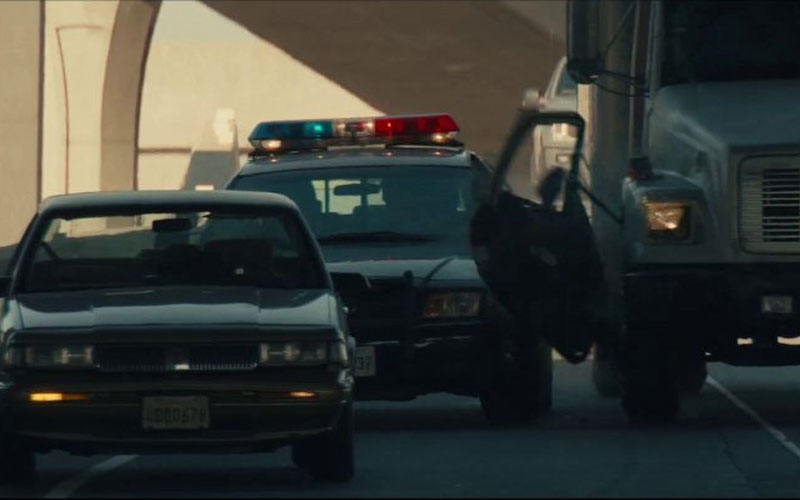
The fourth installment of the Beverly Hills Cop movies isn’t being released on Netflix until later this year, but a trailer is out. It looks like it will pick up where the other movies left off. The trailer shares glimpses of a Dodge Dakota, a 1982 Ford Bronco, a Freightliner, a Lincoln Navigator, and what looks to be a red BMW 3 Series that is hanging from a parking garage. Law enforcement seems to be using mostly Ford Crown Victoria police cars in the trailer, so there’s likely to be a lot of those as well. It certainly seems there will be a lot of smashing, pedal-to-the-metal fun. They probably won’t go the Fast and the Furious route and launch anything into space, but it seems like a safe bet that there will be several more car cameos packed into this movie.


there’s a DeLorean in the first movie, but it seems you forgot about it