
Latest News
2026 Ford Maverick ReviewThe Retro Genius of the Plymouth Prowler
The Plymouth Prowler pushed the envelope as a ‘90s retro hotrod. Though it failed to find an audience then, today it has become a singular classic.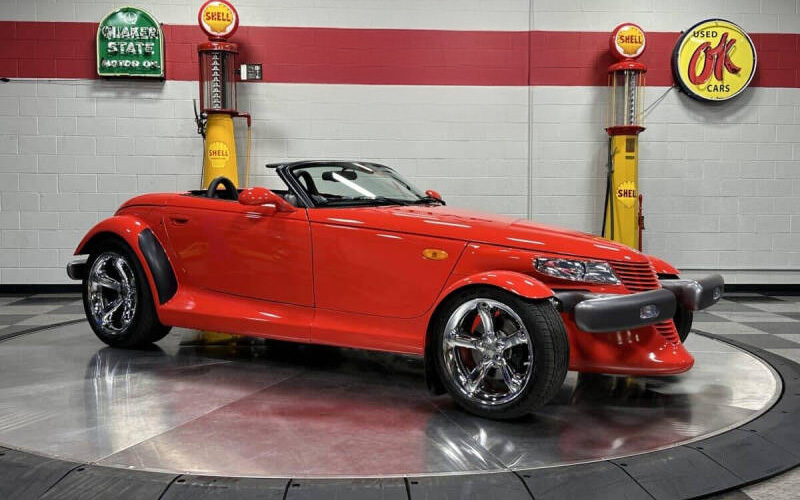
Making the New Old Again
Automotive retro styling has seen a major comeback over the last five years. The Ford Bronco, Nissan Z, and Toyota Land Cruiser borrow liberally from early (classic) iterations. And while you could criticize ours as an age of monetized nostalgia that lacks originality, what you can’t say is those cars are anything but gorgeous, well-executed homages.
The late 1990s and early 2000s saw their own wave of nostalgia-bait retro designs with the Chrysler PT Cruiser, Chevy SSR, and Plymouth Prowler bravely harkening back to pre-war era only to receive lukewarm receptions, critically and commercially.
Was it the execution? In part. Was it the concept? Undoubtedly. Melding the slipstream, jellybean styling of the 1990s and early 2000s with the body styles of the 1930s and ‘40s produced some of the oddest-looking cars of that or really any era before or since. And no car was more head-turningly odd than the Prowler.
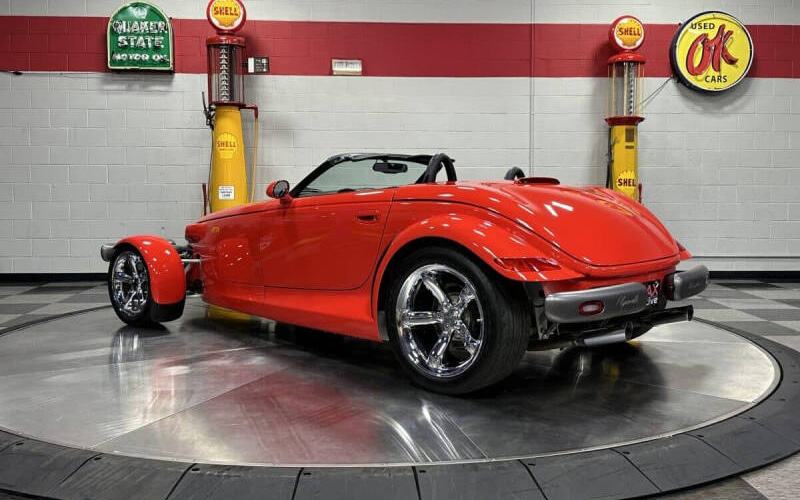
The concept for the Prowler sounds like an automotive designers’ prop bet. “I bet you can’t bring a two-seat retro-styled open-wheeled convertible hotrod to market.” Tom Gale, design chief at Chrysler: “Hold my proverbial beer.”
If you think the Prowler looks more like a design study and test bed than a production car, you’d be right. That the Prowler made it from experiment to reality owes to two factors: Chrysler’s willingness to take risks catering to niche markets (this was also the era of the Dodge Viper after all) and a desire to refine the company’s use of aluminum.
Though unlikely, the Plymouth Prowler has become a collectable today, and its design surprisingly enduring 25 years on. That’s why we sought out the most eye-catching example we could find on Carsforsale.com. This 1999 Prowler in a dazzling Prowler Red clear coat is a stunner, no matter how well or poorly you think the design has aged.
Prowler Experiments in Aluminum
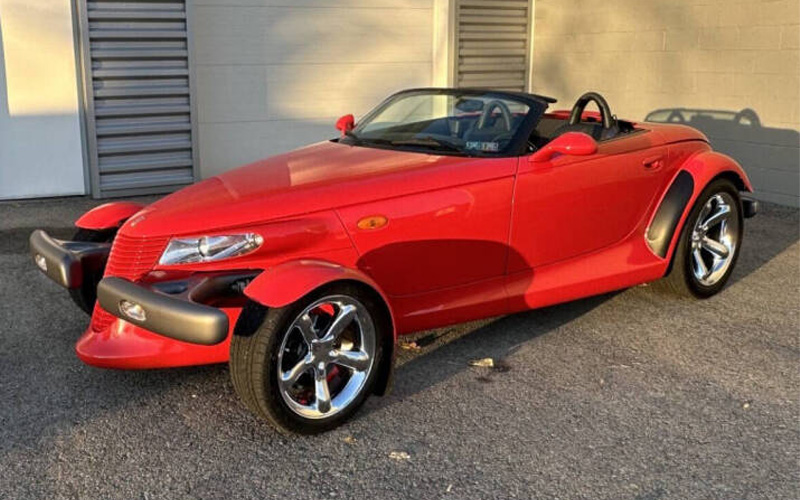
Credit for the Prowler’s design goes to Tom Gale, Kevin Verduyn, and the team at Chrysler’s design studios. However, designer Chip Foose had a hand in the Prowler’s inception. As part of a Chrysler-sponsored design contest at the Art Center College of Design Foose submitted a concept drawing of an open-wheeled roadster in the vein of classic hotrods. Adjudging the students’ work for the design contest? Tom Gale.
An early concept car for the Prowler debuted in 1993, its radical styling wowing attendees at the Detroit Auto Show. The final production version, arriving in 1997, varied little from that initial concept. The Prowler’s uniqueness extended far beyond its throwback looks. Chrysler used aluminum in both the chassis and the bod paneling. According to Tom Gale, using aluminum for the Prowler was a big reason why the car was approved for production. Gale told Road & Track, “The real reason, the rationale in my view, was always applied research for using aluminum.” The aluminum did save considerable weight for the Prowler which tipped the scales at just 2,800 lbs., equivalent to today’s GR86.
Something Borrowed, Something … 3.5 Liters
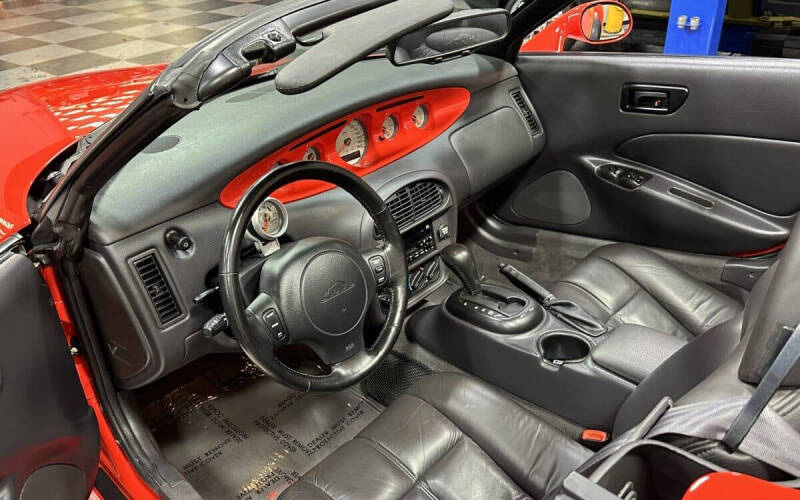
Even with the bespoke chassis and body panels, the Prowler was very much a parts bin car, borrowing from across Chrysler’s lineup. The exterior door handles came from a Dodge Neon while the interior ones originated in the Viper, which also lent its coil suspension to the Prowler. The front brakes and rack-and-pinion steering came from the Caravan while interior elements were native to the Voyager and steering wheel was out of the Grand Cherokee (albeit with a new pather-esque Prowler logo in the middle).
The engine too was on loan from another Chrysler product. The Prowler’s 3.5L V6 was pulled from the Chrysler 300M/Dodge Intrepid, made a modest 214 horsepower, and came paired with a four-speed automatic. For a car that directly referenced hotrods, the lack of a V8 and an anemic 7.2 sprint from zero to sixty were major disappointments for enthusiasts. In truth, the Prowler was a victim of its styling and limited development budget. The narrow engine bay couldn’t accommodate any of Chrysler’s current V8s and there was no money for designing a clean-sheet engine from scratch just for the Prowler.
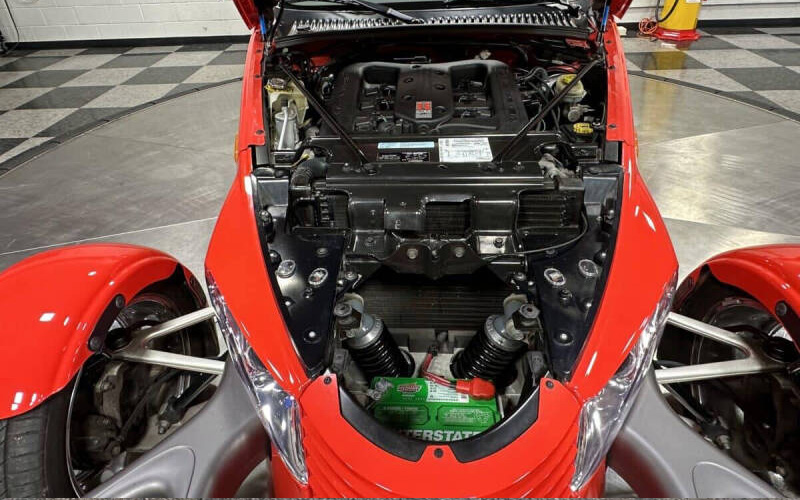
The Prowler skipped its sophomore model year but returned for 1998 with a new High Output version of its V6, now offering 253 horsepower and a spry zero-to-sixty of 5.7 seconds. Plymouth also responded to complaints that the Prowler had next to zero storage capacity with the addition of an optional fiberglass trailer.
The Prowler did not end up a big seller, shocking I know; ending its run after the Plymouth brand folded with the final Prowlers carrying Chrysler badging. A total of 11,702 Prowlers were built over five production years.
This 1999 Plymouth Prowler
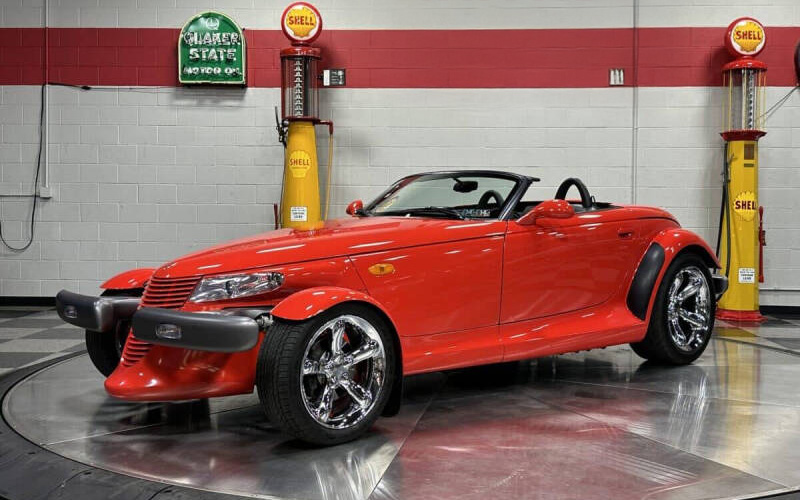
The 1999 Plymouth Prowler we discovered listed on Carsforsale.com is in museum-quality condition top to bottom. The Prowler came in a host of head-turning colors, from the initial-year-only Purple Metallic, the Mulholland Edition’s Blue Pearl, and the final year’s Candy Red to a Yellow clearly inspired by Curious George’s Man in the Yellow Hat. And while all those paint jobs are attention grabbers, this car’s Prowler Red clear coat shows why fire trucks and sports cars are red by default.
Under the hood is the updated 3.5L V6 (253 hp) wedded to the original four-speed automatic. This car carried just 12,255 original miles and comes with a price tag of $38,750.