Latest News
Famous Cars: Patton’s Willys JeepThe Studebaker Golden Hawk’s Striking Silhouette
Built toward the end of Studebaker’s run, the boldly styled Golden Hawk was a potent and posh representation of the best from this storied brand.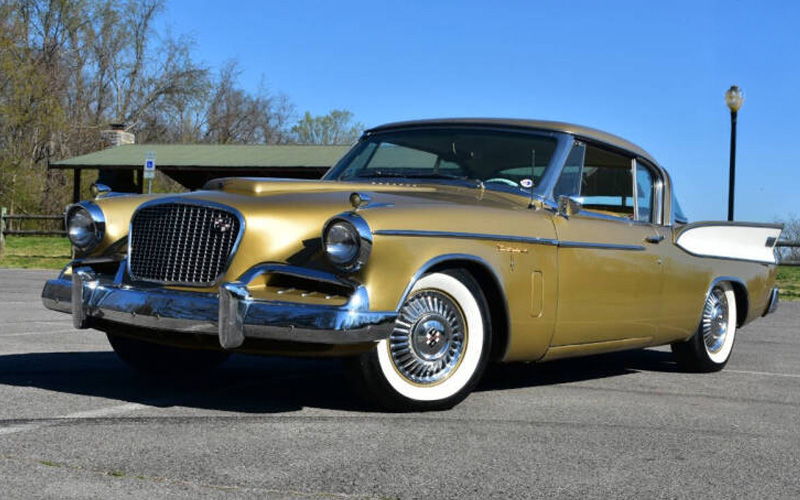
High Flying Hawk
The 1950s were possibly the most distinctive and ambitious period in the history of automotive design. Chrome and fins were the order of the day as carmakers locked into heated competition, each spurring the next on with ever more elaborate designs. Smaller brands like Studebaker were encouraged to take risks to remain relevant.
Studebaker’s Golden Hawk, introduced for 1956, carried many of the era’s hallmarks: copious chrome and stainless- steel exterior adornments, prominent rear fins, wraparound rear glass, and bezeled headlights. And yet, the Golden Hawk was anything but conventional. Raymond Loewy’s design featured a uniquely molded hood and center grille and sporty, near perfect proportions for the two-door hardtop. (Loewy would step in a few short years later to design Studebaker’s final model, the record-setting Avanti.)
The Golden Hawk was Studebaker’s version of a Ford Thunderbird or Chevrolet Corvette, a personal luxury car and a brand halo representing the best the company had to offer. As such, we sought out the best example we could find on Carsforsale.com and came up with a phenomenal example, a 1957 Golden Hawk in the apropos Gold and White two-tone finish.
What Makes the ’57 Golden Hawk Special
Studebaker introduced its line of Hawk models, the Flight and Power Hawk coupes and the Sky and Golden Hawk pillarless hardtops, for the 1956 model year with Loewy’s head-turning design as a bold gambit for the struggling brand. A possible four-way merger between Nash-Kelvinator, Hudson, Studebaker, and Packard had recently fallen through, with Nash and Hudson forming AMC while the weaker Packard and Studebaker were left to pair up on their own.
The Golden Hawk was a bid for continued relevance for Studebaker, a high-end, performance-minded offering for the mid-market brand. As the top-of-the-line model, the Golden Hawk was two-inches shorter in length than the standard Hawk and came with additional exterior trim and a robust V8.
The Packard 352 V8 marked the only time a Packard motor graced a Studebaker engine bay. With a full 275 horsepower, the Packard V8 helped position the Golden Hawk alongside the Chrysler 300B as a performance model (and a clear precursor to the V8-powered coupes that would come to dominate the 1960s). The hefty Packard V8 was powerful enough to get the Golden Hawk up to a top speed of 120 mph. It was also a heavy engine in a relatively light car, making the 1956 Golden Hawk notoriously nose heavy.
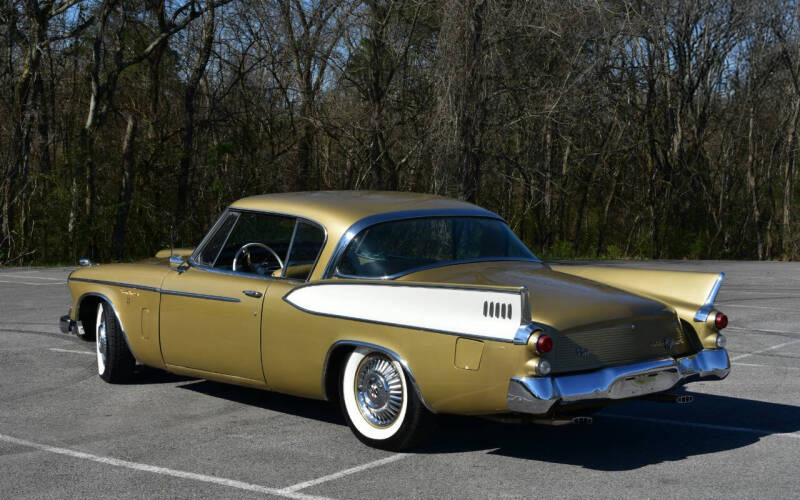
Major changes arrived for the 1957 Golden Hawk. The exterior was updated with the arrival of Duncan McRae as the new head of design at Studebaker. The Golden Hawk was given new, larger, and now concave fins and a bulging hood hump. The latter was necessary to accommodate the Golden Hawk’s other major revision, a new 289 Studebaker V8 and its McCulloch supercharger. While the new supercharged engine made the same 275 horsepower as the prior Packard V8, it did so while weighing roughly 100 lbs. less, helping alleviate the Golden Hawk’s front-to-back weight imbalance.
For 1957, Studebaker’s Hawk line was reduced to just two cars, the pillarless hardtop Golden Hawk and a new pillared coupe, the Silver Hawk. 1958 would be the Golden Hawk’s final year as an economic recession that year hit the automotive industry hard, dropping sales across the board. The previously successful Golden Hawk was reduced to just 878 units sold that year, leading to its eventual cancellation.
This 1957 Studebaker Golden Hawk
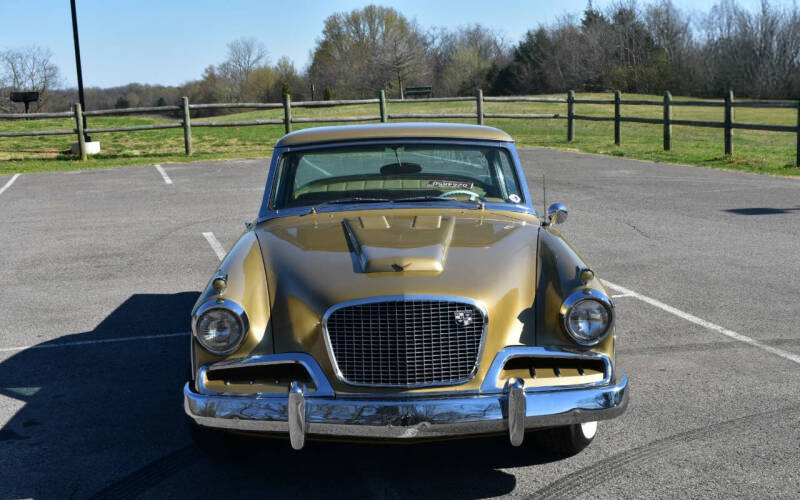
All this brings us to our featured listing on Carsforsale.com, this gorgeous 1957 Studebaker Golden Hawk. As a 1957 model, it features the original supercharged 289 Studebaker V8 paired with a three-speed automatic transmission. The two-tone Gold and White paint job and note-perfect white wall tires make the most of the Golden Hawk’s unique styling. The car’s interior features plush leather upholstery and original instrumentation. Condition, both inside and out, is exceptional.
This 1957 Golden Hawk is a striking representation of Studebaker at its best. With its unique styling and powerful supercharged V8, this Golden Hawk is a steal of a ‘50s classic at $50,000.