
Latest News
2027 GMC Terrain Review
E.L. Cord masterminded not one but three luxury car companies: Cord, Auburn, and Duesenberg, and helped define automotive design in the 1920s and ‘30s.
Peak American Luxury
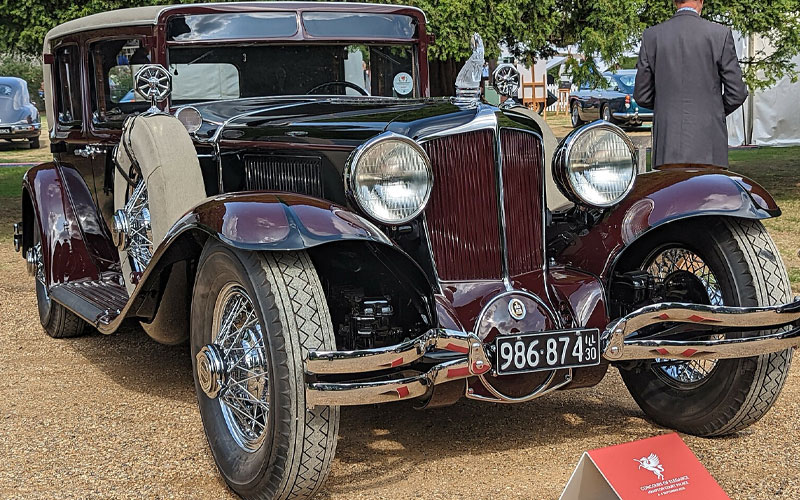
We all know the storied histories of Cadillac and Lincoln, long revered as America’s premier luxury brands. But the most collectable and prestigious of classic American luxury cars didn’t hail from Detroit, they came from Auburn, Indiana. That’s where E.L. Cord headquartered his automotive luxury trifecta encompassing the Auburn, Duesenberg, and Cord marques.
For over a decade, from 1924 through 1937, Cord’s companies created groundbreaking designs featuring the latest innovative engineering. The Auburn Speedster, Duesenberg Model J, and Cord’s L-29 and 810 took luxury cars to new and theretofore unforeseen heights. But just as Cord’s car companies were hitting their stride, the Great Depression swept in, decimating the market for expensive luxury cars.
Today, Cord’s cars are among those most prized by collectors, especially then it comes to American pre-war cars. Below, we’ll look back at E.L. Cord’s astounding rise and fall in the automotive industry and the cars that bear his name.
Who was E.L. Cord?
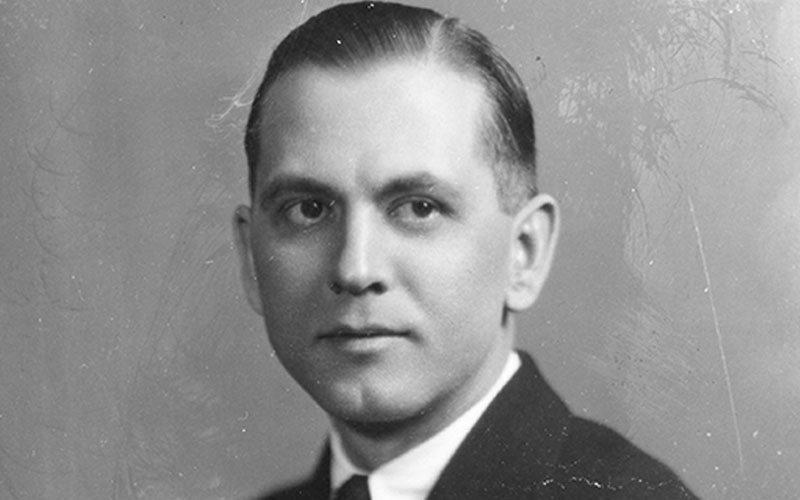
Errett Lobban Cord grew up in Warrensburg, Missouri. An early interest in cars and a flair for entrepreneurship saw him refurbishing and reselling Ford Model Ts at the age of eighteen. Cord would race the cars he worked on – thereby demonstrating the potency of his re-engineering efforts – and resold them at a profitable markup. In his early years, Cord took on numerous business ventures, from selling cars to gas heaters, before making his way to Chicago where he began selling Moon automobiles, expanding franchises throughout the Upper Midwest.
From Auburn and Duesenberg to Cord

Auburn Automobile Company was founded in Auburn, IN by brothers Frank and Morris Eckhart in 1903 as an outgrowth of their father’s carriage company. They produced cars through WWI, but supply shortage impacted company finances and the brothers sold out to a group of Chicago business investors. Struggling for profitability, they approached Cord to help run the company. Cord preferred a leveraged buyout, with him as VP and general manager. His first moves were to sell off the existing Auburn inventory, repainted in bright, eye-catching colors, and to start work on a new model.
The new Auburn Eight debuted at the New York Auto Show in 1925 with an inline-eight-cylinder engine and sharp styling. By the following year, Cord became president at Auburn, already setting his sights on another prestigious automaker, Duesenberg.
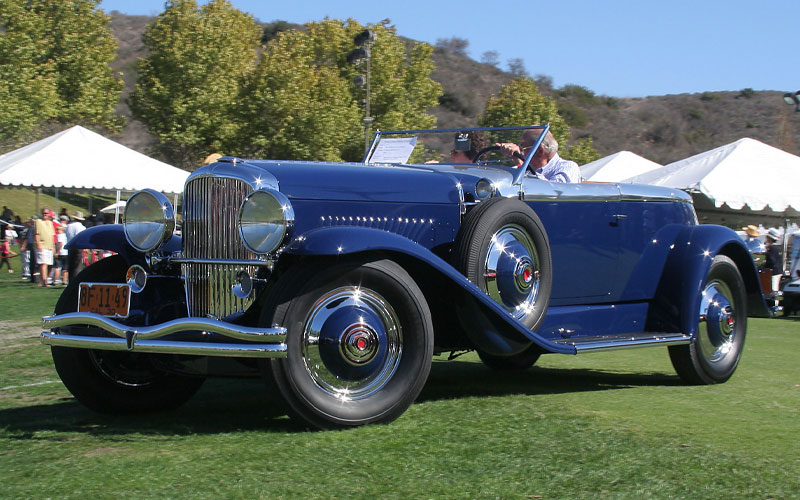
At the time Duesenberg, founded by brothers Frank and August Duesenberg, were well known for their high-quality engines and success in Indy car, winning the Indy 500 in 1922, ’24, and ’25 (they’d win again in 1927). Cord saw an opportunity to take their impressive engineering to a new audience, and he acquired Duesenberg in 1926 with Frank staying on as Vice President of Engineering. As he’d done at Auburn, Cord’s first order of business was to develop a new, headline worthy model. This push produced the now legendary Duesenberg Model J in 1928 alongside the new Auburn Speedster.
In addition to acquiring Auburn and Duesenberg, Cord was busy with a dizzying list of other ventures. Significant for his automotive companies was the addition of Lycoming Engines in 1927, maker of many of the engines used in Auburns, Cords, and Duesenbergs. Other acquisitions included Columbia Axle Company, the Limousine Body Company, Stinson Aircraft Company, two commercial airlines, the Kansas City Southern Railway, the New York Shipbuilding Company, and the Checkered Cab Company. The latter two ventures resulted in the Roosevelt’s administration’s newly formed Securities and Exchange Commission to open an investigation into Cord. (Cord had purchased the shipbuilder just a day before a lucrative government contract came through. The Checkered Cab stock had spiked after his purchase, raising eyebrows among regulators.)
Cord L-29
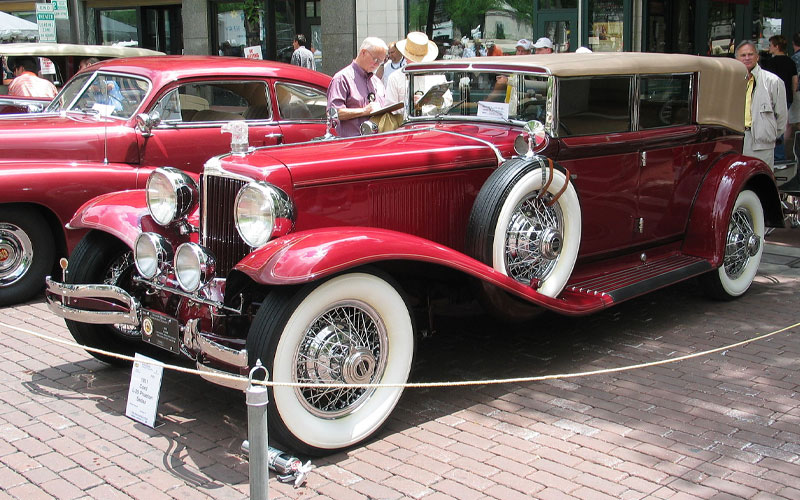
The ever-ambitious Cord was not satisfied as owner multiple car companies. So, he founded a new marque christened with his own name, launching it in 1929. Cord was to be a mid-level luxury brand positioned between Auburn and the rarefied Duesenberg.
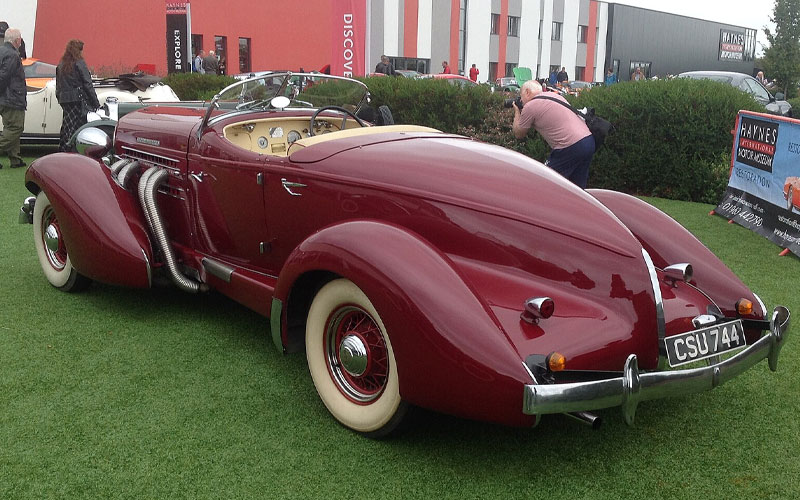
Cord’s first car was the L-29. With a fetching design by Auburn’s John Oswald, the L-29 was remarkable not just visually but technologically. That’s because it was the first American front-wheel drive production car. Cord acquired the design from the racecar driver and designer Henry Miller and Miller’s engineer Carl Van Ranst, and because the car lacked a traditional transmission tunnel thanks to that front-wheel drive design, it was fashionably low-slung, a good foot shorter than average for the time.
The L-29 came in sedan, brougham, convertible sedan, or convertible coupe body styles. Under the hood was a Lycoming straight-eight motor making 125 horsepower. The car’s three-speed proved to be the bane of L-29 owners as the poorly geared transmission kept the top speed to around 80 mph.
The late 1920s were a good time for Cord, Auburn, and Duesenberg and despite the economic headwinds, 1931 was their best year with combined sales of roughly 34,000 vehicles. The good times didn’t last long however, and sales faltered, slumping by half in 1932 and halved again in 1933. By this time, the Cord L-29 was doomed, canceled in 1932 with approximately 4,400 units built during its run.
Cord 810/812
E.L. Cord had a few tumultuous years himself, losing his first wife in 1931 and fleeing the country in 1934 for England, reportedly due to kidnapping threats. His return in 1936 coincided with the resurrection of the Cord badge with the new 810.
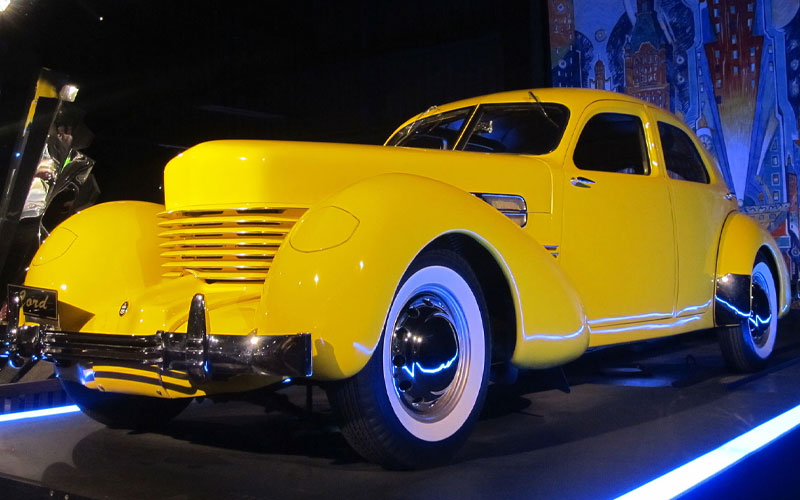
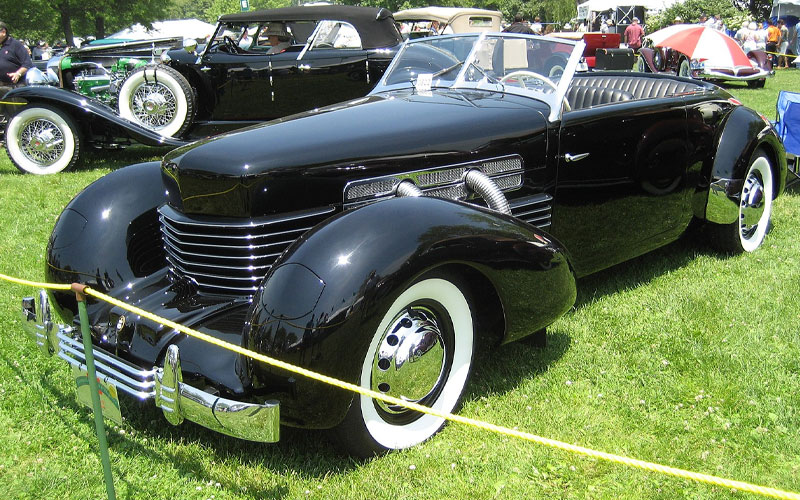
The Cord 810 is one of the most iconic designs of the era and perhaps the quintessential example Art Deco in automotive designs. The body was done by Gordon Buehrig, formerly of Duesenberg and GM, brought back to the Cord fold ostensibly for a new Duesenberg model which then shifted to the new Cord 810. The car’s signature element is its “coffin nose” front end consisting of a tall engine bay, crank-operated hidden headlights, massive fenders, and a recessed grille. The 810 was powered by a Lycoming V8 paired with a four-speed transmission. For 1937, Cord updated the car, redubbed the 812, with two longer wheelbase sedans and optional supercharging (those cars identifiable by their chrome side exhaust pipes). Production ended that year with 2,972 cars built.
Disillusion
By 1937, the business of ultra-high-end automobiles had become untenable. Delivery struggles with the Cord 812 coincided with the SEC finding against Cord in his stock manipulation of Checkered Cab shares. To cut his losses and avoid further federal scrutiny, Cord sold both Duesenberg and Cord/Auburn in 1937, the latter netting him $2.5 million ($53 million in today’s money).
E.L. Cord continued finding success across various sectors and businesses, including in mining, radio, and real estate, among many others. Today, his cars represent a golden era of American luxury. They are prized by collectors and make frequent appearances at the world’s most prestigious car shows, including Pebble Beach’s Concours d’Elegance.