
Latest News
2027 Kia Telluride ReviewFord Announces New EV Platform for $30,000 Truck
In a self-proclaimed “New Model T Moment,” Ford announced a new EV platform to host affordable EVs, starting with a $30,000 pickup.
Reimaging EV Production
CEO Jim Farley promised a new “Model T moment” for Ford. And while today’s announcement of a new EV platform may not deliver the same intrigue as a new vehicle unveiling, Ford’s plans are indeed momentous. The plan entails both a new “Universal EV Platform” and a new “Universal EV Production System,” the latter being more significant than it might sound. Together, these efforts will represent a $5 billion dollar investment from Ford. $2 billion will be dedicated to expanding capacity at Ford’s Louisville facility to produce EVs on the new platform while $3 billion will be devoted to a new EV battery plant in Michigan. Together, Ford says the two facilities will add roughly 4,000 jobs.
Ford’s New EV Platform
Despite the ambition evident in the above plans, its fair to ask why Farley went so far to call this a “Model T moment” for Ford i.e., a foundation-shaking move for the entire automotive industry. Well intentioned hyperbole aside, Ford’s aim to make an “affordable” EV platform, if successful, could indeed reshape not just their business but EV manufacturing more broadly.
Central to Ford’s new EV platform are LFP batteries. Ford said their efforts will make them “the first automaker to make prismatic LFP batteries in the US.” LFP (lithium iron phosphate) batteries are more compact, durable, energy dense, and cheaper to produce than more traditional lithium-ion batteries. That means a smaller, cheaper battery that would, in theory, provide similar or greater ranges, today’s EVs.
Ford’s New Approach to Manufacturing
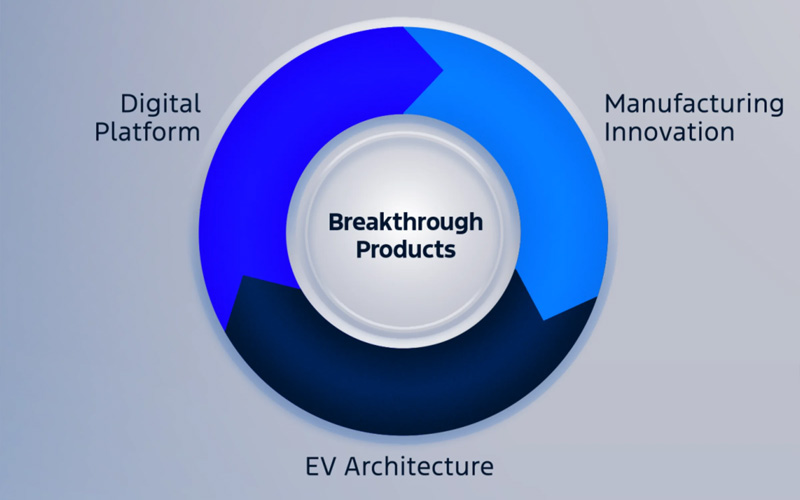
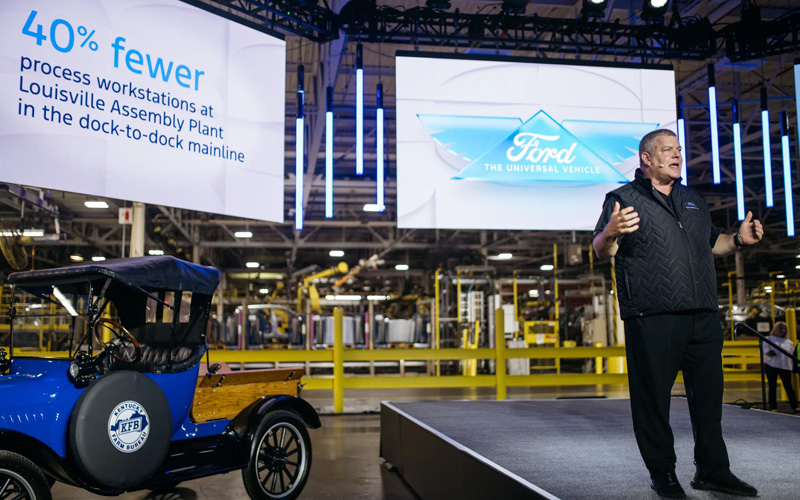
To the average car buyer, the nuances of automotive manufacturing may seem remote from the MSRP they see tacked on a vehicle at their local dealership, but in fact they have everything to do with the margins carmakers operate with. As when the Model T’s assembly line made that car affordable for the masses, Ford hopes their new “Universal EV Production System” will similarly revolutionize their business model. According to CEO Jim Farley, “We tore up the moving assembly line concept and designed a better one,” referring to the new approach as an “assembly tree.”
Farley says, “The platform reduces parts by 20% versus a typical vehicle, with 25% fewer fasteners, 40% fewer workstations dock-to-dock in the plant and 15% faster assembly time.” Ford accomplishes this via a new modular platform that incorporates “Large single-piece aluminum unicastings replace dozens of smaller parts,” parts simplifications, and improved factory ergonomics that reduce worker fatigue.
Making an “Affordable” EV pickup

Taking lessons learned from the hybrid Ford Maverick, Ford is planning the first EV built on their new platform to be a mid-size electric pickup priced at $30,000. Ford says the new truck will be “as fast as a Mustang EcoBoost,” which makes 315 horsepower (power-to-weight ratios notwithstanding, that sounds pretty good). Efficient packaging will allow for “more passenger space than a RAV4,” while the low center of gravity provided by the battery pack improves handling characteristics.
The $5 billion-dollar investment from Ford comes at a time when Toyota has been successful in slow-rolling their electrification while doubling down on hybrids and Tesla’s once booming sales have been faltering. All the same, a new more affordable approach to EVs has long been what the industry and car buyers have been calling for.
Ford says they’re planning for a 2027 launch to the new EV pickup, the first vehicle to ride their new Universal EV platform.