
Latest News
2026 Ford Maverick Review‘70s Land Yachts Ugly or Glorious?
They’re big, really big. They’re comfy, floaty, and underpowered for their size. Above all, 1970s land yachts were charmingly, absurdly over-styled.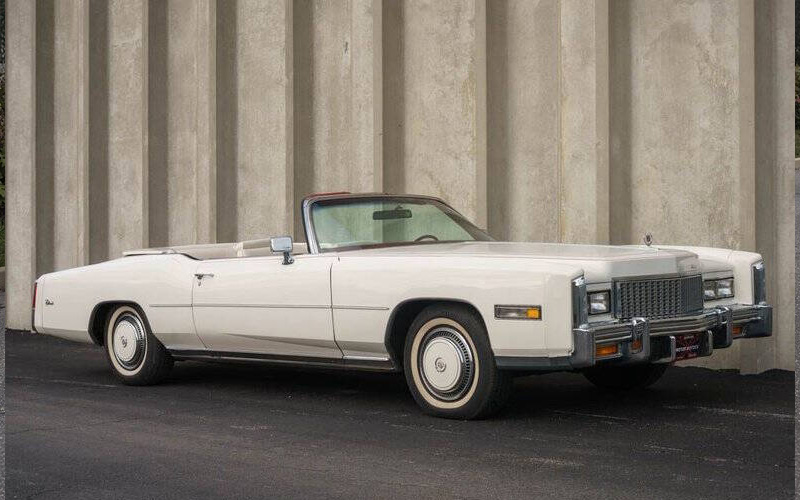
Period Correction
The greatest of classic cars are simultaneously of their time and timeless. They exemplify and define the styling conventions of their day while at the same time they are able to transcend their eras and be recognized as historically exceptional. Examples might include the Jaguar E-Type, Lamborghini Miura, or the 1959 Cadillac. Try as they might, the lavishly styled land yachts of the 1970s, though emblems of luxury in their time have not, depending on who you ask, aged well fifty years on. Or maybe the sophisticated charms of these gargantuan ’70 luxury cars are simply lost on we modern philistines.
The holy triumvirate of ‘70s land yachts is comprised of the Lincoln Continental, the Chrysler Imperial, and the Cadillac Eldorado. While there were indeed other aircraft carrier-sized sedans in production during the 1970s, these were the top models from Detroit’s Big Three automakers; the pinnacles of their respective lines. Their combination of massive size and ostentatious styling gave these luxo-barges a street presence unlike anything built today.
Below we’ll survey each of these monuments to excess and try to answer the question: are these land yachts timeless classics or bloated relics that, like disco music and polyester suits, were best left in the 1970s?
Lincoln Continental
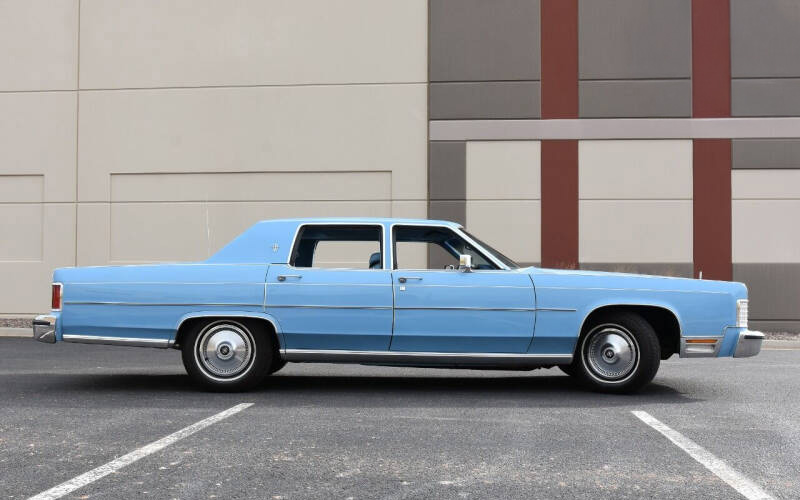
While it’s true that the Lincoln Continental, as well as the Eldorado and Imperial, had been a giant automobile for decades, the 1970s represent the peak for titanic luxury cars. The desire for smaller, more efficient cars eventually began filtering down to high-end luxury cars by the 1980s and formerly imposing cars like the Continental diminished in size. But throughout the 1970s the Continental grew from 225 inches in length in 1970 to 233 inches by 1977. Cushy, sofa-like seats and a forgiving and floaty coil spring suspension made the Continental a veritable living room on wheels.
But since we’re talking about enduring aesthetics, let us turn to the Continental’s styling, which made the most of its broad canvas. The directive from Ford’s Lee Iacocca for a revamped Continental was a Thunderbird with a Rolls-Royce grille. The eventual front-end design managed to thread that needle fairly well with its hidden headlights and hefty egg crate grille. The Continental’s opera window, located in the C-pillar and implemented for the 1975 model year, became a visual calling card for luxo-barges of the time. The spare tire hump on the trunk lid features “Continental” arcing across the top and doesn’t actually house the spare, which is inside of the trunk, a choice identical to the faux spare tire hump of the Contential Mk II of 1956.
One could argue the 1970s Continental is the superfluous luxury car, overwrought in both styling and size, largess perfectly personified.
(Chrysler) Imperial
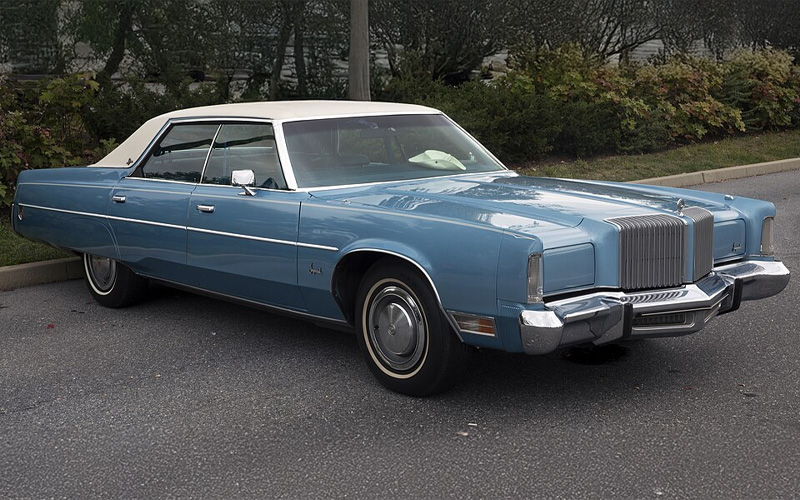
Between 1955 and 1975, Imperial was a separate luxury marque within Chrysler focused solely on the Imperial as that brand’s signature offering. It too was boat-like in its dimensions and handling. In fact, while Ford and GM gave their top-end luxury cars newfangled coil springs, the Imperial rode on a much more traditional front torsion and rear leaf spring suspension. Though the ride was a bit rougher, the Imperial’s interior was no less well-appointed than competitors with its faux wood applique and plush leather seating. Under the hood was Chrysler’s 440 Wedge V8 making 230 horsepower, decent for motivating the Imperial’s 5,000-lbs. curb weight.
The Imperial’s styling featured a striking waterfall grille and stylish hidden headlights. A pair of distinctive recessed taillights were augmented by Imperial badged side marker lights. The Imperial LaBaron Crown Coupe of 1975 sported a semi-landau roof that terminated halfway through the C-pillar and included a rectangular opera window. Compelling to be sure, but not enough to save the Imperial nameplate from being subsumed by the Chrysler New Yorker the following year.
Cadillac Eldorado
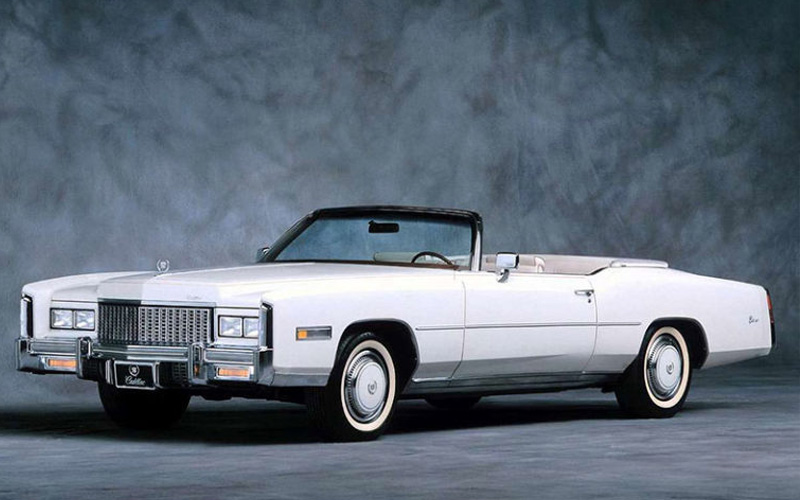
By 1971 and the advent of the Cadillac Eldorado’s ninth generation, Cadillac’s flagship long been America’s quintessential aspirational vehicle. When you’d ascended to Eldo ownership, you’d indisputably arrived. The 1971 model maintained the nameplate’s mammoth dimensions at 224 inches in length with a wheelbase of 126.3 inches. The Eldorado’s engine is one for the ages. From 1971 through 1976, the Eldorado was powered by an 8.2L (500 cu.-in.) V8 which, despite all that displacement, produced a modest 235 horsepower. Big inefficient V8s with little power defined the Malaise Era, and the Eldorado was one of the most extreme examples.
Like the Continental and Imperial, the Eldorado’s styling emphasized the horizontal line with its long and low body and offered grace notes like an opera window and vinyl landau roof options. The ninth generation also re-introduced a convertible top to the Eldorado in 1971. That year the new Eldorado achieved a new sales record for the model, moving over 27,000 units. A few years later, the Eldorado convertible was chosen as the 1973 Indy 500 pace car, of which 566 factory replicas were built.
Are these land yachts the equivalent of bell-bottoms and leisure suits with peaked lapels? Yes, in that they were the height of fashion at the time. But also, no, in that they have not aged their way into classic status they way earlier Cadillacs and Lincolns have. Though they look dated, those looks are these cars’ remaining charm. Sometimes transcending your time period isn’t necessary; merely representing it, in all this over-the-top glory, suffices.



I remember these cars when they were on the lot. I also have a 2001 ElDorado and its a very nice ride. 52k on the dial.