
Latest News
2026 Is a Pivotal Year for New Cars
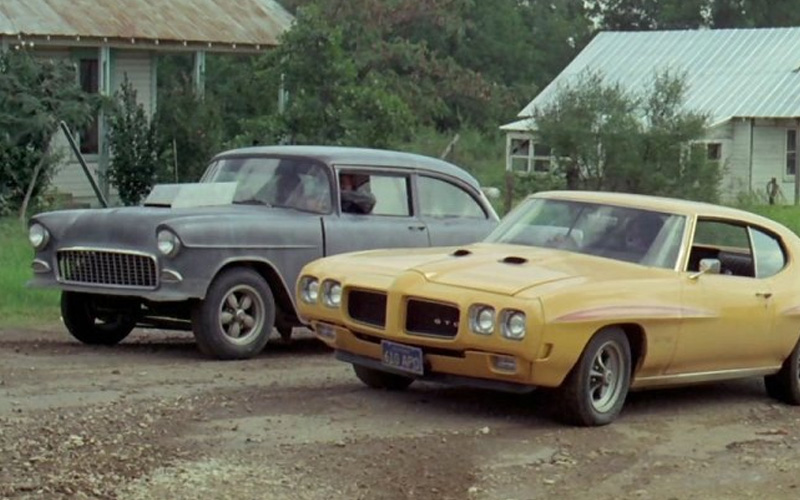
A few of our favorite cars from Two-Lane Blacktop, a 1971 cult classic starring James Taylor, a ’55 Chevy, and an Orbit Orange 1970 GTO.
Old-School Car Movies

In the late 1960s and early 1970s, there was no shortage of cool car movies that have since gone down in history as some of the all-time best car movies. You had Bullitt with its epic car chase and legendary actor Steve McQueen, the original Gone in 60 Seconds with “Eleanor”, The French Connection, and so on, and so on.
Car films of this era are known for being innovative in how scenes and chases were captured and as such, are credited with pushing the boundaries in modern car movies. It’s a fun category for any enthusiast to talk about, so check out our list of the top 10 car chase movies if you want to go deeper.
Today, we’re here to talk about the cars from Two-Lane Blacktop. It’s a film that embodied the rebellious spirit of the time and no shortage of wanderlust. It falls into a small niche of existential road movies like Easy Rider and Vanishing Point, the latter of which was released in 1971, the same year as Two-Lane Blacktop.
Drag Racing Road Trip
Now considered a cult classic, Two-Lane Blacktop was shunned by the studio upon completion and received zero promotion around its release on the 4th of July weekend of 1971. But these days, it owns a 93% approval rating on Rotten Tomatoes and a spot in the US National Film Registry after being selected by the Library of Congress.
So, it’s a good movie, but why? Well, it stars two famous non-actors in singer-songwriter James Taylor and Beach Boys drummer Dennis Wilson. They don’t talk all that much and the plot generally consists of following them on a drag racing road trip from California to Tennessee, picking up hitchhikers, and enjoying the sense of adventure – but in particular, the cars.
1955 Chevrolet 150
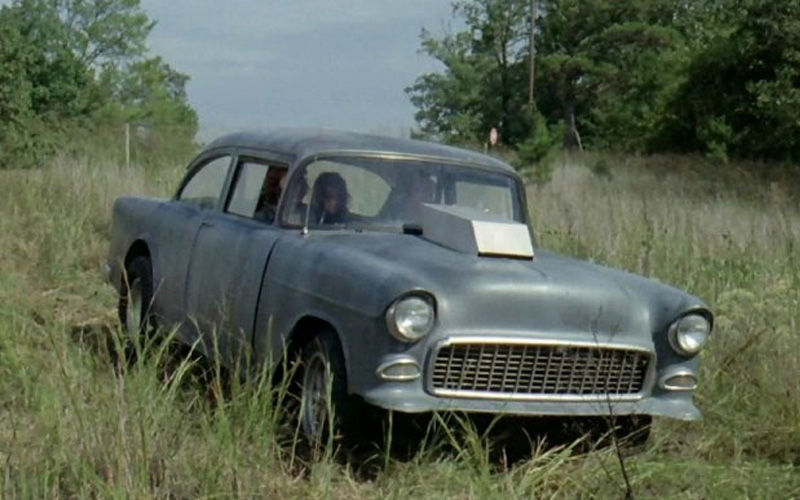
Taking center stage in Two-Lane Blacktop is a 1955 Chevy 150 driven by James Taylor who is known as The Driver with his trusty sidekick Dennis Wilson who is The Mechanic. Their ’55 Chevy is, per screenwriter Rudy Wurlitzer, “the artist’s car, made and created by people who are in love with the process of building a car.”
To that end, car builder Richard Ruth of Competition Engineering was enlisted to create the cars from Two-Lane Blacktop. For the ’55 Chevy gasser role, he built three versions. One was a stunt car, but the two cars for filming were fitted with 454 cubic inch (CID) V8 GM crate engines. They featured Weiand tunnel ram intake manifolds, dual 4-barrel Holley carburetors, aluminum cylinder heads, and Muncie M22 “Rock Crusher” 4-speed manual transmissions.
Straight axles with coilovers were fitted along with four-corner disc brakes and Positraction rear ends. The cabins were stripped and replaced by an all-black gasser look and fitted with roll cages. Outside, the steel doors, trunk, and hood panels were replaced with fiberglass, the window glass was swapped for Plexi-glass, and an aluminum mailbox-style air scoop was fitted.
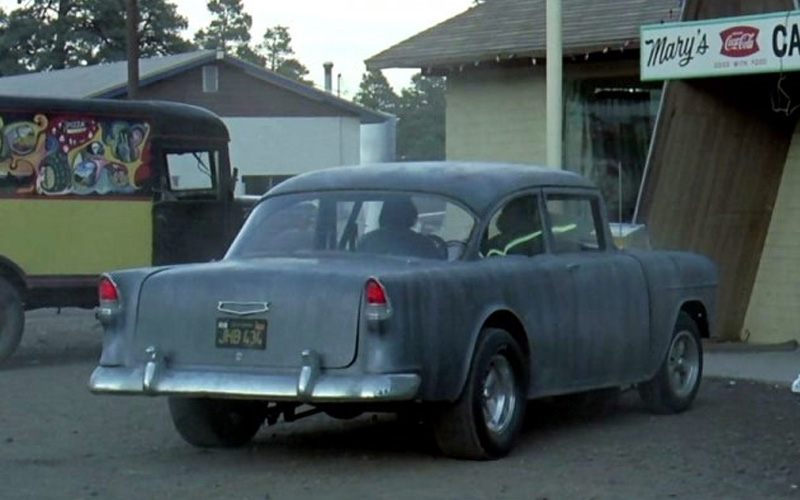
Factor in the mag wheels and period drag tires and you had impressive street racing ’55 Chevys that were far more than just prettied-up donor cars for the silver screen. So impressive that one of these Chevys was said to have been used for recording engine sounds played for Burt Reynold’s Trans Am in Smokey and The Bandit. Not only that, these ’55 Chevys were later re-purposed for use in American Graffiti.
Other stories from this hot rod include one from James Taylor himself. During shooting – which literally took place as part of a cross-country road trip – he was told to dump the clutch at 6,500 rpm as part of a racing scene with him behind the wheel. So he did, but mistakenly had the transmission in reverse instead of first gear. As a result, the drive shaft snapped off and broke through the floor into the rear cabin nearly impaling a cameraman.
1970 Pontiac GTO
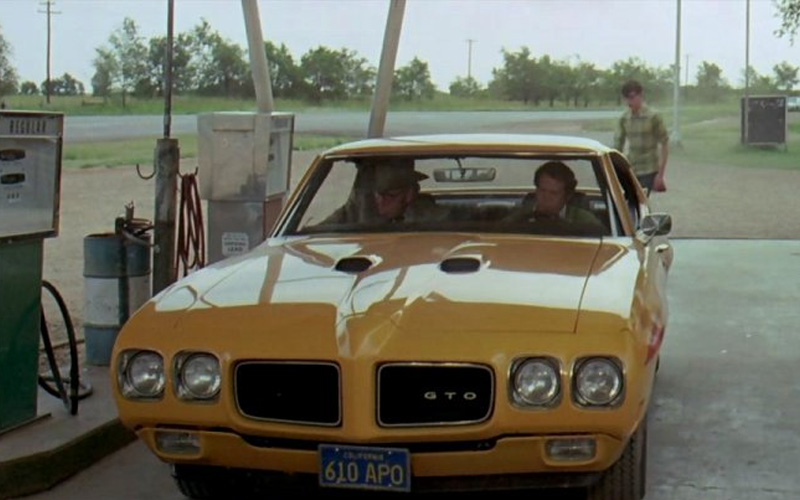
As the foil to the workingman’s ’55 Chevy gasser, the other main car from Two-Lane Blacktop was an off-the-showroom-floor 1970 Pontiac GTO finished in Orbit Orange. It was chosen as “the consumer car par excellence, a metaphor for the consumer culture. It’s absurd, but in a great way” per Rudy Wurlitzer.
Even the man behind the wheel, known simply as GTO and played by Warren Oates, was dressed the part in colorful V-neck sweaters and rolled shirt cuffs. Portrayed as an unskilled driver looking to show off behind the wheel, GTO encounters Driver and Mechanic on Route 66 east of Needles, California and they begin a cross-country race for pink slips.
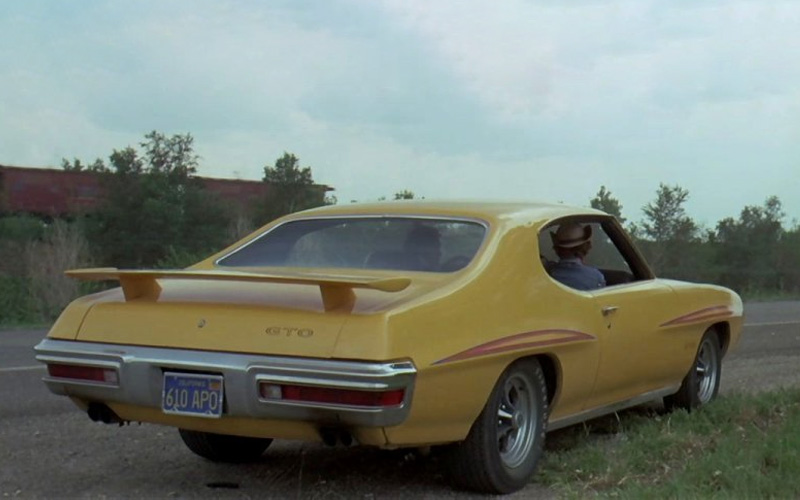
Regardless of how the film casts GTO and his car, a 1970 Pontiac GTO was one killer muscle car. It came about in 1964 when Pontiac ignored General Motors’ internal cap on engine displacement of 330 cubic inches. Instead, the GM division released an optional package on the Tempest and Le Mans named “GTO” and with it, a 389 cubic inch V8. At the time, Pontiac hoped to sell 5,000 but instead, they sold more than 32,000.
And so, the Detroit muscle car craze took off leading to ever more potent machines like the 1970 GTO, one of the primary cars from Two-Lane Blacktop. Though the GTO in the film has the looks of “The Judge” package, it lacks the decals that would confirm this. However, it does appear to have the Ram Air IV package, which brought the 400 cubic inch V8 up to 370 horsepower and 445 lb-ft of torque in factory spec.
1970 Chevrolet El Camino SS
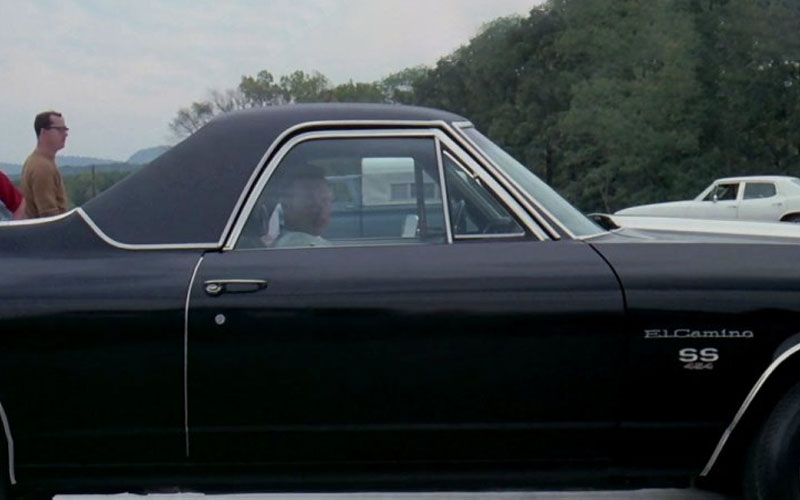
Toward the end of the film, a bet for pink slips is struck with the driver of a 1970 Chevy El Camino SS. This funky “coupe utility” vehicle was produced from 1959 to 1960 and again between 1964 and 1987. The model in the movie sports a 454 fender badge, so we know it at least had a 360-horse 454 cubic inch V8, dual exhausts, and power front disc brakes.
What we don’t know, but certainly hope, is whether it was the 454 LS6 variant. For an extra $263 and change in 1970 dollars, buyers could select this freakish high-output setup that featured solid valve lifters, a more radical camshaft, and an 800 CFM Holley carburetor. Only produced for the 1970 model year, this LS6 option was rated for a heady 450 hp and 500 torques.
1969 Dodge Charger Daytona
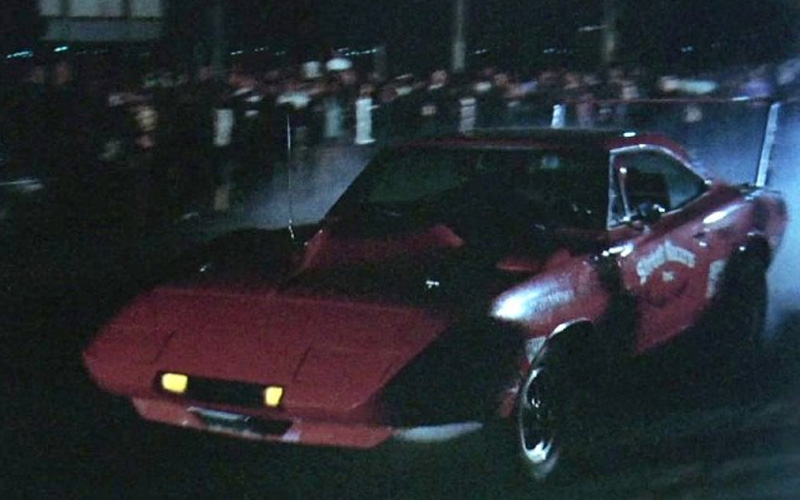
Recently, Dodge unveiled a King Daytona package for the outgoing Charger SRT Hellcat Redeye. It pays homage to the King Daytona Charger famously raced by “Big Willie” Robinson in Southern California. Mr. Robinson’s very car is featured in Two-Lane Blacktop with either a “mildly” tuned 426 CID Hemi V8 or a thundering 556 CIB brute – which converts to 9.1 liters – powering it, depending on who you ask.
1930 Ford
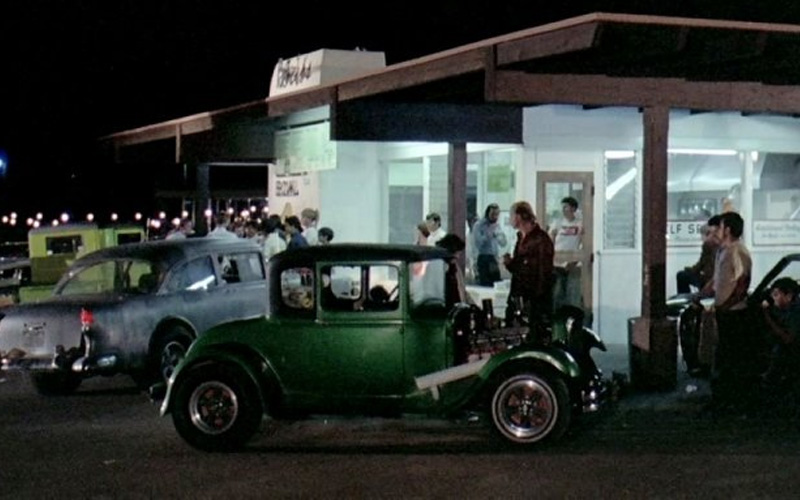
During filming in the Santa Fe, New Mexico environs, the Two-Lane Blacktop production team went looking for extras in the local gearhead community. One such fellow was Ben Cordova, a man who happened to race a 1930 Ford coupe packing a fuel-injected 427 Chevy V8. In the race scene, Mr. Cordova drives his own car but is told to lose. Which he does, but not before flames shoot out of the exhaust pipes.