
Latest News
2026 Ford Maverick ReviewTravel-Sized Mitsubishi Pajero Mini
The Mitsubishi Pajero Mini took all the trappings of its larger namesake and shrunk them down to build one of the most memorable kei cars of all time.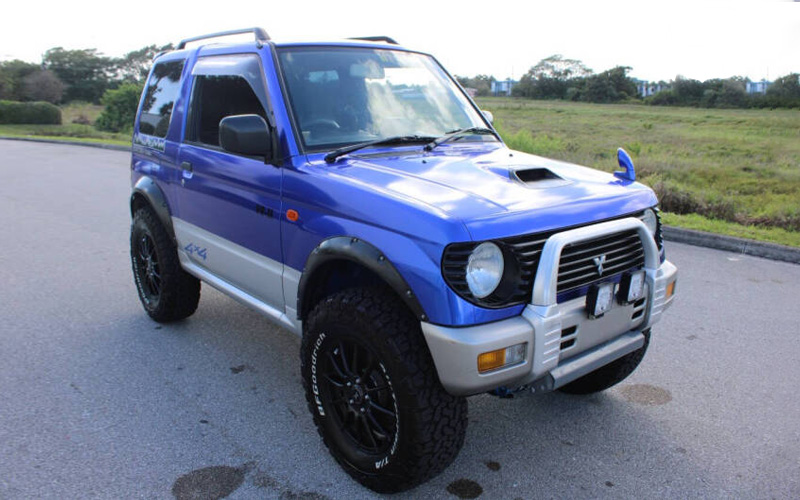
When Mitsubishi Shrink Rayed the Pajero
It’s not often, in fact I can’t recall another instance, when a carmaker creates a precisely scaled-down recreation of a popular model, but Mitsubishi did just that in 1994 with the Pajero Mini, a kei car-sized version of their Pajero SUV.
Kei cars, for the uninitiated, are a special classification of Japanese domestic cars limited in size (no more than 3.4 meters, two meters tall, and 1.48 meters wide) and in displacement (660 cc). Those cars that fall within those limits are given major tax benefits and reduced licensing fees, which can be substantial in Japan. The smaller cars reduce vehicle congestion, lower emissions, and cost less to purchase. They are also charmingly petite.
Stumbling across a 1996 Mitsubishi Pajero Mini on Carsforsale.com seemed a good excuse to revisit the kei car phenomenon. Before we get to the specific example we’ve picked out, here’s a bit of background on one of the most unique and capable 4x4s you’re likely to encounter.
Pajero, But Little
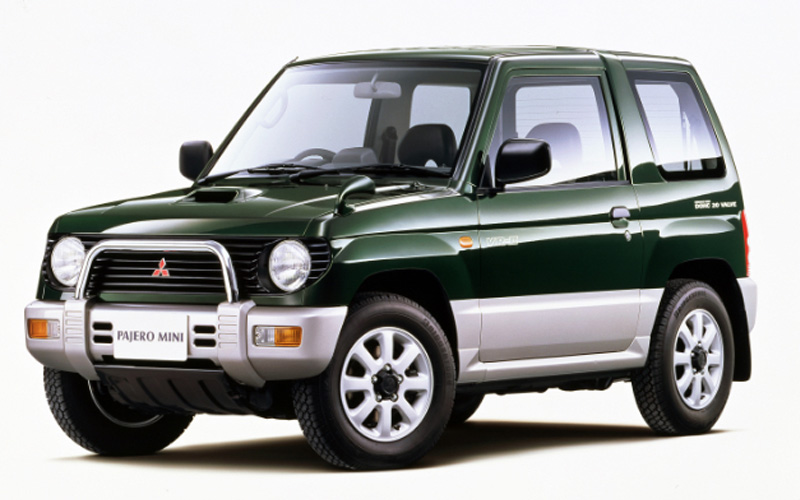
The Mitsubishi Pajero Mini debuted in 1994 as a kei car version of the carmaker’s successful Pajero SUV, which dates back to 1982. To meet kei car displacement standards, the big Pajero’s engines (2.0L and 2.4L inline-fours and 3.0L V6) are traded out for a 659-cc 16-valve or 659-cc 20-valve turbocharged inline-four. The latter was sold as either the VR-1 or VR-II, with a max output hitting the kei car limit of 64 horsepower.
That may sound puny but the Pajero Mini was indeed a miniature. Curb weight maxed out at 2,050 lbs.; that’s 800 lbs. lighter than a Miata. The kei car dimensions are likewise astonishing. The Pajero Mini stretched a mere 129.7 inches. That means the Pajero Mini could conceivably fit inside the wheelbase of the ’59 Cadillac. An 86.6-inch wheelbase and 54.9 inches of width both aid the Pajero Mini’s off-roadability. The combination of light weight and small size, including width and breakover and departure angles, make the Pajero Mini uniquely maneuverable among light 4x4s.
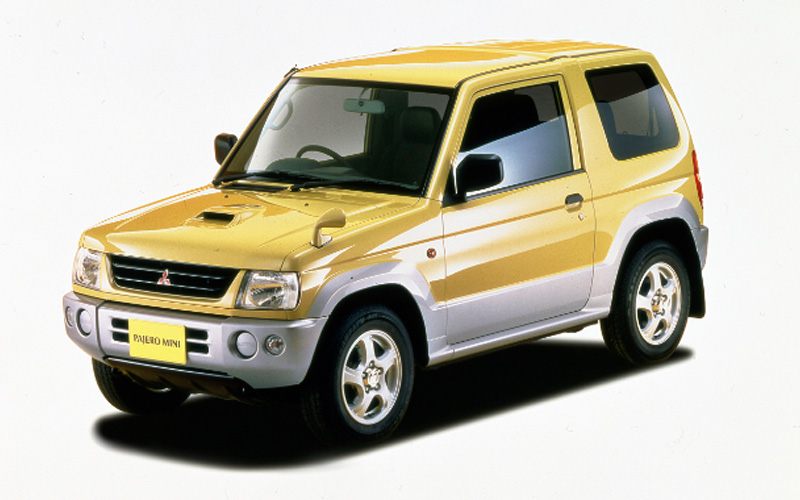
Running gear included the choice of a five-speed manual or, more commonly, three- or four-speed automatic transmissions as well as four-wheel drive (uptake was roughly six-to-one version the two-wheel version). In addition to the turbocharged engine, the VR-II version came with two-tone paint, chrome accenting, and alloy wheels.
Despite its small stature, the Pajero Mini offered more than ample room for front-seat passengers, even those above six feet tall. The backseat was, of course, a different story and best left to small children, pets, and luggage.
The Pajero Mini was successful enough to garner a second generation starting with the 1998 model year and running through 2012. Like the first generation, the second-gen Pajero Mini ran on 16- and 20-valve 660-cc inline fours and featured styling and amenities similar to but scaled down from the full-size Pajero proper.
This Pajero Mini
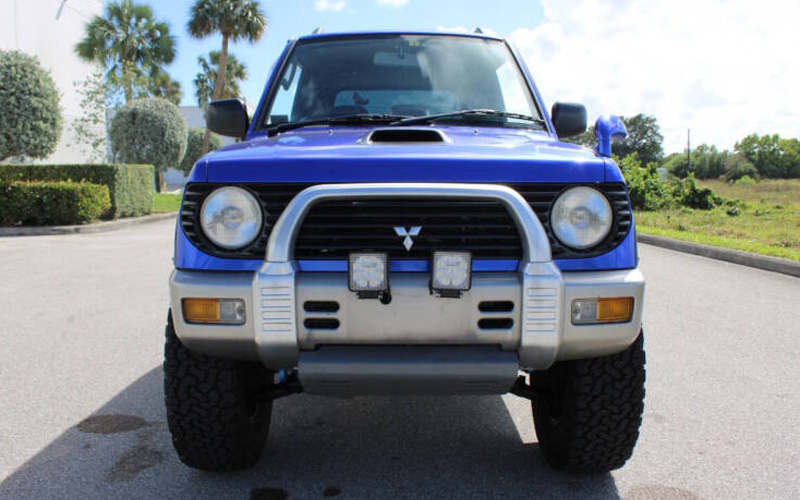
One of the great charms of the Pajero Mini is how the larger version’s signature characteristics were downsized. This 1996 model year example is a VR-II version equipped with the surprisingly peppy turbo four-cylinder. Like all things miniature, the Pajero Mini is a study in detail all adapted from its larger namesake. Consider the sign-out tailgate carrying the spare tire, note the cleaver rear bumper cutaway to accommodate. There’s the very Japanese fender side mirror. These may not have caught on in the States but perhaps they should have for what they lack in aesthetics they make up for in utility, effectively eliminating the far-side blind spot. While the larger Pajero situates the hood intake on the passenger side the Pajero Mini’s diminutive size allows for it to be centrally located here.



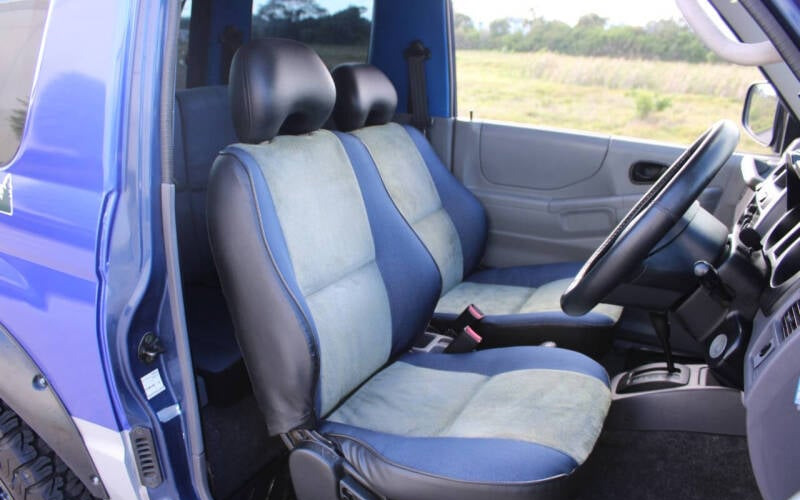
Proper 4×4 nods include the roof rails for added cargo capacity. Bolt-on fender flares accommodate new BF Goodrich all-terrain tires. Spotlights up front add another layer to the Pajero Mini’s off-roadability. A small rear spoiler adds to the Pajero Mini’s prodigious character as does the VR-II two-tone paint scheme, here in blue and grey, and some very 1990s style decals, including an idyllic scene of wildlife, a sunset, and mountains (very rad). The interior features cloth seats, AC, an aftermarket navigation system, and a four-speed automatic transmission.
This 1996 Mitsubishi Pajero Mini VR-II is listed for $27,000.