
Latest News
2026 Toyota Grand Highlander Review
In this deep dive article we consider the history of Monster Trucks complete with high flying antics, supercar levels of horsepower, and a whole lotta mud.
Humble Beginnings to a Billion-dollar Industry

The massive and iconic machines that defy gravity with enormous wheels and supercar power we know as Monster Trucks have a rich history. For decades now, they’ve captured the imagination and attention of millions of fans around the globe. Today, we’re going to take a look at that history, find out how the sport has changed, and where it’s likely headed in the future.
The Birth Of The Beasts
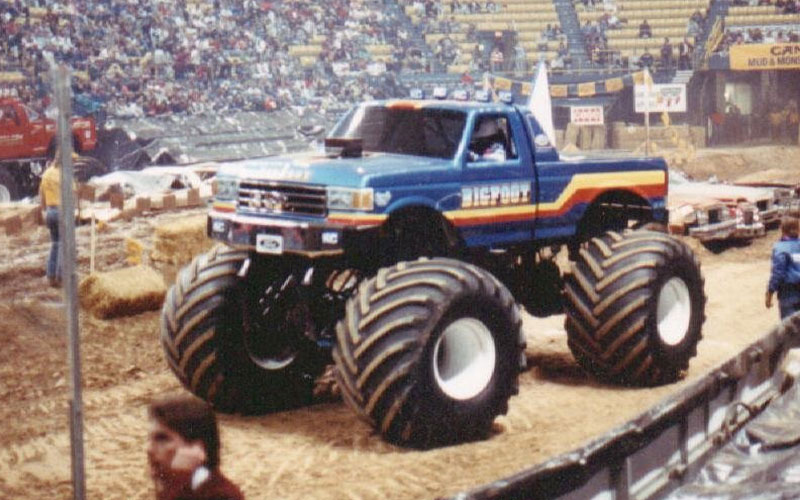
There was a time in the early 1980s when the term monster trucks referred to just a few unique vehicles. Before that, off-road enthusiasts Bob Chandler, Jeff Dane, and Fred Schafer engaged in all manner of automotive enthusiasm from drag racing to muddin. The trio would however help to give birth to what we all know today as Monster Trucks.
Debate continues to rage even now over whether or not Chandler or Dane was the first to build what we’d consider today to be a monster truck. Chandler is the man behind Bigfoot, a Ford F250 with four-foot tires, 2.5-ton axles, and a Merlin big block engine under the hood. He and Bigfoot are often credited as the genesis of monster trucks. History confirms that it was Bigfoot that was first dubbed a monster truck so there seems to be some validity to that claim.
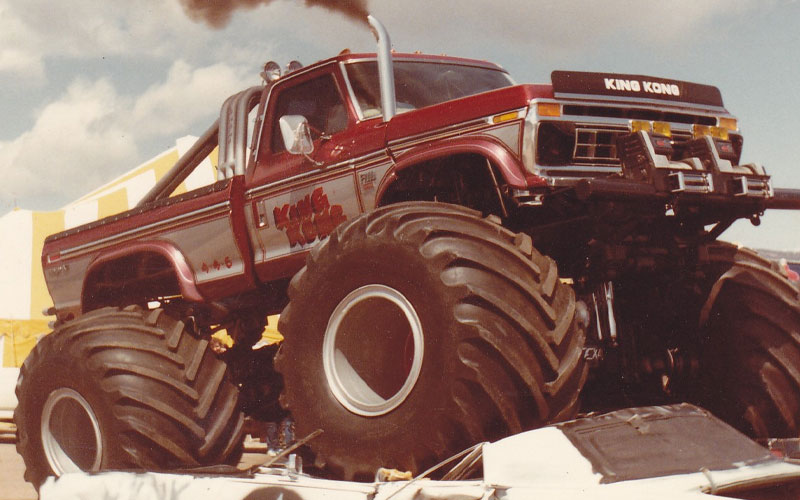
Dane, for his part, crafted King Kong, another F250 which was the first to ever publicly crush a car underneath its gigantic frame and tires. Then there was Schafer who was the third to build just such a truck but he did so with a Chevrolet Silverado that leveraged a supercharged alcohol-fueled 454 V8 under the hood. Schafer called his creation Bearfoot as a nod to his literal pet black bears Sugar and Spice.
These three enthusiasts were the beginning of monster trucks. The trio would attend one appearance after another across the country, crushing cars, pulling tractors, and kicking up mud wherever they went. Sometimes they’d appear together but most often they were one truck shows. That became even more true as the 1980s went on. Bearfoot specifically appeared in a ZZ Top music video, on an episode of Knight Rider, and in multiple commercials.
The nation became enraptured in the fuel-burning machines and other builders came online with creations like Frankenstein, King Krunch, and Blue Thunder. These trucks weren’t built up production trucks but instead featured bespoke or military chassis with full roll cages in place for safety. The stage was set for monster trucks to gain even more traction and an even larger fandom.
Taking The Next Leap
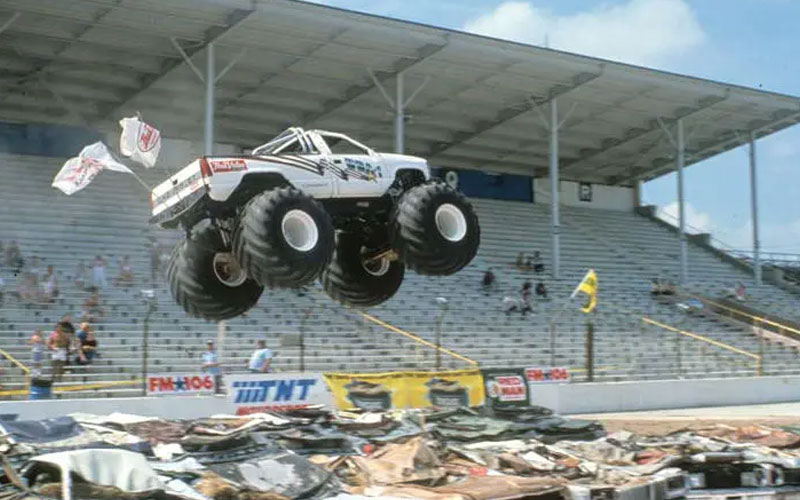
It’s one thing to have a bunch of independent monster truck owners putting on exhibitions around the nation and a whole other thing to have an organized sport. Throughout the remaining years of the 1980s, that transition wasn’t a sure one but more and more monster truck builders and drivers came into the community.
Then, in 1988, TNT Motorsports, the sanctioning body of truck and tractor pull sports put on the very first Monster Truck Challenge. Events debuted on ESPN to major success. Sponsors signed up left and right to support the new sport and truck owners were making hand over fist. In 1990, SRO/Pace, a promoter who owned the rival United States National Hot Rod Association, acquired TNT.
This acquisition caused a lot of controversy: as part of its takeover it reduced the amount of cash that drivers could make per event. Some, like Bigfoot, left the scene. That didn’t stop Monster Trucks from continuing to grow in popularity though. The USNHRA put on the first Monster Jam in 1992. Modern-day monster truck events as we know them now were born.
The Technical Revolution of Monster Trucks

Big trucks that can drive over anything and kick up mud are fun but they’re not enough to maintain worldwide fandom. Instead, the trucks and the experience need to be constantly improving in one way or another. In the 1980s and 1990s, the big innovations came in the way of reliability. Builders found creative solutions like increasing suspension travel to keep trucks from breaking. They also managed to shoehorn bigger and bigger engines under the hood.
The introduction of Monster Jam made a big difference as well since the competition was clearly structured around various events. That made it easier for fans to understand what was going on and how to keep track of which trucks were leading the competition. Innovations in safety and engineering technology meant that high flying jumps and stunts became commonplace.
Today, the experience has improved even further. Monster Jam events today consist of four sections: racing, two-wheel skills, donut competition, and freestyle. Each competition demonstrates unique attributes that only a monster truck possesses. Fans get to be part of the action as well since judging is now done by the fans via a score-tracking website.
What The Future Looks Like
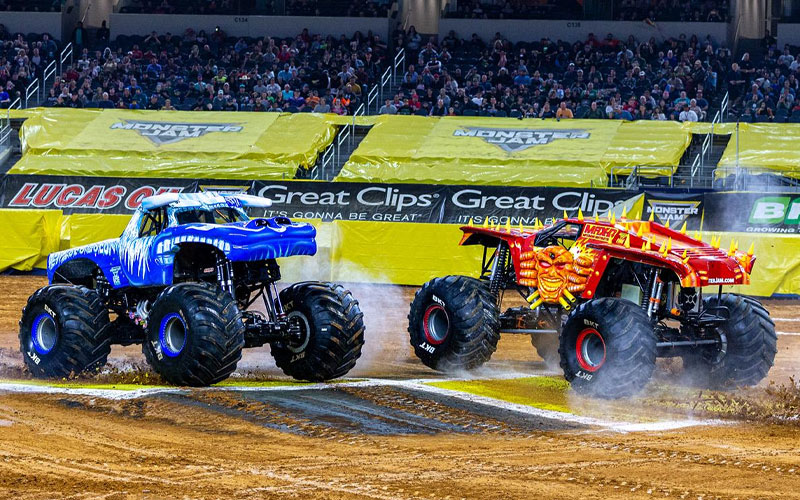
There’s no question that the world of monster trucks has a big green elephant in the room. These machines aren’t exactly what one would call eco-friendly. The cost in moving their communal circus around the globe is itself a massive pollutant. So how will Monster Jam continue to exist in a world that is trying to become more carbon neutral? There are a number of potential solutions.
Monster truck builders will likely begin to incorporate some level of electrification in their trucks soon. While electric vehicles often carry heavy batteries we expect innovation to continue and for monster truck builders to leverage that technology to continue their passion.
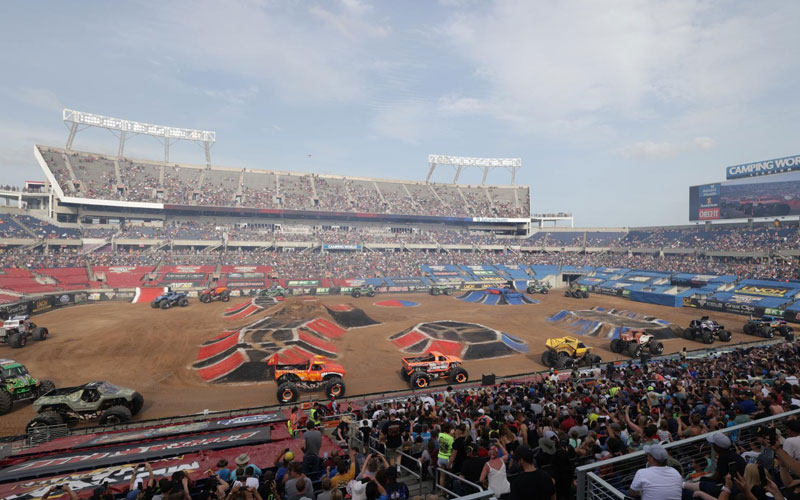
Monster Jam can follow the course already set by Formula 1 and reduce its travel costs. F1 has done so by reducing the amount of stuff it brings to each race, reducing the distance it travels, and by prioritizing the most fuel efficient way to travel.
One thing is clear. The world loves Monster Trucks and monster truck drivers are a scrappy bunch that are happy to live on the bleeding edge of engineering. If that’s not a combination for decades more of high flying car crushing action we don’t know what is.