Latest News
Hands on with the 2026 Acura ADXNissan Ariya Delay Extends to Next Year

The global chip shortage has hooked the all-electric Nissan Ariya SUV, delaying its American arrival to at least next year.
Chip Shortage Hampers Ariya Production

The global semi-conductor shortage has snagged another victim, the 2022 Nissan Ariya. Slated to go on sale in Japan right now with U.S. sales targeted towards the end of this year, that schedule has been bumped by about 6 months. Asako Hoshino, Nissan’s Executive Vice President, commented that Japan can expect deliveries this winter with Europe and the US seeing the new Ariya in 2022.
According to a company spokesperson, “Nissan is facing various industry challenges, including the semiconductor shortage. Our priority is to ensure that we deliver the all-new, all-electric Nissan Ariya to customers with the highest level of quality and care.” In other words, the new, tech-laden, electric SUV requires a lot of processing power and Nissan does not want to ship a diluted version.
A Peek at Nissan’s Next Electric Vehicle
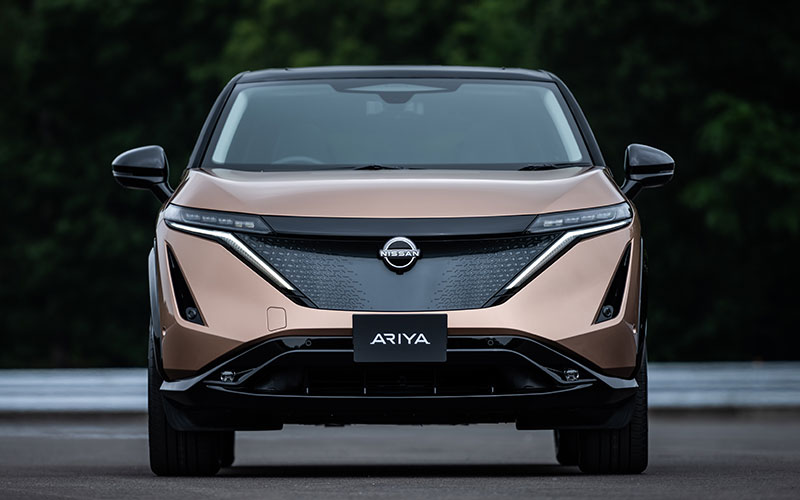
Nissan’s first all-electric vehicle since it’s Leaf sedan debuted in 2011, the Rogue-sized Ariya has Nissan dealerships salivating thanks to its claimed 300-mile range and semi-autonomous driving skills. Ford and Volkswagen have beaten Nissan to the punch with their Mustang Mach-E and ID.4, so the company can ill afford to fumble the Ariya launch.
It is coming to market in two flavors. A likely $40,000 base model will have a 63-kWh battery pack, plus a higher-end model with 87-kWh of juice. That top-tier version is expected to offer 300 miles of range with it’s dual-motor, all-wheel drive setup – one up front and one in the rear. The new Ariya will also feature Nissan’s ProPilot 2.0 system, which promises hands-free semi-autonomous driving capability.
As the electric vehicle segment heats up, Nissan has an opportunity to shine with their new SUV. Like the new Ford F-150 Lightning, the Ariya will use the CCS charging standard meaning it can double as a home power station when parked. Other notable features are the “magic carpet” interior with a completely flat floor, front to back. There is also a single-piece infotainment interface, that blends two touchscreens, at different distances, so that the driver’s eyes can pan more smoothly side-to side.
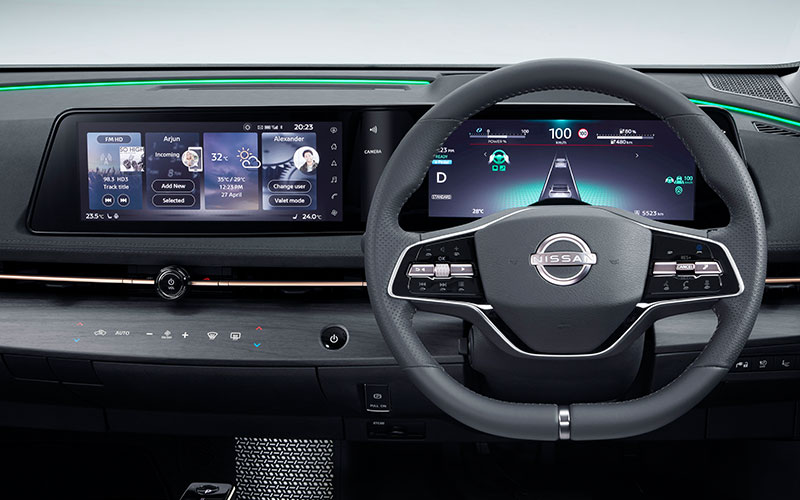
It remains to be seen how these new all-electric SUVs will sell here in America. Hoshino expects demand to be highest in Europe, noting “I think in Europe, (the Ariya) will of course contribute to (the overall) unit sales.” If the new Ariya can deliver 300 miles of range and qualify for the $7,500 federal EV tax credit, it seems poised to be a popular with American consumers as well.
Those buyers will find a sleek, minimalistic interior and Nissan’s Zero Gravity seats. The blended touchscreens are both 12.3” in size, one for infotainment and the other for gauge cluster duty. Amazon Alexa will be on hand, the rear-view mirror doubles a live-feed video stream behind the vehicle and a color, heads-up display makes semi-autonomous driving all the easier.
2022 Nissan Ariya, Coming Eventually
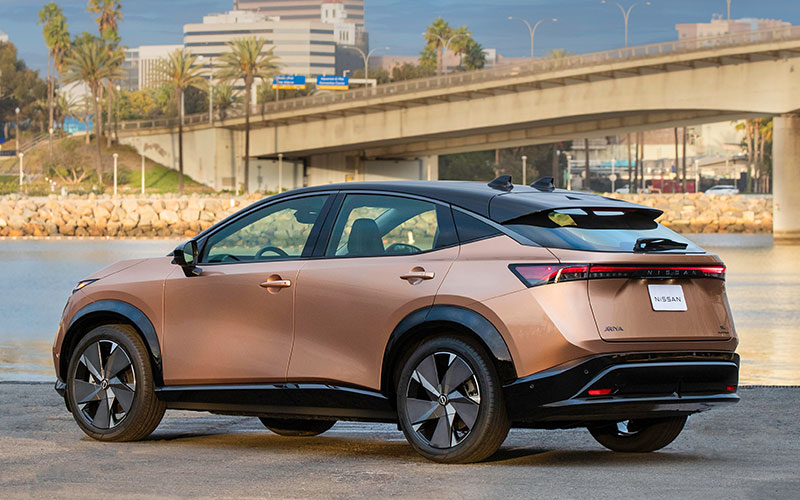
Reservations for the Nissan Ariya are coming later this year, as of now. But this ongoing semi-conductor shortage could throw another wrench into that timing. Intel CEO Pat Gelsigner commented, in an April Wall Street Journal article, that this global squeeze on chips could stretch for two more years. Given all the semi-conductor juice required to make the Ariya deliver on its high-tech promises, prospective buyers might not want to hold their breath.