Latest News
2026 Chevrolet Suburban Review
An unlikely collaboration between Mercedes-Benz and McLaren gave us one of the era’s most unique and compelling supercars, the Mercedes-Benz SLR McLaren.
Mainstream Supercar
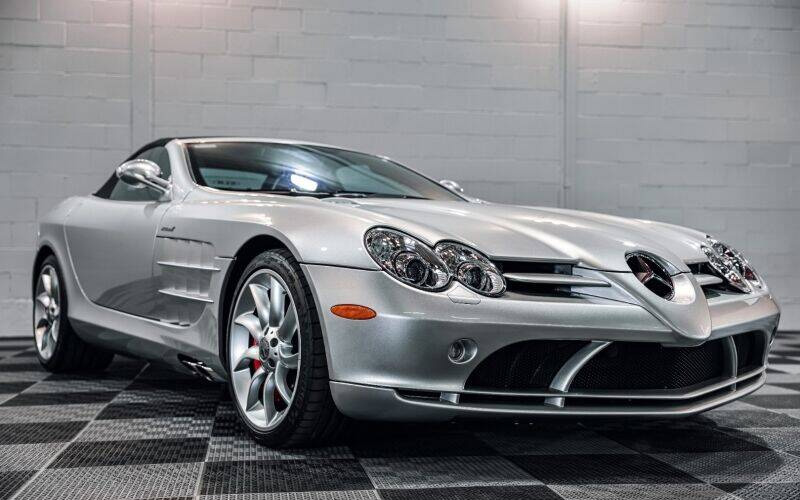
Proper perspective is often a function of time. The true value, uniqueness, and significance of something only becomes clear when we can finally situate it within a historical context. At the time of its debut in 2003, the Mercedes-Benz SLR McLaren was emerging alongside a couple of other notable European supercars, the Porsche Carrera GT and the Ferrari Enzo, perhaps you’ve heard of them. Compared to those rear mid-engine cars, with their overwhelming sensory experiences affairs, the relatively laidback SLR might have seemed a step behind.
And yet, appreciated in context for what it is, the Mercedes-Benz SLR McLaren is clearly, twenty years on, one of the best, most thrilling, most unique cars to come out of the early aughts. That’s because the SLR is not one thing. It is not a British supercar. It is not German muscle car. It is not a proper European Grand Tourer. Instead, the Mercedes-Benz SLR McLaren is all three of those things at once.
The Mercedes-Benz SLR McLaren Background
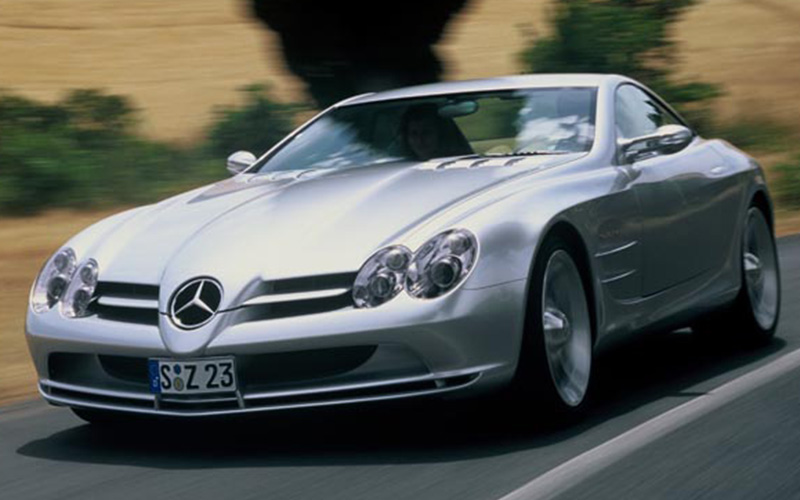
The Mercedes-Benz SLR McLaren, as the name suggests, is an improbable collaboration between the venerated German mark Mercedes-Benz and McLaren, the boutique British maker of racecars and supercars. Back in 2003, Mercedes held a forty percent stake in McLaren and was hard at work building engines for McLaren’s F1 team.
The Mercedes-Benz SLR McLaren was based on Mercedes’s 1999 Vision SLR concept and designed by McLaren’s Gordon Murry, the creator of the legendary F1, considered one of the greatest supercars cars ever built. The SLR was intended to harken back to the great racing Mercedes of old, including the Silver Arrow and the 300 SLR, but with McLaren leveraging their performance engineering.
SLR Rips and Rumbles
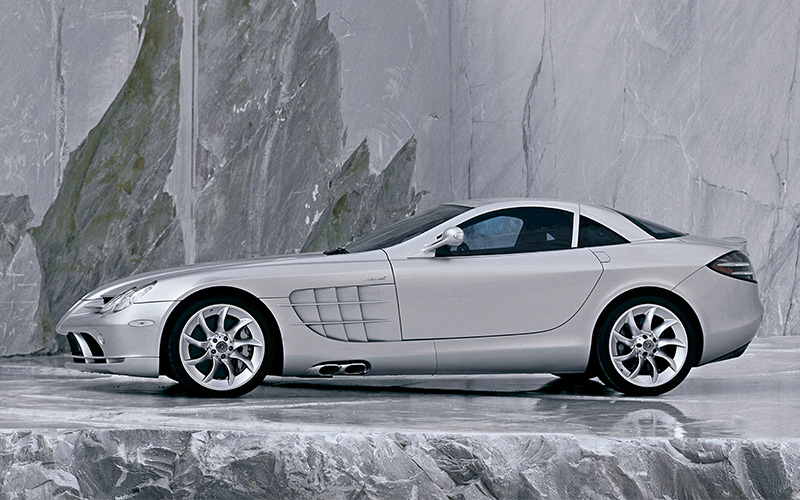
The Mercedes-Benz SLR McLaren debuted in 2003 (as a 2004 model year car). Despite the Mercedes badging, the car was built in McLaren’s facilities in the UK. The SLR came equipped with a hand-built all-aluminum twin-screw supercharged 5.4L V8. This engine produced 617 horsepower and 575 lb.-ft. of torque and came paired with a 5-speed AMG SPEEDSHIFT automatic transmission. Stopping power was provided by carbon ceramics on all four wheels, eight piston front and four piston calipers in the rear.
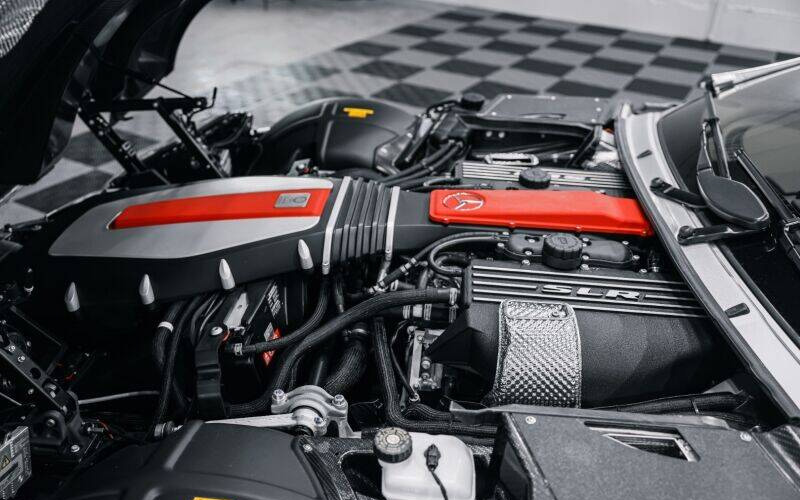
A few notes on each of these. The supercharged 5.4L V8 might not appear on paper as extraordinary as the Carrera GT’s V10 or the Enzo’s V12, but the SLR’s V8 gives the car a lot of its character. A zero-to-sixty sprint of 3.3 seconds is fast even by today’s standards but the combination of supercharger whine and the V8’s rumble gave the SLR an auditory signature worthy of today’s Dodge Hellcats. The five-speed automatic transmission can feel a bit dated by today’s standards, spoiled by the smoothness of dual-clutches. Though the SLR offers manual paddle shifting, the shift delays are comically slow and by all accounts, it’s best to leave shifting to the transmission. Those carbon ceramics, specifically used for their heat resistance, fight brake fade up to 2,200 degrees Fahrenheit (on Top Gear’s Jeremy Clarkson got them to glow orange!). They were also known for biting hard, requiring time with the car to acclimate to their aggressiveness.
The SLR was indeed fast off the blocks and handled well, but where it truly excelled was at speeds over 100 mph, a realm where most ordinary and even many performance cars become scary. The Mercedes-Benz SLR McLaren by contrast was most at home between 100 and 200 mph where Murry and McLaren’s engineers had dialed in the suspension, chassis, and weight distribution for maximum stability.
German Engineering + British Engineering
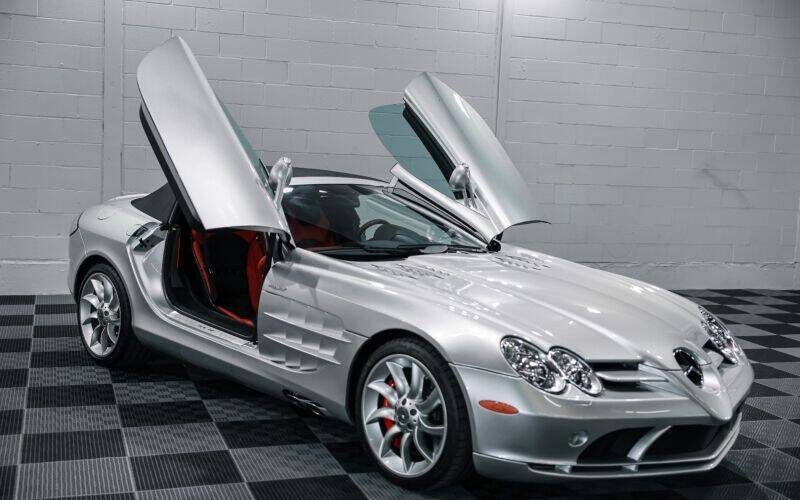
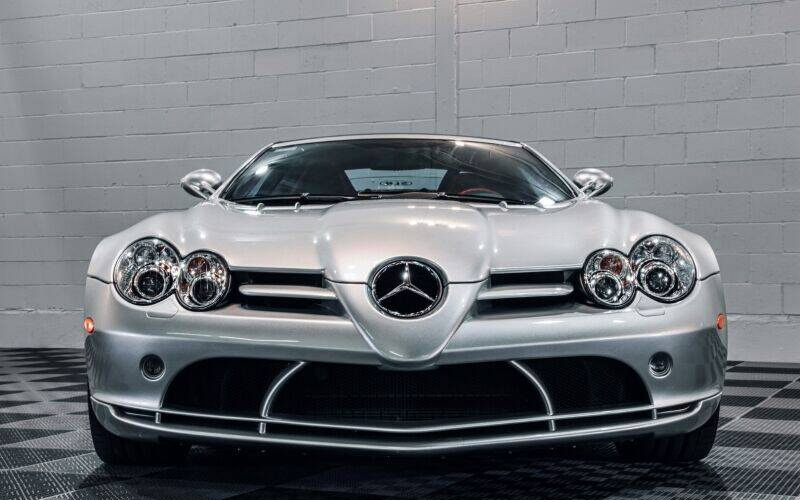
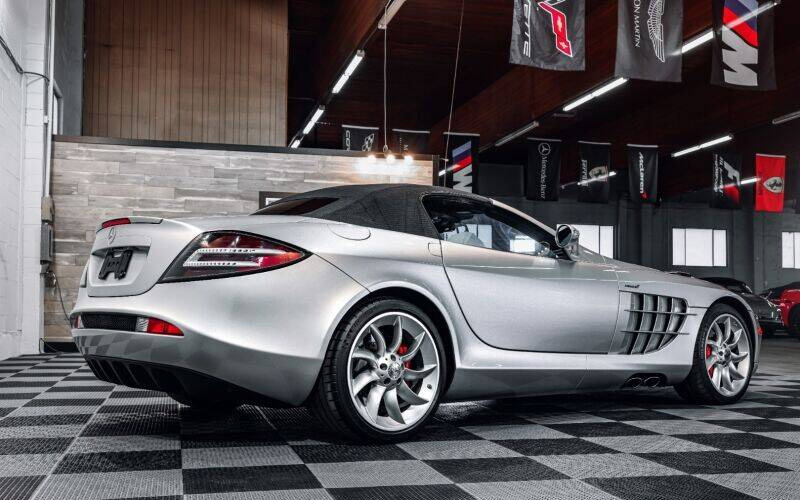
It is one of the wonders of the automotive industry that two nations known for buttoned-down, exacting engineers in the Germans and the Brits together inevitably produced one of the quirkier supercars of the twenty-first century in the Mercedes-Benz SLR McLaren. The SLR delivered performance, sure, but it also delivered unusual design choices.
Among these are supercar features like the automatic air brake spoiler in the rear, set to deploy at a default of 10 degrees (manually adjustable up to 30 degrees). Another is the car’s butterfly doors and clamshell hood. The mid-front engine position gave the SLR a long hood and a rearward seating position that gave it all the feel of a real life Batmobile. And then there are the vents in the side and hood of the car. The undercar aero paneling precluded sending the exhaust all the way to the rear, so engineers gave the SLR side pipes instead.
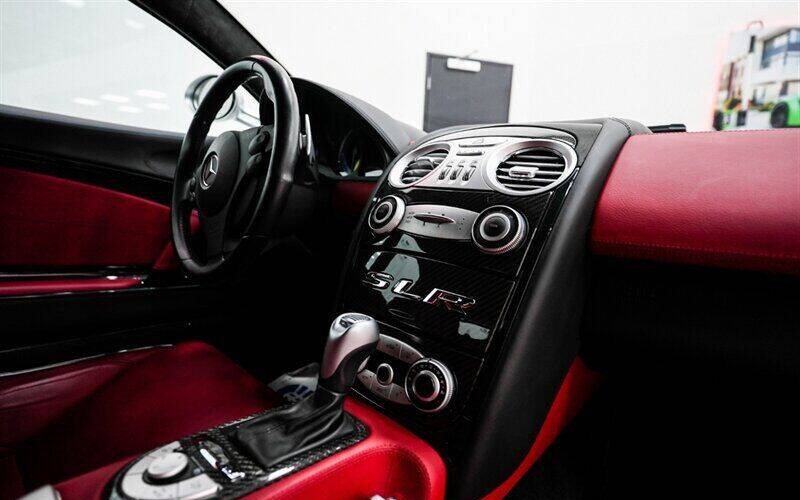
Inside the SLR is no less unusual. Some common features you might struggle to find include how to start the car. The car has a traditional key, but starting the SLR is done by inserting it, turning it, and looking to the shift knob where, hidden by a metal flip cover, is the start button. Opening the doors and windows takes some button hunting as well, they are located down near the door sill where you’d typically find the fuel door release in “normal” cars.
The SLR’s Many Variants
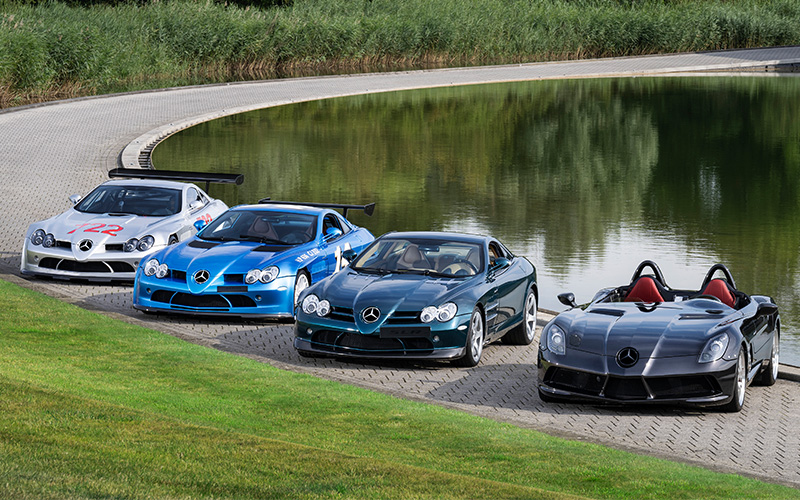
Production on the Mercedes-Benz SLR McLaren resulted in seven model years, from 2004 through 2010 for a total of 2,157 cars. Some of those included special variants like the 722 Edition. This 2006 variant was named after the departure time of Sterling Moss when he set the record for the Mille Maglia in 1955 in a Mercedes-Benz 300 SLR. The 722 Edition Mercedes-Benz SLR McLaren featured a tuned version of the car’s V8, bumped up to 641 horsepower and capable of a top speed of 209 mph. 150 of these were built. A roadster version, the 722 S, was released in 2009 with another 150 units produced. Mercedes and McLaren also built a racecar version, the 722 GT which shed some 877 lbs. from the road car and juiced to 671 horsepower.
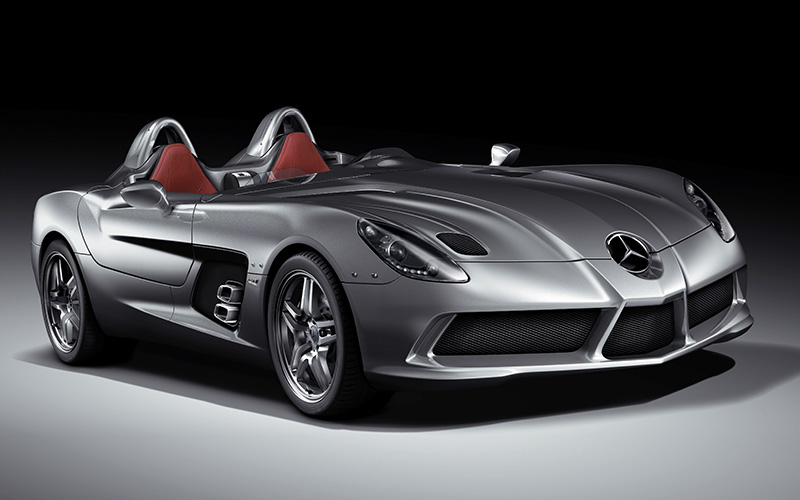
Most striking of the SLR variants is without question the SLR Sterling Moss, built in 2009. This speedster sans windshield was designed by Yoon Il-Hun to reference the original 300 SLR. A scant 75 units were built and sold exclusively to customers who’d already purchased an SLR. A brace of 25 continuation cars, the McLaren Edition, featured special body work.
The Mercedes-Benz SLR McLaren might have been overshadowed in its day by the bright shining lights of the Porsche Carrera GT and Ferrari Enzo. But twenty years later, the Mercedes-Benz SLR McLaren is finally getting the respect it deserves as one of the coolest and most unique supercars of this century.