Latest News
2027 Chevrolet Equinox Review
Stellantis unveils plans for a major EV push that will see electrification across brands like Jeep, RAM, and Dodge.
Turning the Page
Stellantis, the newly formed parent company to some 14 automotive brands that including Jeep, Dodge, RAM, Peugeot, Maserati, and Fiat, recently unveiled its multi-year, multi-billion-dollar electrification initiative. Automotive companies the world over are committing billions of dollars toward this pivot away from internal combustion with GM, Volkswagen, Ford, and others laying out ambitious EV targets and backed those targets with major financial commitments.
With unique brands like Dodge and Jeep, and arguably the best full-size truck on the market in the RAM 1500, Stellantis’s electrification plans can be seen as something of a bellwether for what is likely the most significant shift in personal transportation since the dawn of the automobile itself.
Big Money, Big Ideas
Stellantis said it plans to commit some $36 billions dollars over the next five years with a goal of offering an electrified version of nearly every model by 2025. By 2030, Stellantis said it aims for electrified vehicles to represent more than 70% of total sales in Europe and more than 40% in the US. Significantly, while this “electrification” will include a mix of hybrid and full electric vehicles, the majority will be BEV (battery electric vehicles).
To get from here to there, Stellantis is employing four new EV platforms which breakdown as follows. The first three STLA (stella) platforms will be unibody constructions. The STLA Small, intended for smaller city cars, will have a maximum range of 300 miles. The STLA Medium, which Stellantis says in intended for their premium-level vehicles, will offer a maximum 440-mile range. The STLA Large will offer up to 500 miles of range and play host to AWD and future electric muscle cars (whatever Dodge has planned). The final platform will be the body-on-frame STLA Frame intended for trucks and commercial vehicles and feature a maximum 500 miles of range.
These platforms will carry battery packs ranging in size from 37 to 200 kWh. Stellantis says they plan to initially offer both high energy-density batteries and a nickel- and cobalt-free alternative by 2024. Additionally, plans are in the works for a version of a solid-state battery by 2026. Despite recent advanced in solid-state technology, five years to market, even for deployment in fleet vehicles, feels ambitious.
Bold New Directions
Like the rest of the industry, Stellantis is pitching its electrification push as a net positive not just in the fight against global warming but for the consumer experience as well. While this is obviously wise marketing, Stellantis’s portfolio does offer some unique opportunities as we’ll see below.
RAM
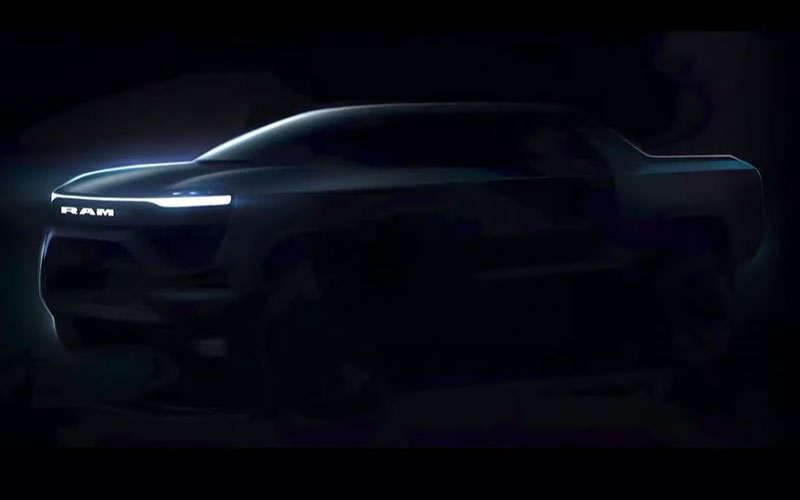
In the perpetual one upmanship that is the full-size truck segment, the RAM is known for bringing it to the competition. The screaming, HEMI-hearted RAM TRX was a brilliant answer to the Ford Raptor, and you can expect that their response to the Ford Lightning will be no less impressive. As part of Stellantis’s big EV day reveal, RAM only offered a few tea leaves in the form of a silhouette image of their future electric truck. While details were scarce, it’s immediately clear that the RAM EV will be more futuristic in its bearing than the relatively conventional Ford Lightning. It’s not Tesla Cybertruck, to be sure, but the outline is a clear departure from the RAM 1500 and its current cohort.
RAM says their new EV pickup will be built on the STLA Frame platform and feature a 159-200 kWh battery pack good for up to 500 miles of range. They also plan to offer on-board charging and fast charging capabilities up to 150 kWh.
Release of the RAM EV is slated for 2024. Though RAM has proven that benchmarking the competition and then delivering the superior product has been a winning formula for them, 2024 feels like a long way off considering the Ford Lightning is already out and a bevy of upstarts like Rivian, Lordstown, and Bollinger all have electric trucks coming to market in the next few years.
Dodge
Dodge’s pivot to electrification is both tricky and intriguing. The brand synonymous with silly, giggle-inducing amounts of raw V8 power will be ditching the petrol for kilowatts. But Dodge is insistent that their brand is about power, not where it comes from. To that end, Dodge acknowledges that their last hurrah, the Hellcat versions of the Challenger, Charger, and Durango are reaching the upper bound limits of what is possible with internal combustion.
Enter the new STLA Larger platform with up to a 200kWh battery pack and 500 miles of range. With electrification, Dodge aims to deliver even greater levels of acceleration. Their pledge of 0-62 (100 km) per hour times in the 2 second range would keep Dodge’s EV muscle car right in line with the fastest Tesla and Porsche have to offer.
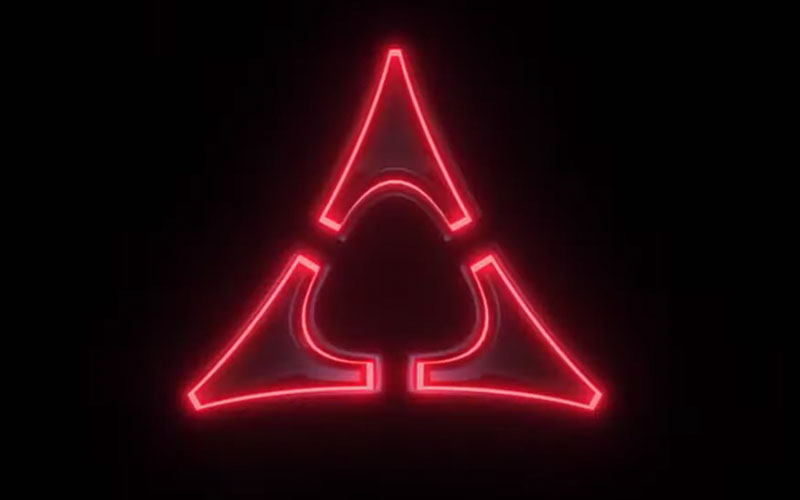
Dodge hasn’t said what name their new EV muscle car will carry, or whether it will come with two or four doors. They did, however, tease a logo, the Fratzog logo dating back to the 1950s and ‘60s. Which might indicate something other than just a Challenger version of the Mustang Mach E.
Jeep
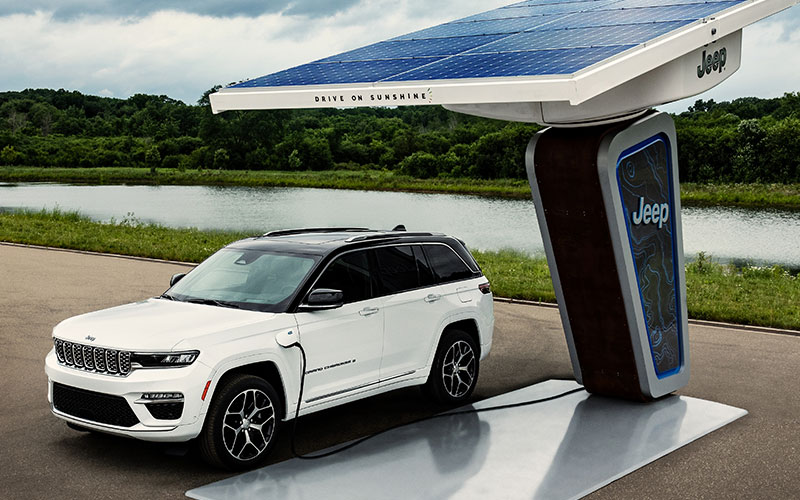
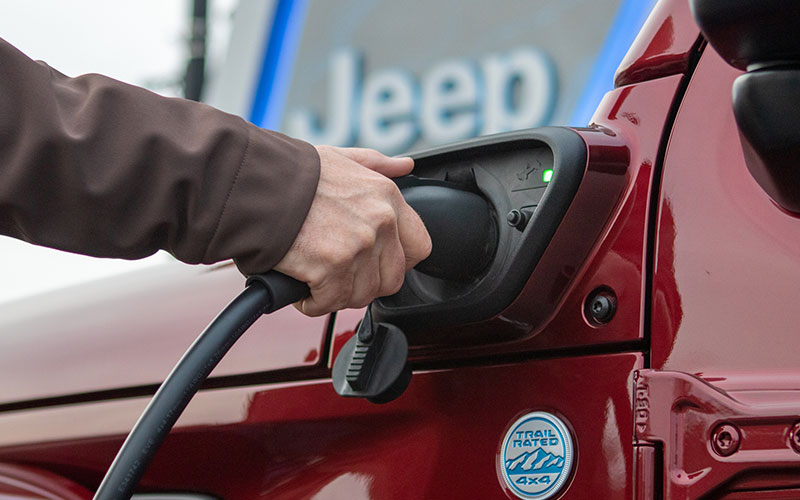
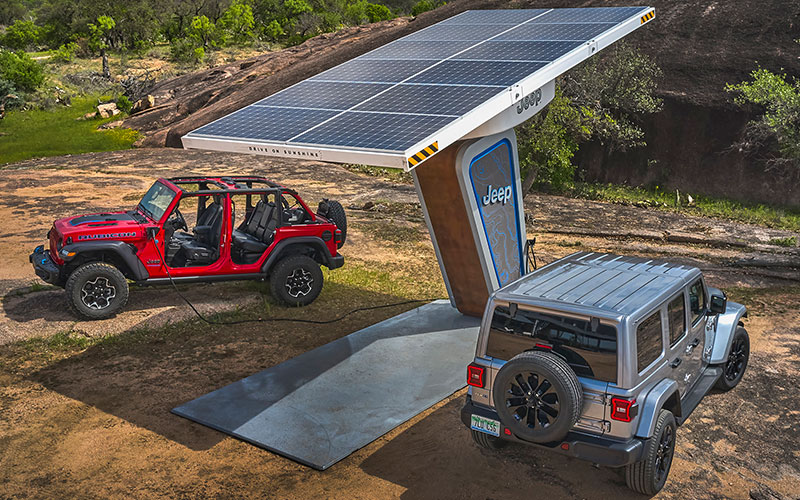
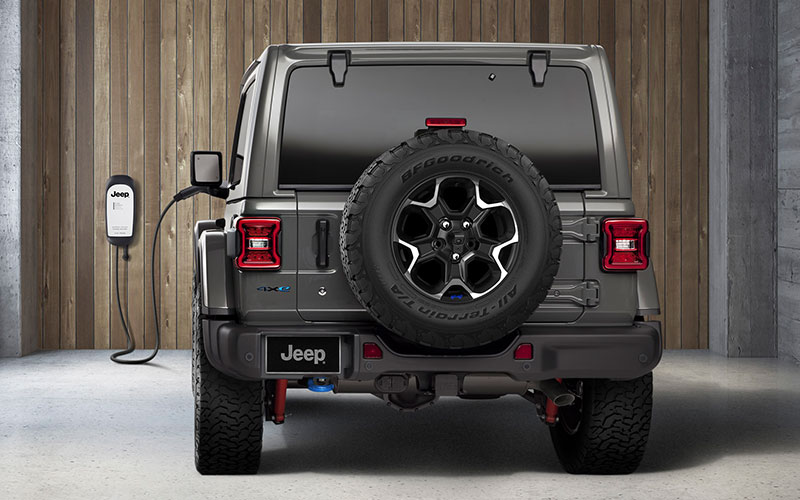
Unlike Dodge and RAM, Jeep has already gotten some of their new electrified vehicles to market. Jeep’s plug-in hybrid Wrangler 4xe came out early this year and the company says it plans to have an electrified version of every model out by 2025. Also, unlike their FCA brethren, Jeep had a vehicle to reveal for the Stellantis EV day announcement, the Grand Cherokee 4xe. The new Cherokee 4xe will slot along side an upcoming BEV version of the Grand Wagoneer and a plug-in hybrid version of the Gladiator.
Christian Meunier, Global President for the Jeep Brand, says that the company aims to be “the greenest SUV brand” in the world. Their target of 70% of sales being electrified by 2030 is both lofty and laudable. Indeed, the allure of plentiful low-end torque, may be just the ticket to widespread PHEV/EV adoption among the Jeep faithful.